AI-powered supplier search tools are transforming how businesses discover, evaluate, and engage suppliers by reducing weeks of manual research into hours. Rather than relying solely on directories or marketplaces, modern platforms use AI to interpret sourcing requirements, identify qualified suppliers, analyze certifications and risk factors, and support supplier comparison and outreach. Solutions such as SourceReady help buyers move from product ideas to supplier matching, RFQs, and negotiations, while other platforms focus on supplier intelligence, procurement analytics, or supply chain traceability. The most effective sourcing strategies combine AI-driven discovery with human validation, ensuring faster supplier identification without sacrificing compliance, transparency, or procurement quality.
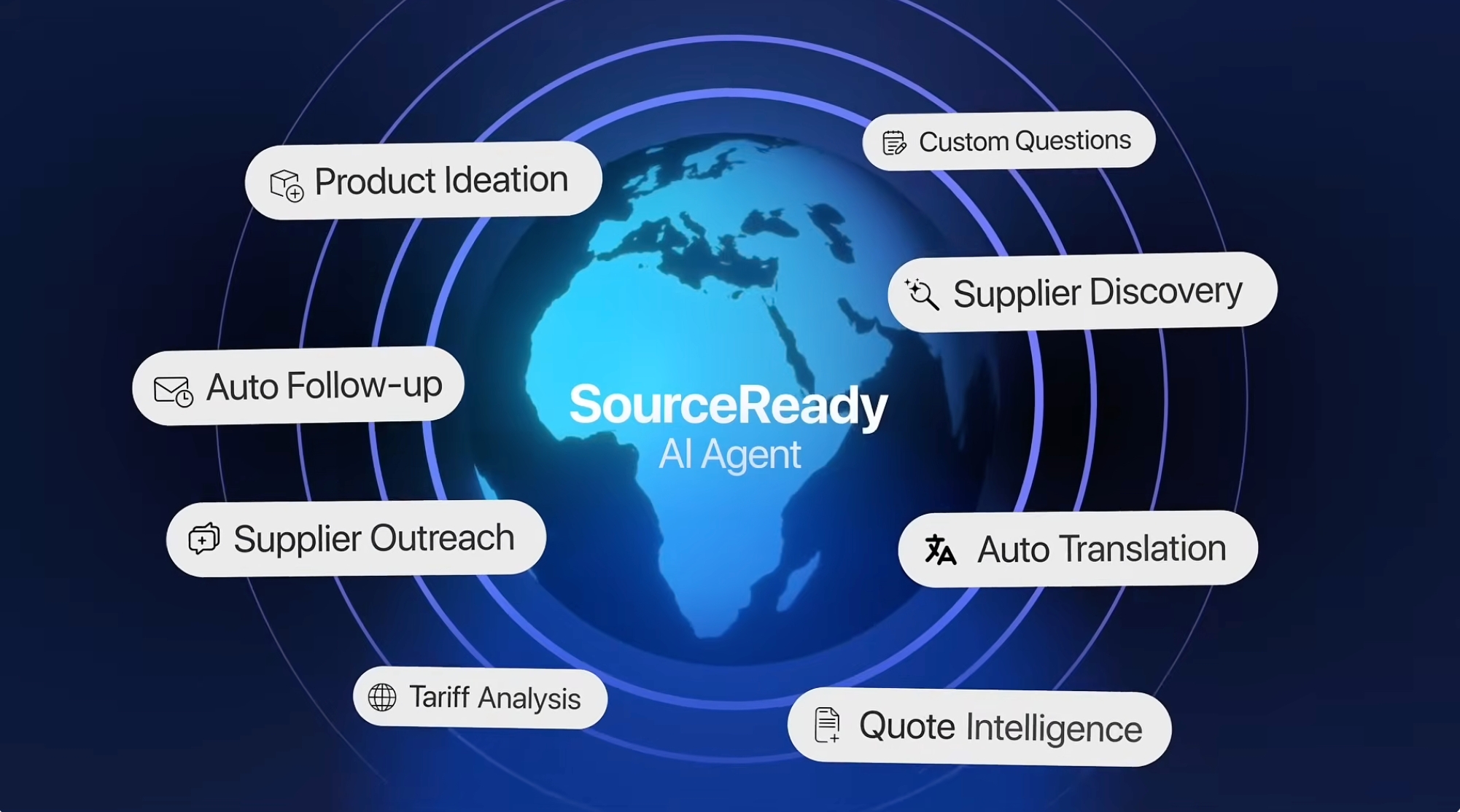
There's a better way to source ❤️
Watch the video to see how SourceReady helps brands move from product ideas to trusted supplier relationships faster
Watch the VideoWhat should “AI-powered supplier search” actually mean?
If a tool only adds a chatbot on top of a supplier directory, treat it as AI-assisted search, not true supplier intelligence.
A serious AI-powered supplier search tool should help you do four things:
1. Translate messy requirements into supplier criteria.
You may start with “premium stainless steel water bottles for EU retail.” The tool should convert that into materials, certifications, MOQ ranges, regions, production capabilities, and risk checks.
2. Find suppliers beyond obvious marketplace listings.
Good tools combine public web data, registries, trade records, marketplace data, supplier profiles, ESG data, certifications, and sometimes buyer-supplier relationship signals.
3. Explain why a supplier appears.
“Because AI said so” is not audit-ready. You need evidence: product match, company history, certification status, capacity signals, customer references, location, export activity, and ownership data where available.
4. Support shortlisting, outreach, and due diligence.
Search is only the first step. The real work starts when you compare suppliers, validate claims, request quotes, check compliance, and document why you chose one vendor over another.
The key point: AI should reduce manual search time, not replace procurement judgment. A clever shortlist is useful. An undocumented shortlist is a liability with a nice interface.
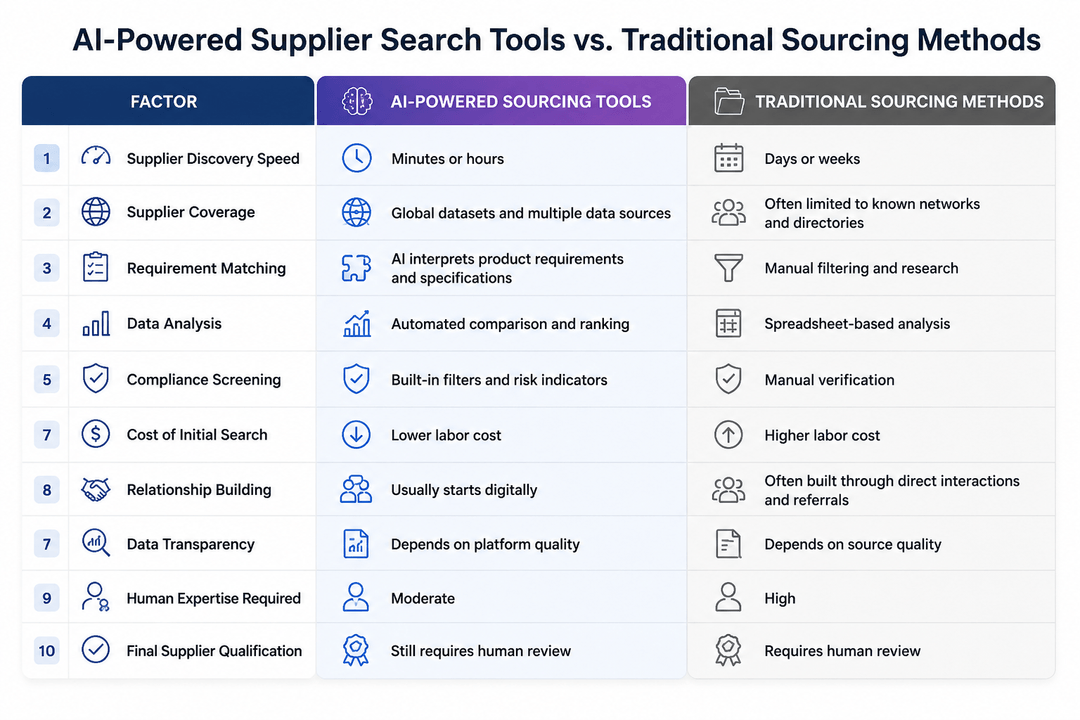
AI Sourcing Tools vs Traditional Sourcing Methods
Before evaluating specific platforms, it helps to understand how AI-powered sourcing differs from traditional supplier discovery.
Traditional sourcing typically relies on trade shows, industry referrals, supplier directories, sourcing agents, online marketplaces, and manual internet research. While these methods can be effective, they often require significant time and effort to identify, compare, and validate suppliers.
AI sourcing tools aim to automate much of this process by analyzing large datasets, identifying supplier matches, and surfacing relevant information faster than manual research alone.
Advantages of AI sourcing tools
- Faster supplier discovery and shortlisting.
- Ability to analyze thousands or millions of supplier records.
- Better visibility into certifications, trade activity, and company attributes.
- Reduced manual research effort.
- Easier comparison of suppliers across regions and categories.
Advantages of traditional sourcing
- Stronger relationship-building opportunities.
- Better understanding of supplier culture and communication style.
- Access to suppliers that may not appear in digital databases.
- Valuable insights gained through factory visits, trade shows, and industry networks.
The best approach: combine both
For most organizations, the strongest sourcing strategy combines AI-powered discovery with traditional supplier validation.
A practical workflow looks like this:
- Use AI tools to generate an initial supplier shortlist.
- Review supporting evidence and supplier profiles.
- Conduct manual qualification and compliance checks.
- Request samples and quotations.
- Hold supplier interviews and factory audits where appropriate.
- Make final sourcing decisions based on both data and human judgment.
AI can dramatically reduce the time spent finding suppliers, but supplier relationships, negotiations, audits, and strategic decisions still benefit from human expertise.
Which tools should you compare first?
The leading tools fall into different categories. Do not compare them as if they all solve the same problem.
SourceReady
Best fit: Product sourcing, supplier matching, and quote workflows.
SourceReady is designed for teams that want to move from a product idea to supplier discovery, supplier comparison, and negotiation. Rather than acting as a standalone supplier database, it focuses on helping buyers manage the sourcing process from start to finish.
Strengths:
- Database of 4 million suppliers across 200+ countries, sourced from and cross-verified against customs data, trade shows, directories, and other trusted sources.
- Converts product requirements into sourcing criteria.
- Supports supplier matching and comparison.
- Helps streamline RFQs and supplier communication
- Useful for teams that want sourcing workflow support, not just supplier data.
Watch out for: Organizations looking primarily for a massive supplier intelligence database may find workflow features more valuable than raw supplier coverage.
Veridion / Scout
Best fit: Global supplier discovery and supplier data APIs.
Veridion focuses on large-scale supplier intelligence. Its AI-powered search capabilities help procurement teams identify suppliers across industries and geographies using structured company data.
Strengths:
- Web-scale supplier coverage.
- Structured supplier attributes and company intelligence.
- Strong filtering by capabilities, certifications, and geography.
- API access for integration into procurement systems.
Watch out for: Discovery is only the first step. You will still need your own supplier qualification and due diligence process.
Beroe Live.ai
Best fit: Enterprise procurement intelligence.
Beroe combines supplier discovery with broader procurement insights, including category intelligence, supplier risk monitoring, and market analysis.
Strengths:
- Supplier discovery and market intelligence in one platform.
- Risk monitoring and disruption tracking.
- Useful for strategic sourcing and category management.
- Supports enterprise procurement decision-making.
Watch out for: The platform is generally better suited to procurement teams and larger organizations than small importers or startups.
Supplier.io
Best fit: Supplier intelligence, diversity tracking, and vendor data enrichment.
These platforms focus on supplier data quality rather than simply generating supplier lists. They help organizations enrich supplier records, validate diversity status, and improve vendor master data.
Strengths:
- Supplier enrichment and entity resolution.
- Diversity certification tracking.
- Vendor master cleanup and maintenance.
- Better visibility into supplier ownership and relationships.
Watch out for: Search depth and supplier coverage may vary depending on industry and geography.
Alibaba.com / Accio
Best fit: Marketplace-based sourcing and cross-border buying.
Alibaba remains one of the largest supplier ecosystems in the world, while Accio adds AI-powered search, supplier discovery, and sourcing assistance on top of that ecosystem.
Strengths:
- Massive supplier and product coverage.
- AI-assisted supplier search.
- RFQ support and supplier communication tools.
- Fast access to manufacturers and exporters.
Watch out for: Strong coverage within Alibaba's ecosystem does not eliminate the need for independent supplier verification and due diligence.
Find My Factory
Best fit: AI-vetted manufacturer discovery.
Find My Factory focuses on helping buyers quickly identify manufacturing partners rather than browsing large supplier directories.
Strengths:
- Fast supplier shortlisting.
- Manufacturer-focused search.
- Useful for buyers seeking production partners rather than traders.
- Simplifies early-stage supplier discovery.
Watch out for: As an emerging platform, buyers should validate supplier coverage within their specific product category and region.
How should you evaluate each platform before buying?
Start with the boring questions. Boring questions save expensive mistakes.
1. Can the tool show its sources?
Ask whether supplier recommendations include:
- Company website
- Registry data
- Certifications
- Trade records
- Marketplace profile
- ESG or diversity records
- Buyer-supplier relationship signals
- Last updated date
- Confidence score or match explanation
If the tool cannot show evidence, treat the result as a lead, not a verified supplier.
2. Does it understand your category?
AI supplier search works best when the system understands production language. For apparel, it should know cut-and-sew, knitting, dyeing, trims, compliance audits, and fabric composition. For electronics, it should understand PCB assembly, firmware, testing, certifications, and component sourcing.
Test with three prompts:
- A simple product request.
- A technical product request.
- A deliberately ambiguous request.
If the tool gives the same shallow answer each time, you are looking at keyword search in a tuxedo.
3. Can it filter for compliance requirements?
For audit-ready sourcing, you need filters and evidence for:
- Certifications: ISO, BSCI, WRAP, GOTS, OEKO-TEX, FSC, FDA, CE, UL, depending on category.
- Trade exposure: import/export activity, destination markets, tariff exposure.
- Geography: country, region, production cluster, nearshoring options.
- Company identity: legal entity, parent company, related entities, factory vs trader.
- Risk indicators: sanctions, adverse media, forced labor exposure, ESG concerns.
- Operational fit: MOQ, lead time, production capability, sample process, capacity.
Do not accept “verified” as a single checkbox. Ask: verified by whom, when, using what evidence?
4. Does it fit your workflow?
A great database can still fail if your team lives in spreadsheets, email, ERP, or procurement software. Look for exports, API access, CRM-style shortlists, RFQ workflows, team notes, and audit logs.
For small teams, ease of use matters more than enterprise dashboards. For enterprise teams, governance matters more than pretty search results.
Final Takeaway
AI-powered supplier search tools have matured significantly, but they are not all designed for the same purpose. Some focus on rapid supplier discovery, others on procurement intelligence, supplier data enrichment, or supply chain traceability. The best platform depends on your sourcing goals, industry requirements, and internal workflows. Regardless of the tool you choose, supplier recommendations should always be supported by transparent evidence, compliance data, and human review. AI can dramatically accelerate supplier discovery and reduce research time, but successful sourcing still depends on careful qualification, relationship management, risk assessment, and informed procurement decisions.
If you're evaluating AI sourcing platforms, start with a pilot project and compare results against your current sourcing process. The right tool should not only find suppliers faster but also improve supplier quality, transparency, and decision-making across your procurement workflow.

Find the sourcing tools you need.
Explore how SourceReady helps you research products, discover suppliers, verify factory information, analyze trade data, and manage your sourcing workflow in one place
Explore Features
Graduating from USC with a background in business and marketing, Judy Chen has spent over a decade working in e-commerce, specializing in sourcing and supplier management. Her experience includes developing strategies to optimize supplier relationships and streamline procurement processes for growing businesses. As SourceReady’s blog writer, Judy leverages her deep understanding of sourcing challenges to create insightful content that helps readers navigate the complexities of global supply chains.