
India is one of the world’s largest producers of essential oils, offering scale, technical expertise, and competitive cost structures. For companies seeking sustainable sourcing, India presents real opportunity—but only with disciplined verification. Sustainability in essential oils must be measurable, documented, and chemically validated. This guide outlines how to evaluate key oil categories, define sustainability standards, select appropriate certifications, prevent adulteration, and structure documentation properly. It also explains how to use structured supplier intelligence tools like SourceReady to identify credible exporters. When traceability, certification, and chemical testing align, India becomes a reliable and defensible sourcing base.
There's a better way to source ❤️
Watch the video to see how SourceReady helps brands move from product ideas to trusted supplier relationships faster
Watch the VideoWhy Source Sustainable Essential Oils from India?
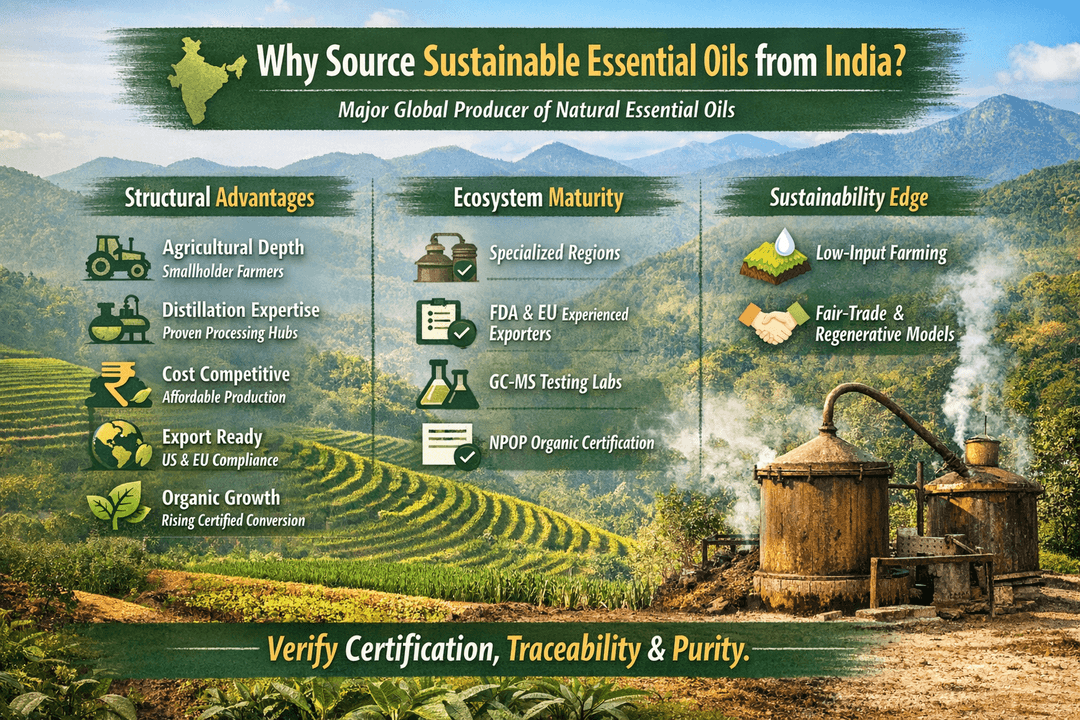
India is one of the largest global producers of natural essential oils. That scale matters.
The country combines:
- Agricultural depth, with millions of smallholder farmers cultivating aromatic crops.
- Decades of distillation expertise, supported by regional processing clusters.
- Competitive cost structures, driven by labor economics and domestic raw material availability.
- Export infrastructure, including familiarity with US and EU regulatory requirements.
- Growing organic conversion, particularly in response to global clean beauty demand.
India’s essential oil ecosystem is mature. You will find:
- Specialized distillation regions with technical know-how.
- Exporters experienced in FDA, EU, and cosmetic compliance.
- Third-party laboratories capable of GC-MS and residue testing.
- Government-recognized certification bodies for organic production (NPOP).
From a sustainability perspective, India offers two advantages:
- Many aromatic crops are suited to rain-fed or low-input farming.
- Smallholder systems can support fair-trade and regenerative agriculture models—if properly documented.
However, scale and maturity do not eliminate risk. You must still verify traceability, certification authenticity, and chemical composition.
India is not a shortcut. It is a strong foundation—if you build on it correctly. Don't have time to read the article? Check out the India Essential Oil suppliers here!
Which Essential Oils Are Commonly Sourced from India?
India’s production is geographically concentrated by oil type. Understanding these clusters improves traceability and sourcing efficiency.
1. Peppermint (Mentha arvensis) – Uttar Pradesh
India dominates global peppermint oil production. Uttar Pradesh is the core cultivation hub.
- The region supports large-scale mentha farming with established aggregation networks.
- Many farms are transitioning to organic-certified cultivation due to export demand.
- Strong distillation infrastructure enables consistent batch processing.
- The supply chain is mature, but price volatility and adulteration risk require chemical testing.
If you need volume with scalable organic options, peppermint from India is strategically strong.
2. Lemongrass – Kerala and Karnataka
Lemongrass thrives in southern India’s tropical climate.
- It is often cultivated in rain-fed conditions, reducing irrigation pressure.
- Chemical input requirements are relatively low compared to other crops.
- Smallholder farming is common, which requires traceability oversight.
- Distillation units are typically local and decentralized.
This oil category offers strong sustainability positioning, provided traceability is documented properly.
3. Eucalyptus – Tamil Nadu
Eucalyptus oil production is concentrated in plantation-managed systems.
- Plantation sourcing allows clearer chain-of-custody documentation.
- Large-scale operations support export-grade quality control.
- Distillation units are often industrial and export-oriented.
From a traceability standpoint, eucalyptus can be easier to verify than smallholder-sourced oils.
4. Vetiver – Rajasthan and Uttar Pradesh
Vetiver is often cultivated in arid regions and used for soil conservation.
- The crop supports erosion control and land stabilization.
- Production volumes are smaller, which increases price sensitivity.
- Sustainability claims should be tied to cultivation documentation rather than marketing narratives.
Vetiver is suitable for brands that want a soil-regeneration story—but documentation must back it up.
5. Sandalwood – Karnataka
Sandalwood is high value and heavily regulated.
- Legal harvesting permits are mandatory.
- Government oversight exists for cultivation and extraction.
- Adulteration risk is high due to price premiums.
If you source sandalwood, you must require chemical fingerprint validation and legal documentation. There is no shortcut here.

What Does “Sustainable” Actually Mean in Essential Oils?
“Sustainable” must be operational. You should be able to audit it.
Here are the five pillars you should evaluate:
1. Agricultural Sustainability
- The farm follows certified organic standards or documented low-input practices.
- Synthetic pesticides and prohibited chemicals are restricted and monitored.
- Crop rotation and soil regeneration practices are documented.
2. Environmental Stewardship
- Harvesting does not contribute to deforestation or illegal wild collection.
- Water usage during cultivation and distillation is monitored.
- Wastewater from distillation is treated properly.
3. Energy Use
- Distillation methods rely on efficient steam systems.
- Some producers integrate biomass or renewable energy sources.
- Fuel sourcing for boilers is documented.
4. Social Responsibility
- Suppliers have written policies prohibiting child labor.
- Farmers are compensated transparently and fairly.
- Worker safety procedures are documented.
5. Traceability
- Each batch can be traced to a farm or aggregator.
- Harvest dates are recorded.
- Distillation batch logs are maintained.
- Export documentation aligns with production records.
If these elements cannot be documented, sustainability is a claim—not a system.

Which Certifications Should You Require?
Certifications depend on your product positioning and destination market. They are compliance tools, not marketing decorations.
Start by identifying your sales geography. Then match certification requirements accordingly.
1. Organic Certifications
If you sell in the United States, you will need USDA Organic certification or India’s equivalent NPOP certification that aligns with USDA standards. For the European Union, you need EU Organic certification.
Important checks:
- The certificate must be issued to the exporter entity.
- The specific oil must be listed.
- The certificate must be valid at the time of shipment.
- A transaction certificate should be available for each organic shipment.
Without a transaction certificate, your organic claim may not withstand audit.
2. Cosmetic Certifications
If you supply cosmetic brands in Europe, COSMOS certification strengthens regulatory alignment. This is particularly relevant for finished cosmetic formulations claiming organic content.
3. Food and Ingestible Standards
For ingestible essential oils, you should require:
- ISO 22000 or FSSC 22000 for food safety management.
- HACCP documentation.
- Residue testing compliance.
Essential oils used internally face stricter regulatory scrutiny.
4. Ethical Certifications
Fair Trade certification can support ethical sourcing positioning, especially for premium consumer brands. However, verify that the certification covers the specific farming network—not just the exporter.
5. Quality Management Systems
An ISO 9001 certification demonstrates that the supplier has a documented quality management system. It does not guarantee sustainability, but it signals process discipline.
You should verify all certificates directly with issuing bodies. Never rely solely on PDF copies.
How Do You Verify Botanical Authenticity and Prevent Adulteration?
Adulteration is one of the most significant risks in essential oil sourcing.
You must require:
- A recent GC-MS report identifying the chemical fingerprint.
- A Certificate of Analysis (COA) with physical and chemical parameters.
- Clear disclosure of the Latin botanical name.
- Harvest season information.
High-value oils such as sandalwood, rose, and jasmine are especially vulnerable.
Red flags include:
- Prices significantly below market norms.
- No third-party lab documentation.
- Inconsistent aroma between batches.
- Vague origin disclosure.
Independent lab testing should be part of your incoming quality protocol. It is inexpensive insurance.
How to Use SourceReady to Find Essential Oil Suppliers in India
One of the biggest challenges in sourcing essential oils from India is separating credible exporters from traders or newly formed suppliers with limited track records.
You will often encounter:
- Organic claims without transaction certificates
- Manufacturers with no verifiable export history
- Traders presenting themselves as distillers
Screening manually takes time. This is where SourceReady helps.
Instead of relying on rigid filters or exact keywords, SourceReady allows you to search in natural language—just like you would brief a sourcing manager.
For example:
- “Organic peppermint essential oil exporters to US”
- “India sandalwood oil supplier with EU organic certification”
- “Vetiver oil manufacturer, cosmetic grade”
- “Lemongrass oil India, food safety certified”
- The system narrows results based on intent—not just keyword matches.
From there, you can:
- Identify suppliers with established export activity.
- Filter by certification type and product specialization.
- Review structured supplier profiles with historical data.
- Shortlist manufacturers already integrated into global cosmetic or food supply chains.
Most importantly, you can cross-check supplier claims against real export patterns rather than relying solely on marketing materials.
SourceReady accelerates the screening process. You still conduct GC-MS testing and compliance verification independently—but you start with a stronger, data-backed shortlist.
Conclusion
Sourcing sustainable essential oils from India is not about finding the lowest price or the most attractive marketing claim. It is about building a system grounded in documentation, traceability, and chemical verification. India offers agricultural depth, established distillation clusters, and growing organic infrastructure, but supplier discipline varies. You must verify certifications, require GC-MS testing, and define sustainability operationally. Structured discovery tools like SourceReady reduce screening time, but compliance validation remains your responsibility. When you combine data-backed supplier selection with rigorous quality controls, you create a resilient essential oil supply chain that supports both regulatory compliance and long-term brand credibility.
FAQ
1. Are smallholder farms in India a risk for sustainability claims?
Not necessarily. Smallholder systems can support fair-trade and regenerative agriculture models. The key issue is documentation. You must ensure traceability systems link farms, harvests, and distillation batches clearly.
2. Do I need on-site audits in India?
It depends on your purchase volume and risk tolerance. For large annual volumes or high-value oils like sandalwood, on-site audits add strong verification. For smaller volumes, desk audits combined with lab testing may be sufficient.

Find the sourcing tools you need.
Explore how SourceReady helps you research products, discover suppliers, verify factory information, analyze trade data, and manage your sourcing workflow in one place
Explore Features
Graduating from USC with a background in business and marketing, Judy Chen has spent over a decade working in e-commerce, specializing in sourcing and supplier management. Her experience includes developing strategies to optimize supplier relationships and streamline procurement processes for growing businesses. As SourceReady’s blog writer, Judy leverages her deep understanding of sourcing challenges to create insightful content that helps readers navigate the complexities of global supply chains.