Mid-market companies are under increasing pressure to scale procurement operations without scaling headcount at the same pace. Manual approvals, fragmented supplier data, and weak spend visibility quickly become operational bottlenecks as purchasing complexity grows. Modern procurement automation software helps streamline workflows, improve compliance, and centralize purchasing processes—but not all platforms solve the same problems. While traditional tools focus heavily on approvals and spend management, platforms like SourceReady extend procurement into supplier intelligence, risk monitoring, and sourcing visibility. This guide compares the most relevant procurement automation tools for mid-market companies and explains where each platform fits best.
There's a better way to source ❤️
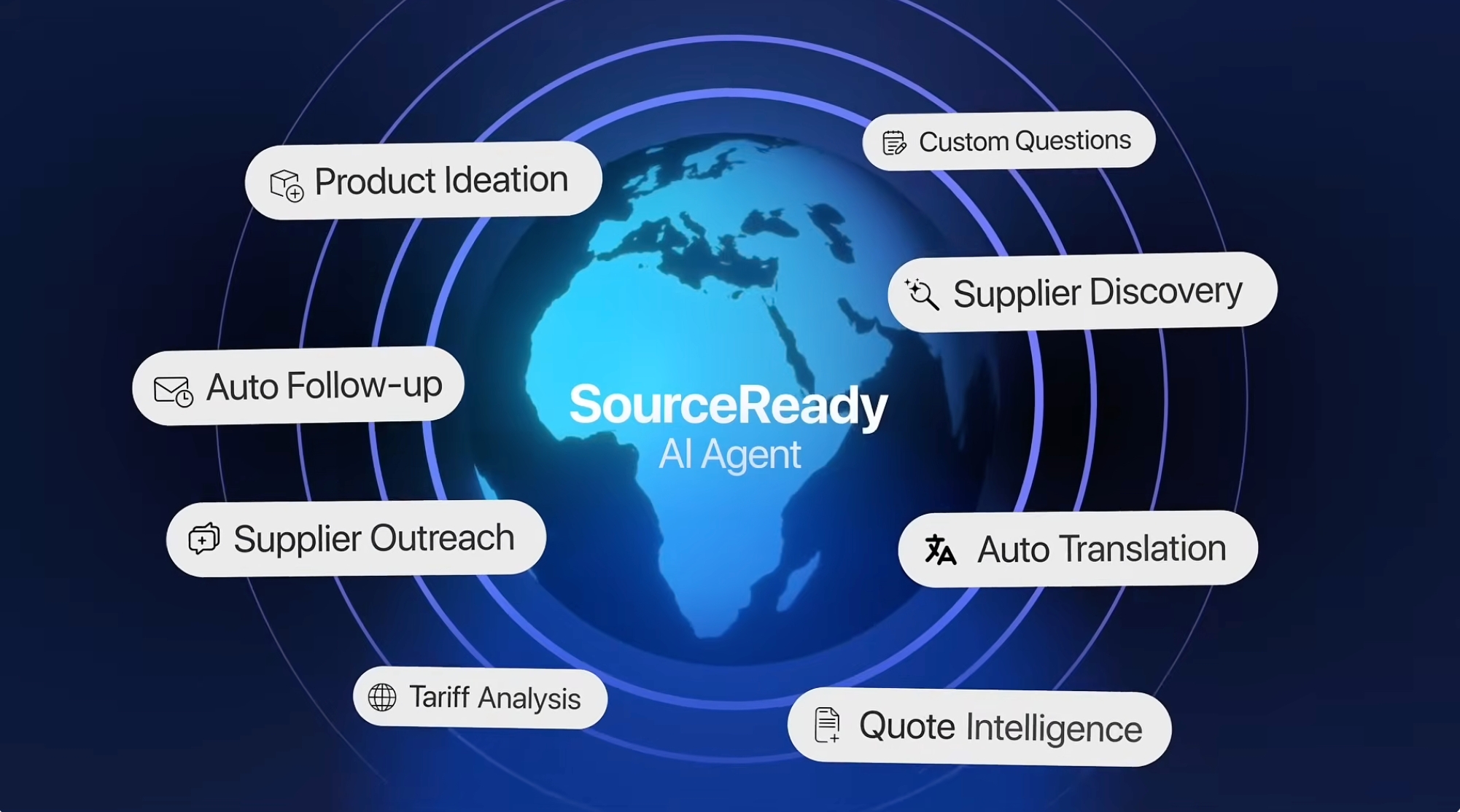
Watch the video to see how SourceReady helps brands move from product ideas to trusted supplier relationships faster
Watch the VideoWhy are mid-market companies investing in procurement automation now?
Procurement used to be manageable with spreadsheets, email approvals, and ERP exports. That stops working once supplier counts, purchase volumes, and compliance requirements increase.
Mid-market companies now face many of the same operational challenges as large enterprises, but without large procurement departments or dedicated sourcing operations teams. As a result, manual procurement processes create bottlenecks much earlier.
Where procurement processes usually break first
- Manual approval chains: Purchase requests move through email threads and Slack messages with little visibility into status, ownership, or delays.
- Fragmented supplier information: Contracts, certifications, invoices, and supplier contacts live across multiple systems, making it difficult to maintain a reliable supplier record.
- Weak spend visibility: Without centralized procurement workflows, companies struggle to identify duplicate vendors, inconsistent pricing, or unauthorized purchases.
- Reactive supplier management: Teams spend most of their time processing requests instead of improving sourcing strategy, reducing supplier risk, or negotiating better terms.
- Compliance exposure: Manual procurement processes make it harder to maintain audit trails, monitor supplier documentation, and enforce approval governance consistently.
This is why procurement automation is becoming less of a “nice-to-have” and more of an operational requirement for scaling companies.
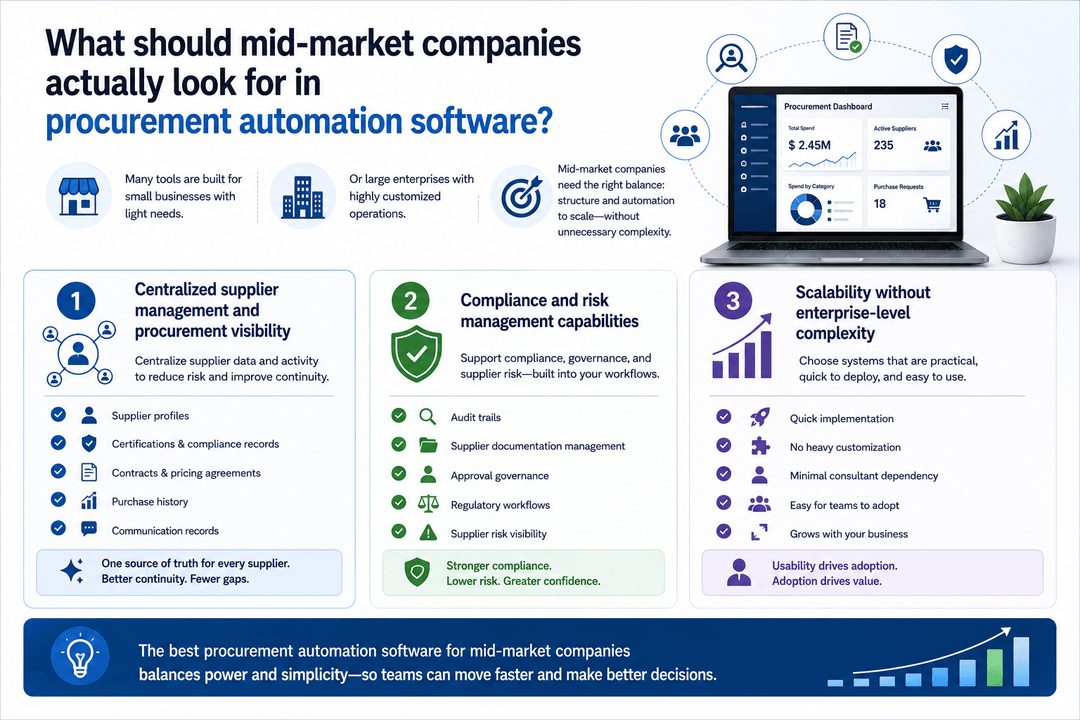
What should mid-market companies actually look for in procurement automation software?
Many procurement tools are designed either for:
Small businesses with lightweight purchasing needs or
Large enterprises with highly customized procurement operations
Mid-market companies need something different: enough structure and automation to scale, without introducing unnecessary complexity.
1. Centralized supplier management and procurement visibility
As supplier networks grow, fragmented information becomes a major operational risk.
Strong systems centralize:
Supplier profiles
Certifications and compliance records
Contracts and pricing agreements
Purchase history
Communication records
This improves procurement continuity and ensures teams are working from the same supplier information instead of maintaining disconnected records across departments.
2. Compliance and risk management capabilities
Modern procurement increasingly overlaps with compliance and supplier governance.
Mid-market companies should prioritize platforms that support:
Audit trails
Supplier documentation management
Approval governance
Regulatory workflows
Supplier risk visibility
This becomes especially important for companies sourcing internationally or operating in regulated industries where supplier compliance directly impacts operations.
3. Scalability without enterprise-level complexity
One of the biggest mistakes mid-market companies make is overbuying procurement software.
Many enterprise procurement platforms require:
- Long implementation cycles
- Dedicated consultants
- Heavy customization
- Extensive training
Mid-market teams usually benefit more from systems that are practical, deploy quickly, and improve operational visibility without requiring large implementation projects.
In procurement automation, usability often matters more than feature count.
Which procurement automation tools are most relevant for mid-market companies?
Different procurement platforms solve different operational problems. Some focus heavily on spend management and approvals, while others focus more on sourcing visibility and supplier intelligence.
1. Coupa
Coupa is one of the most established procurement platforms in the market and is commonly used by larger mid-market companies transitioning toward enterprise-scale procurement operations.
Where Coupa performs well:
- Spend management and procurement governance
- Complex approval workflows
- Financial reporting and analytics
Why companies choose it: Coupa provides strong purchasing controls and mature workflow automation capabilities, making it useful for organizations with increasingly complex procurement structures.
Where it can become challenging: The platform can be expensive and operationally heavy for lean procurement teams. Implementation and customization often require significant internal resources.
2. Procurify
Procurify focuses on simplifying procurement operations for growing companies that need purchasing visibility without enterprise-level complexity.
Where Procurify performs well:
- Purchase approvals
- Budget visibility
- Operational procurement workflows
Why companies choose it: The platform is relatively easy to implement and user-friendly for non-technical teams, which improves adoption across departments.
Limitations: While operational workflows are strong, supplier intelligence and sourcing capabilities are more limited compared to specialized sourcing platforms.
3. Zip
Zip specializes in intake-to-procure orchestration, helping companies standardize how procurement requests enter the organization.
Where Zip performs well:
- Procurement intake workflows
- Cross-functional approval coordination
- Workflow orchestration across teams
Why companies choose it: Zip improves procurement visibility at the request stage and creates more structured purchasing workflows across departments.
Limitations: The platform is more workflow-focused than supplier-focused, meaning sourcing intelligence and supplier visibility remain relatively limited.
4. Airbase
Airbase combines procurement workflows with broader spend management and finance operations.
Where Airbase performs well:
- Spend controls
- Corporate card management
- Finance and procurement alignment
Why companies choose it: The platform centralizes multiple financial workflows and improves purchasing visibility across finance and operations teams.
Limitations: Procurement depth is lighter compared to platforms focused specifically on sourcing and supplier management.
5. Jaggaer
Jaggaer focuses heavily on strategic sourcing and supplier lifecycle management.
Where Jaggaer performs well:
- Strategic sourcing
- Supplier lifecycle management
- Procurement analytics
Why companies choose it: The platform provides deeper sourcing workflows and procurement analysis capabilities than many general procurement tools.
Limitations: The setup and operational complexity may require more procurement maturity than some mid-market teams currently have.
6. SourceReady
SourceReady approaches procurement differently. Instead of focusing primarily on approvals and purchasing workflows, it focuses on improving supplier visibility, sourcing intelligence, and procurement decision quality.
Where SourceReady performs well:
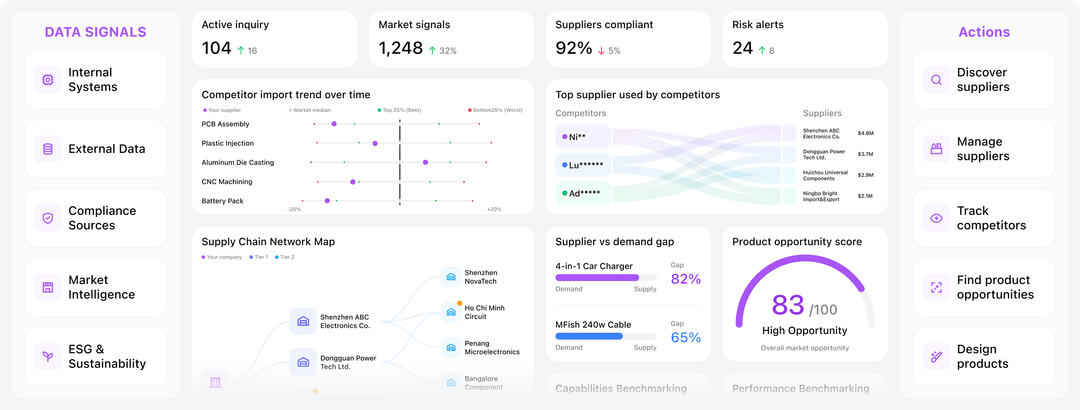
- Continuous supplier risk monitoring and geographic visibility: SourceReady continuously screens suppliers against sanctions, tariffs, and regulatory changes while also providing visibility into where suppliers manufacture and export from. This helps procurement teams assess geopolitical exposure and react to risks before disruptions occur.
- Verified supplier activity signals: Customs and trade data validate whether suppliers actually produce and export relevant products at meaningful scale, reducing reliance on self-reported claims.
- Supply chain mapping and dependency analysis: Tier 1 and Tier 2 visibility helps identify upstream vulnerabilities, material concentration risks, and hidden supply chain dependencies.
- Competitor sourcing intelligence: Procurement teams can track where competitors are sourcing from, which suppliers they rely on, and how production shifts across regions over time.
- Product and market intelligence: By scanning websites, marketplaces, and trade activity, SourceReady helps identify emerging sourcing trends and product opportunities earlier.
Limitations: SourceReady is more sourcing- and intelligence-focused than finance- or AP-focused, meaning it complements procurement workflow platforms rather than fully replacing them.
Final takeaway: what procurement software actually matters most?
The best procurement software for mid-market companies is not necessarily the platform with the most features—it’s the one that improves visibility, reduces manual work, and helps your team make better supplier decisions consistently. Traditional procurement tools are strong at approvals, spend controls, and financial workflows, but modern procurement increasingly requires supplier intelligence, risk visibility, and sourcing agility as well. That’s where platforms like SourceReady add value by helping teams monitor supplier risk, validate supplier activity, and gain deeper supply chain visibility. If your procurement stack still relies heavily on spreadsheets and fragmented supplier data, it may be time to modernize how your team sources and scales.
FAQ
1. Why do mid-market companies need procurement automation?
As companies grow, manual procurement processes become difficult to manage. Mid-market teams often face:
- Increasing supplier counts
- Higher purchasing volume
- More compliance requirements
- Limited procurement headcount
Automation helps reduce operational bottlenecks and improves control without requiring large procurement teams.
What is the difference between procurement automation and sourcing software?
Procurement automation software primarily focuses on:
- Purchasing workflows
- Spend management
- Financial controls
Sourcing software focuses more on:
- Supplier discovery
- Supplier verification
- Supplier risk visibility
- Supply chain intelligence
Platforms like SourceReady sit closer to the sourcing intelligence side of procurement.

Find the sourcing tools you need.
Explore how SourceReady helps you research products, discover suppliers, verify factory information, analyze trade data, and manage your sourcing workflow in one place
Explore Features
Graduating from USC with a background in business and marketing, Judy Chen has spent over a decade working in e-commerce, specializing in sourcing and supplier management. Her experience includes developing strategies to optimize supplier relationships and streamline procurement processes for growing businesses. As SourceReady’s blog writer, Judy leverages her deep understanding of sourcing challenges to create insightful content that helps readers navigate the complexities of global supply chains.