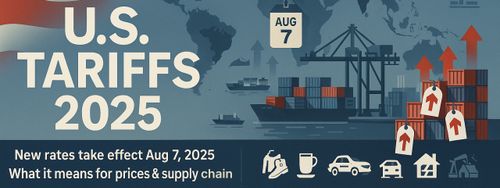
U.S. tariffs were introduced to change manufacturing behavior, not as a temporary trade tactic. Beginning under the Trump administration, tariffs raised the structural cost of offshore production across categories like apparel, furniture, metals, and consumer goods—making unit price alone an unreliable measure of cost.
Today, tariffs function as a permanent margin and cash-flow tax. When combined with freight volatility, long lead times, and inventory risk, they can push offshore sourcing past the tipping point. In those cases, “Made in USA” can outperform offshore manufacturing on total system cost, not just resilience.
This guide explains which products are most exposed to tariff pressure, which actually make sense to manufacture in the U.S., and how to evaluate onshoring decisions using SourceReady—from identifying low-tariff options to calculating total landed cost with audit-ready data.

There's a better way to source ❤️
Watch the video to see how SourceReady helps brands move from product ideas to trusted supplier relationships faster
Watch the VideoWhat Did Tariffs Change About Global Manufacturing Economics?
Tariffs were introduced with a clear objective: bring manufacturing back to the U.S.
Under the Trump administration, tariffs were applied broadly across categories like apparel, furniture, steel, aluminum, and consumer goods. The intent was not subtle. By raising the cost of imported goods, policymakers aimed to make domestic production more competitive and to reduce dependence on offshore supply chains.
What matters for you is not the politics—it’s the permanence.
Many companies assumed tariffs would:
- Be temporary
- Be negotiated away
- Be absorbed as a short-term cost
Tariffs remain embedded in the cost structure of many products. They have become a baseline condition, not a temporary shock.
Is “Made in USA” Actually More Affordable Because of Tariffs?
This is the wrong question if asked narrowly—and the right one if asked correctly.
Tariffs do not automatically make U.S. manufacturing cheaper. What they do is remove the illusion of cheap offshore production.
Once tariffs are applied:
- Offshore labor advantages shrink
- Inventory becomes more expensive to hold
- Long lead times become a financial liability
At that point, the comparison shifts from unit price to total system cost.
In some categories, offshore sourcing still wins.
In others, tariffs push offshore costs past the tipping point.
The only way to know which side you’re on is to model the full system—tariffs included.
Here's the list of U.S. manufacturing options for small-batch electronics!
Why This Question Matters More Now Than Before
Tariffs changed the math in three critical ways:
They scale with volume: The more you sell, the more you pay. There are no efficiency gains that reduce tariff impact.
They hit cash flow, not just margins: Tariffs are paid when goods cross borders—long before revenue is realized.
They compound with other offshore risks: Tariffs amplify freight volatility, inventory exposure, and forecasting errors.
This is why many companies are quietly re-evaluating “Made in USA.” Not because they want to reshore—but because the offshore model they relied on no longer behaves the way it used to.
Which Products Are Most Exposed to Tariff-Driven Onshoring?
Tariff pressure does not fall evenly across industries. The products most exposed are those where import dependence is high and tariff costs cannot be diluted through pricing or scale.
These categories are not necessarily well suited for U.S. manufacturing—but they are often the first forced to reconsider geography when tariffs become permanent.
Product Categories Under the Most Tariff Pressure
- Textiles, apparel, and footwear: Products with structurally high duty rates, seasonal demand, and limited ability to pass cost increases to consumers.
- Furniture and home goods: Low unit value relative to size, high freight exposure, and thin margins amplify the impact of tariffs.
- Consumer electronics assemblies: Heavy reliance on imported components and tariff-exposed subassemblies increases landed cost volatility.
- Automotive parts and subcomponents: Tariffs applied at the component level cascade through tightly integrated supply chains.
- Toys and mass-market consumer goods: Import-dependent categories with price-sensitive demand and long production cycles.

Why These Categories Feel Tariff Pressure First
These products tend to share several structural traits:
- High reliance on offshore production
- Tariffs in the 10–30% range that do not decline with scale
- Long lead times requiring large inventory commitments
- Limited pricing power to offset cost increases
The result is not just higher cost, but loss of flexibility. Once production is locked into a long offshore cycle, companies absorb tariffs earlier, hold more tariff-paid inventory, and have fewer options to adjust when demand shifts.
Which Products Actually Make Sense to Manufacture in the U.S.?
U.S. manufacturing works when tariff removal and operational advantages outweigh labor cost differences. The products that succeed domestically share practical, repeatable characteristics.
Product Categories That Consistently Work in the U.S.
- Large and bulky goods: Products where transportation cost, damage risk, and handling complexity dominate unit economics. Manufacturing domestically avoids long-distance freight exposure and reduces losses tied to breakage and delays.
- High-tech and highly specialized equipment: Products that depend on advanced engineering, close R&D collaboration, or skilled technical labor. In these cases, execution quality and iteration speed matter more than hourly wage rates.
- High-margin, long-life products: Durable goods designed for extended use, where reliability, craftsmanship, and brand trust justify higher production costs and support stable pricing.
- Automotive and transportation components: Products embedded in regional supply chains, where proximity to final assembly, just-in-time delivery, and tariff avoidance are operational necessities rather than preferences.
- Chemicals and agricultural-based products: Categories that benefit from domestic access to raw materials, established processing infrastructure, and regulatory familiarity—making local production structurally competitive.
- Specialty and brand-driven consumer goods: Products where brand identity, quality signaling, and origin matter. Domestic manufacturing supports tighter quality control, faster response to demand shifts, and stronger differentiation.
Why These Categories Survive Higher Labor Costs
In each case, U.S. manufacturing succeeds not because labor is cheap, but because it removes entire layers of cost and risk:
- No import tariffs
- Shorter and more predictable lead times
- Lower inventory exposure
- Faster design and production adjustments
- Reduced freight and handling losses
For these products, offshore savings often disappear once tariffs, logistics, and operational friction are fully priced in.

How to Use SourceReady to Find the Right Suppliers
When tariffs shift this quickly, the biggest risk isn’t choosing the wrong country — it’s choosing the wrong factory.
India has depth, but it also has fragmentation. Supplier quality, export readiness, and execution capability vary widely across regions and categories. This is where SourceReady becomes a practical decision tool rather than just a discovery layer.
Here’s how sourcing teams are using SourceReady to evaluate India efficiently and safely.
Step 1: How Do You Identify Low-Tariff Countries Using Natural Language?
When tariffs are the trigger, the first task is not supplier selection. It’s eliminating tariff-heavy countries from the equation.
SourceReady lets teams do this using natural language search, instead of rigid country filters or tariff tables. That matters because tariff decisions are rarely clean or binary.
Instead of asking “Which countries are cheap?”, teams search for intent.
Example Searches Teams Actually Use
- “Low-tariff countries for cotton apparel, U.S. import”
- “Non-China suppliers for home furniture”
- “Tariff-efficient alternatives to Vietnam for footwear”
- “U.S. manufacturing options for small-batch electronics”
- “Non-China, non-Section 301 supply chain for [product]”
These searches immediately surface countries and supplier clusters that reduce tariff exposure before any factory-level evaluation begins.
This prevents a costly mistake:
deeply evaluating factories in a country that is already economically disqualified by tariffs.

Step 2: Filter for Export-Ready, U.S.-Focused Factories
Not all Indian suppliers are built for U.S. buyers.
On SourceReady, teams filter suppliers based on:
- Prior U.S. export history
- Compliance and certification signals
- Factory scale and capacity indicators
- Experience with FOB / CIF / DDP terms
This avoids the most common India sourcing mistake: choosing a technically capable factory that isn’t operationally ready for U.S. import standards.
Step 3: Use Match Scores to Reduce Switching Risk
Switching countries increases execution risk.
SourceReady’s Match Score helps reduce that risk by:
- Scoring suppliers against your MOQ, quality, cost, and compliance priorities
- Explaining why a supplier is a good or poor fit
- Highlighting trade-offs before you commit to samples or tooling
This is especially valuable when testing India for the first time after years of Vietnam sourcing.
Step 4: CompareSuppliers Side-by-Side
One of the biggest advantages of SourceReady is direct comparison.
Teams can:
- Compare suppliers for the same product
- Evaluate differences in MOQ, lead time, and reliability
- Evaluate whether tariff savings are offset by operational friction
This makes it much easier to decide:
- Which SKUs should move to India
- Which should stay in Vietnam
- Which should be dual-sourced
Step 5: Shortlist, Test, Then Scale
The most successful teams don’t move everything at once.
They use SourceReady to:
- Shortlist a small number of high-fit Indian factories
- Run pilot orders or repeat SKUs
- Validate quality, lead time, and communication
- Scale only after execution is proven
Note: How Do You Calculate Total Landed Cost
You can also use SourceReady's tariff calculator to calculate total landed cost.
Using SourceReady's tariff calculator, teams evaluate:
- Tariff rates by product category
- Freight and transit time differences
- Inventory carrying cost driven by lead time
- MOQ-driven overproduction risk
- Historical reliability signals
This allows teams to model:
- Offshore vs alternative offshore
- Offshore vs nearshore
- Offshore vs Made in USA
before engaging suppliers.
Conclusion
Tariffs didn’t end offshore manufacturing, but they changed the economics. For many products, unit price is no longer the right benchmark once tariffs, inventory exposure, and lead-time risk are fully accounted for.
“Made in USA” isn’t universally cheaper. But for tariff-heavy, bulky, specialized, or high-margin products, domestic manufacturing can outperform offshore sourcing on total system cost and operational control.
The teams getting this right aren’t reshoring everything. They’re modeling total landed cost early, testing selectively, and using real data to guide decisions.
Tools like SourceReady make those decisions defensible—by identifying low-tariff options, comparing suppliers, and calculating total cost before capital is committed.
That’s when the pivot actually makes sense.
FAQ
1. Is onshoring always better than nearshoring?
No. Many companies start with nearshoring or hybrid models. Onshoring makes sense when tariff elimination and operational benefits outweigh labor cost differences.
2. How does inventory risk factor into tariff decisions?
Tariffs are paid before revenue is realized. Long lead times increase tariff-paid inventory exposure, tying up cash and increasing write-down risk if demand shifts.

Find the sourcing tools you need.
Explore how SourceReady helps you research products, discover suppliers, verify factory information, analyze trade data, and manage your sourcing workflow in one place
Explore Features
Graduating from USC with a background in business and marketing, Judy Chen has spent over a decade working in e-commerce, specializing in sourcing and supplier management. Her experience includes developing strategies to optimize supplier relationships and streamline procurement processes for growing businesses. As SourceReady’s blog writer, Judy leverages her deep understanding of sourcing challenges to create insightful content that helps readers navigate the complexities of global supply chains.