Supply chain organizations are not short on AI investment. Demand planning platforms, inventory optimization tools, supplier sourcing systems, digital twin simulations. The technology is deployed, the contracts are signed, and the dashboards are live.
Six months later, the numbers haven't moved.
Forecast accuracy is unchanged. The operations team overrides recommendations manually. The platform generates outputs nobody trusts. Leadership starts questioning the software. Usually, that's the wrong place to look.
There's a better way to source ❤️
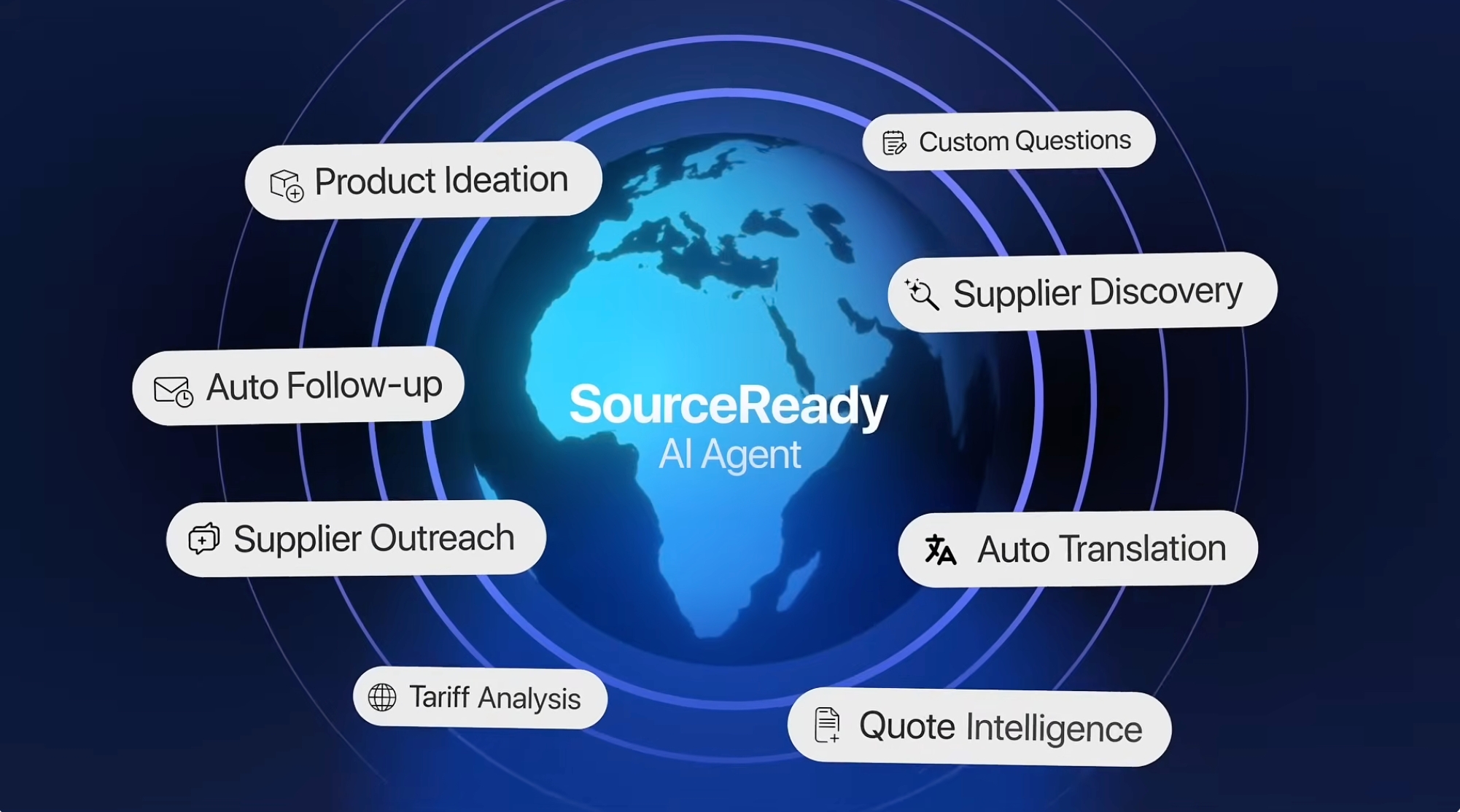
Watch the video to see how SourceReady helps brands move from product ideas to trusted supplier relationships faster
Watch the VideoThe Real Problem Isn't the Technology
What we see consistently across supply chain organizations is a version of the same story. A company invests in AI, speeds up certain processes, and produces better-looking reports. But customer satisfaction stays flat, costs don't come down, and the teams closest to the work are more frustrated than before.
The technology didn't fail. The organizational structure around it did.
Companies layered AI on top of roles and processes designed for a pre-AI world. A demand planner is still spending their day doing what the platform should be handling, because nobody redesigned what the demand planner's job actually is now. A procurement team adopted an AI sourcing tool but evaluates suppliers exactly the same way they always have. New tools, old logic.
That gap between what AI can do and how organizations are actually set up to use it is where most implementations quietly fall apart. Accenture's research on talent strategy puts a number on it: 84% of executives plan to redesign roles and teams around AI within five years, yet only one in five are actively rethinking how work gets done today.
Supply chain is where that disconnect is most expensive.
What It Actually Takes to Make AI Work in Supply Chain
The organizations getting real results from AI aren't the ones with the most sophisticated platforms. They're the ones that stopped asking "how do we add AI to what we already do?" and started asking "now that AI handles this, what should our people be focused on instead?"
The distinction matters enormously in practice.
In demand planning, AI can process thousands of SKUs, incorporate external signals, and generate statistically sound forecasts continuously. What it cannot do is understand why a product launch is being accelerated, how a key retail relationship is shifting, or what a competitor's recent capacity decision signals for future demand. Those calls require context, relationships, and operational judgment that only experienced practitioners carry. The demand planner role, redesigned well, shifts almost entirely toward that kind of analysis.
In procurement, AI can surface suppliers at global scale, analyze shipment histories, and automate outreach across hundreds of potential partners simultaneously. What it cannot do is read a supplier's production culture, build trust through repeated interaction, or own a high-stakes sole-source decision with full accountability. Redesigning the procurement role means moving people out of manual discovery and into supplier development, risk management, and relationship work that actually requires human presence.
The underlying principle is straightforward: decide which tasks belong to the system and which require human judgment, then build roles around that division. The organizations that have done this work are the ones where AI investments are generating real operational improvement.
The Talent Gap Behind Every Stalled Implementation
Here's what makes this hard. Redesigning supply chain work around AI is not a technology project. It's a leadership and talent project. And the professionals capable of doing it well are not the ones showing up in most hiring pipelines.
What's needed is not someone with AI tools on their resume. It's someone who has operated supply chain functions at enough depth to know where human judgment is irreplaceable, where process discipline is what makes AI perform well, and where organizational resistance will surface before it becomes a problem. Someone who has led a team through the transition from doing work manually to supervising AI doing it, and understands that this is a fundamentally different management challenge than anything that came before.
Harvard Business School research found that more than 27 million qualified professionals in the U.S. are systematically overlooked by traditional hiring processes. In supply chain, the issue is more specific. The professionals capable of leading AI organizational redesign aren't just being screened out. They're not in the candidate pool at all.
Job postings reach roughly 30% of the talent market. Active candidates, people currently searching, who have optimized their profiles for keyword matching. The other 70% are employed, performing well, and have no reason to be looking. They are running the implementations your competitors stood up two years ago. They are exactly the professionals your organization needs and exactly the ones a standard hiring process won't surface.
Finding the Right People Requires a Different Approach
Reaching that 70% means abandoning the logic of posting and waiting entirely. Here's what actually works:
1. Map where the experience lives before you start searching.
The right candidates aren't randomly distributed across the market. Start by identifying the organizations whose alumni carry the operational depth you need. Companies like Procter & Gamble, Toyota, Unilever, and Apple are known training grounds for world-class supply chain talent. A sparse LinkedIn profile that shows "Supply Chain Manager, Toyota 2018-2023" tells you more than a keyword-optimized resume from someone without that pedigree. You're not just hiring the person. You're hiring the methodology they've absorbed.
2. Look for career velocity, not just years of experience.
Years in a role is a blunt instrument. What actually signals top talent is the shape of a career: three promotions within the same $5B company is worth far more than a decade of lateral moves. In supply chain specifically, it takes a full 12-month cycle just to see the results of a major implementation. Professionals who left roles before that point have never lived with the consequences of their own decisions.
3. Search for outcomes, not job titles.
The strongest supply chain professionals don't market themselves. Their profiles are often sparse because their reputation precedes them in their industry circles. This is where most keyword-based searches fail entirely. A candidate who writes "reduced regional freight spend by 12% while maintaining 98% on-time delivery during peak season" may never have typed "logistics optimization" anywhere on their profile. Reading between the lines is a skill. Matching keywords is not.
4. Use Boolean searches to find the people AI tools miss.
When searching LinkedIn, target pedigree and outcomes simultaneously rather than titles alone. A search string like ("Supply Chain" OR Logistics) AND (Toyota OR "P&G" OR Apple OR Amazon) AND (KPI OR "Cost Savings" OR "Inventory Turn") surfaces a fundamentally different candidate pool than searching for a job title. Set "years at current company" to 2+ and "years of experience" to 8+ to find the stable, experienced professionals who aren't job-hopping and whose profiles don't advertise availability.
5. Lead every outreach with the operational problem.
Passive candidates aren't moved by exciting opportunities. They're moved by problems worth their attention. Before reaching out to anyone, articulate the specific challenge clearly: what was deployed, what hasn't worked, and what needs to change. A message that connects that problem directly to the candidate's specific background and treats them as a practitioner with something to contribute will generate responses that a job posting never will.
6. Redesign your interview questions around decisions.
The standard question "do you have experience with this platform?" tells you almost nothing. Replace it with "tell me about a time an AI implementation your organization invested in disappointed early. What was actually wrong and how did you address it?" Follow with: "How did you get operations leadership to trust the outputs?" These questions separate the professionals who owned implementation from the ones who attended the project meetings.
7. Involve a practitioner in every evaluation.
Without deep supply chain experience, it's nearly impossible to distinguish between a candidate who led organizational change and one who observed it. Someone with hands-on operational background will immediately recognize the difference in how candidates describe implementation challenges, model limitations, and stakeholder resistance.
That is what specialized supply chain recruiting is designed to do. Not because the mechanics are complicated, but because finding the right people depends on knowing what effective supply chain AI leadership looks like before the search begins.
The Organizations That Get This Right Are Pulling Away
The supply chain leaders who are seeing real returns on AI investment made two decisions simultaneously: invest in the technology and redesign the talent strategy around it. Not sequentially. Together.
The ones still waiting for the software to produce results without changing how the organization works or who leads that work are falling further behind with each deployment cycle. The technology doesn't close the gap. The right people in the right roles do.
Supply chain AI is ready. The question every organization needs to answer honestly is whether its talent strategy is.

Find the sourcing tools you need.
Explore how SourceReady helps you research products, discover suppliers, verify factory information, analyze trade data, and manage your sourcing workflow in one place
Explore Features
Friddy Hoegener is the Co-Founder and Head of Recruiting at SCOPE Recruiting, a boutique firm specialising in supply chain and manufacturing talent. As a former supply chain professional himself, he now connects companies with the right talent to solve critical operational challenges.