Diversifying your supply chain is no longer optional. Tariffs, geopolitical risk, and concentration exposure have made single-country sourcing fragile. You already know this. What you need now is execution.
AI platforms are changing how quickly—and how confidently—you can shift production across regions. But not all tools are built for real sourcing decisions. This guide focuses on what actually works.
There's a better way to source ❤️
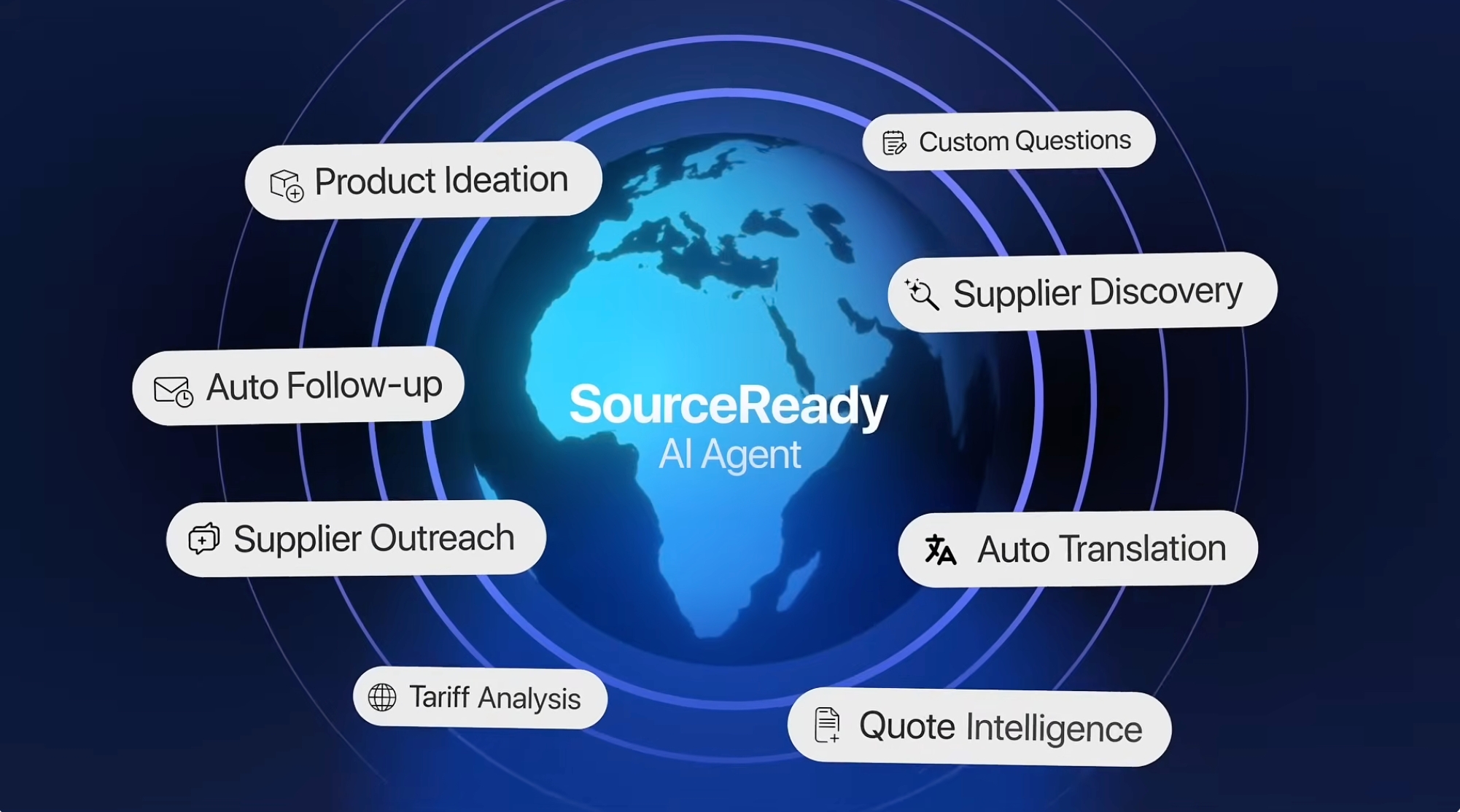
Watch the video to see how SourceReady helps brands move from product ideas to trusted supplier relationships faster
Watch the VideoWhat Should You Look for in a Sourcing Platform?
Before evaluating tools, define what good looks like. Most platforms claim “AI-powered supplier discovery.” That’s meaningless unless it translates into actionable sourcing outcomes.
Core Capabilities
You should expect:
- Verified supplier data: Not scraped directories. Look for platforms using customs data, certifications, and trade records.
- Cross-country comparability: The system should let you compare Vietnam vs India vs Mexico on the same SKU.
- Filtering beyond price: MOQ, lead time, certifications, capacity, and export history matter more than unit cost.
- Match scoring or ranking logic: AI should explain why a supplier fits your needs—not just list options.
- Data freshness: Trade relationships change fast. Stale data is a hidden risk.
Advanced Capabilities (Where AI Actually Helps)
- Supplier similarity matching: (finding alternatives to your current China suppliers)
- Risk signals: (shipment volatility, compliance gaps, dependency concentration)
- Natural language search: (e.g., “sustainable cotton hoodie manufacturer in Turkey”)
If a platform lacks these, it’s a directory with a chatbot.

Which AI Platforms Are Actually Useful for Diversification?
Below is a practical breakdown of leading AI-driven sourcing tools. Each tool is assessed based on how it actually fits into a diversification workflow.
1. SourceReady — End-to-End Supplier Discovery
Best for: Cross-country supplier matching and qualification, SourceReady provides
What it actually does:
- Aggregates supplier data from customs records, trade shows, certifications, and export history
- Uses AI to generate a match score based on your requirements (MOQ, price, lead time, certifications)
- Surfaces comparable suppliers across multiple countries for the same product
Why it matters for diversification:
- You can directly answer: “Who can replace my China supplier in Vietnam or India?”
- Reduces time spent manually comparing suppliers across regions
Strengths:
- Structured, comparable supplier data (rare in sourcing)
- Clear reasoning behind matches (not a black box)
- Strong for mid-market and growing brands
2. ImportYeti — Reverse Sourcing from Competitors
Best for: Finding real suppliers already used by competitors
What it actually does:
- Parses bill of lading data from US imports
- Shows which factories are shipping to which brands
Why it matters for diversification:
- You avoid guessing. You see proven supplier relationships outside China
Strengths:
- High signal: shipment data is hard to fake
- Simple interface, fast insights
Limitations:
- No filtering for MOQ, certifications, or capabilities
- No qualification workflow
3. Panjiva (S&P Global) — Enterprise Trade Intelligence
Best for: Deep supplier intelligence and compliance checks
What it actually does:
- Provides global customs data across multiple countries
- Tracks shipment frequency, volume, and trading partners
Why it matters for diversification:
- Helps validate whether a supplier has real export experience at scale
Strengths:
- Highly reliable, enterprise-grade data
- Strong for risk and compliance teams
Limitations:
- Expensive
- Not designed for sourcing workflows (no RFQs, no match scoring)
4. Alibaba/ Accio— Broad Supplier Discovery
Best for: Initial outreach and supplier testing
What it actually does:
- Provides access to a massive database of suppliers
- Offers RFQ tools and chat-based communication
Why it matters for diversification:
- Lets you quickly test pricing, responsiveness, and feasibility across regions
Strengths:
- Huge supplier base
- Fast communication loop
Limitations:
- Data quality varies significantly
- Requires heavy manual validation
How Do You Identify the Right Countries Beyond China?
Diversification is not about leaving China. It’s about placing the right products in the right regions.
1. Vietnam — The Most Mature China+1 Option
Best for: Apparel, furniture, electronics assembly
What’s actually happening on the ground:
- Vietnam has become the default China+1 destination for global brands
- Many Chinese suppliers have already set up factories there
Why it works:
- Strong export infrastructure (ports, logistics, trade agreements)
- Familiar manufacturing standards similar to China
Trade-offs:
- Capacity is increasingly constrained
- Prices are rising as demand increases
When to choose Vietnam: You want minimal operational disruption when shifting away from China.
Here's the report of comparing manufacturing capabilities between China and Vietnam generated by SourceReady!
2. India — Scale with Complexity
Best for: Textiles, jewelry, pharmaceuticals, some consumer goods
What’s actually happening on the ground:
- India is investing heavily in manufacturing through PLI (Production Linked Incentives)
- Large domestic supply chain for raw materials
Why it works:
- Competitive labor costs
- Massive production capacity potential
Trade-offs:
- Infrastructure and logistics can be inconsistent
- Lead times are typically longer than China or Vietnam
When to choose India: You are optimizing for cost and long-term scalability, not speed.
3. Mexico — Nearshoring Advantage
Best for: Automotive, electronics, consumer goods for US market
What’s actually happening on the ground:
- Strong growth in nearshoring driven by US companies
- Increasing investment in manufacturing clusters
Why it works:
- Geographic proximity reduces shipping time dramatically
- USMCA provides tariff advantages
Trade-offs:
- Higher labor costs than Asia
- Supplier ecosystem is still developing in some categories
When to choose Mexico: You prioritize speed, inventory turns, and reduced logistics risk.
4. Turkey — Speed for European Markets
Best for: Apparel, textiles, fast fashion
What’s actually happening on the ground:
- Turkey serves as a nearshoring hub for European brands
- Strong vertically integrated textile industry
Why it works:
- Very short lead times to Europe
- Flexible production runs
Trade-offs:
- Currency volatility impacts pricing
- Economic instability can affect operations
When to choose Turkey: You need fast replenishment cycles for trend-driven products.
5. Indonesia — Emerging Capacity Play
Best for: Footwear, furniture, light manufacturing
What’s actually happening on the ground:
- Increasing investment from global brands diversifying out of China
- Growing industrial zones and manufacturing clusters
Why it works:
- Competitive labor costs
- Expanding supplier base
Trade-offs:
- Logistics can be complex due to geography (islands)
- Less mature ecosystem than Vietnam
When to choose Indonesia: You are planning for long-term diversification and capacity expansion.

How Do You Validate Suppliers Without Flying There?
This is where most diversification strategies fail. Discovery is easy. Validation is hard.
AI can reduce risk—but only if you use it correctly.
Step-by-Step Validation Framework
1. Data Validation (Desk Research)
Check:
- Export history (consistent shipments?)
- Certifications (ISO, BSCI, GOTS, etc.)
- Customer overlap (are they supplying known brands?)
If data is missing, assume risk.
2. Commercial Validation (RFQ Process)
Send structured RFQs:
- Detailed specs (materials, tolerances, packaging)
- MOQ and pricing tiers
- Lead times and capacity
Look for:
- Response speed
- Clarity of communication
- Willingness to share documentation
3. Operational Validation
Before committing:
- Request samples
- Conduct video audits
- Use third-party inspection services
AI can flag inconsistencies, but it cannot replace due diligence.
Red Flags You Should Not Ignore
- Sudden pricing that is too competitive
- Inconsistent company names or addresses
- No verifiable export records
These are common in low-quality directories.
Conclusion: Are You Using AI to Reduce Risk—or Just Browse Suppliers?
Most companies use AI tools like search engines. That’s a mistake.
The real advantage comes from structured workflows:
Data → Matching → Validation → Allocation
If your current process skips any of these steps, you’re not diversifying—you’re gambling.
Start with one product category. Run a parallel sourcing test outside China. Use AI to compare, not just discover. Then scale what works.
If you want a faster way to identify and compare verified suppliers across multiple countries, start testing an AI-driven sourcing workflow today. The earlier you build optionality into your supply chain, the less you’ll pay for it later.
FAQ
1. How do I compare suppliers across different countries fairly?
You need a standardized comparison framework:
Compare:
Unit cost (EXW / FOB)
MOQ
Lead time
Defect rate (from samples or history)
Certifications
Shipping cost + time
Don’t compare just price. Compare total landed cost + risk.
2. Can AI replace factory audits?
No.
AI can:
Flag inconsistencies
Verify documentation
Analyze shipment patterns
But it cannot:
Inspect production lines
Assess quality systems in practice
You still need:
Samples
Video audits
Third-party inspections

Find the sourcing tools you need.
Explore how SourceReady helps you research products, discover suppliers, verify factory information, analyze trade data, and manage your sourcing workflow in one place
Explore Features
Graduating from USC with a background in business and marketing, Judy Chen has spent over a decade working in e-commerce, specializing in sourcing and supplier management. Her experience includes developing strategies to optimize supplier relationships and streamline procurement processes for growing businesses. As SourceReady’s blog writer, Judy leverages her deep understanding of sourcing challenges to create insightful content that helps readers navigate the complexities of global supply chains.