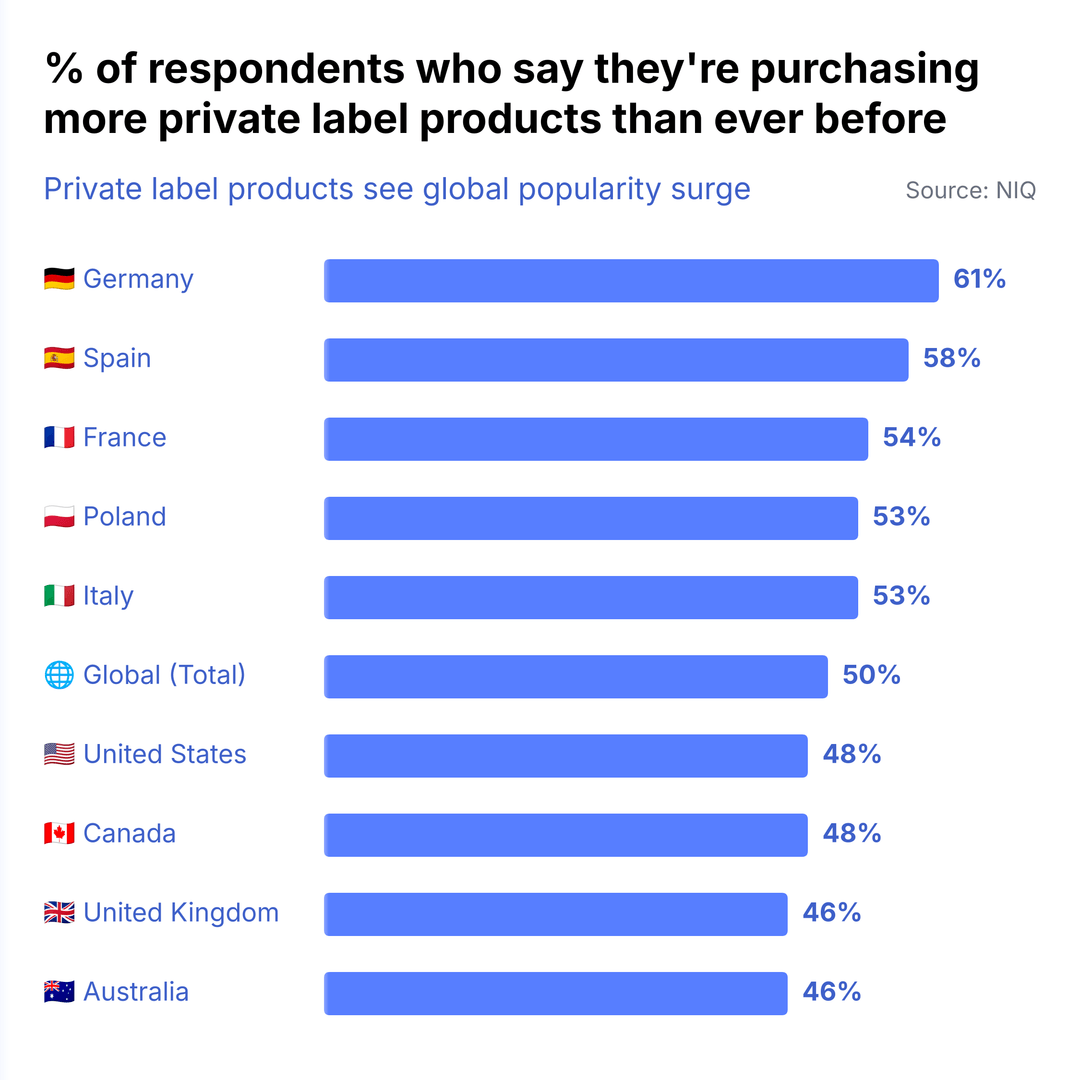
Private-label and white-label products are no longer a side bet. Globally, private-label sales exceed USD 1.5 trillion and continue to outpace branded growth in many categories, from apparel and home goods to supplements and electronics. The driver is simple: margin control, speed to market, and brand ownership.
But here’s the catch. Finding suppliers is easy. Finding the right suppliers is not.
Most sourcing failures don’t come from bad pricing. They come from:
- Misaligned capabilities
- Hidden compliance gaps
- Unverified capacity claims
- Incomplete cost modeling
This guide is about tools, not theory. You’ll learn:
- Which supplier discovery tools actually work for private-label and white-label sourcing
- Where each tool breaks down
- How to combine them into a defensible, audit-ready sourcing stack
If you care about landed cost, compliance, and repeatability—not just “finding a factory”—this is for you.
There's a better way to source ❤️
Watch the video to see how SourceReady helps brands move from product ideas to trusted supplier relationships faster
Watch the VideoWhat Private-Label and White-Label Actually Mean
These terms are often used interchangeably. In sourcing, they are not the same, and the distinction affects supplier selection, cost structure, and risk.
Private-Label
You own the product definition.
- You control specifications, materials, packaging, and branding.
- The supplier manufactures to your design.
- Tooling, MOQs, and development timelines are usually higher.
- IP risk, quality control, and compliance responsibility sit primarily with you.
Typical examples: Apparel with custom fabrics, supplements with proprietary formulations, furniture built to brand-specific dimensions.
Implication for supplier discovery: You need suppliers with engineering depth, product development capability, and a proven track record producing custom SKUs at scale.
White-Label
You own the brand, not the product design.
- The product already exists.
- You apply branding, packaging, or minor cosmetic changes.
- Faster to launch, lower upfront cost.
- Limited differentiation and less control over long-term supply exclusivity.
Typical examples: Skincare bases, electronics accessories, generic home goods.
Implication for supplier discovery: You need suppliers with stable capacity, consistent quality, and clear compliance documentation—not R&D-heavy partners.
Why This Distinction Changes Your Tooling Strategy
White-label sourcing prioritizes speed, availability, and compliance verification.
Private-label sourcing requires deep capability matching, BOM alignment, and risk modeling.
This is why AI-driven supplier discovery tools matter.

What job you’re hiring AI to do.
Before comparing tools, you need to be clear on what job you’re hiring AI to do.
Supplier discovery breaks into five distinct functions:
- Market coverage — Who exists in the global supply base?
- Capability matching — Who can actually make your product, not just claim they can?
- Compliance screening — Who is legally and ethically usable?
- Cost modeling inputs — Who fits your landed cost targets at scale?
- Shortlisting & comparison — Who should you talk to first?
Core Supplier Discovery Tools
Below are AI-centric platforms designed to surface and qualify suppliers based on your specs and signals — not just corporate directories.
1. SourceReady — AI Agent for Supplier Discovery & Research
Best for:
- Deep AI-driven supplier matching to product requirements
- Supplier research and outreach automation
What it does
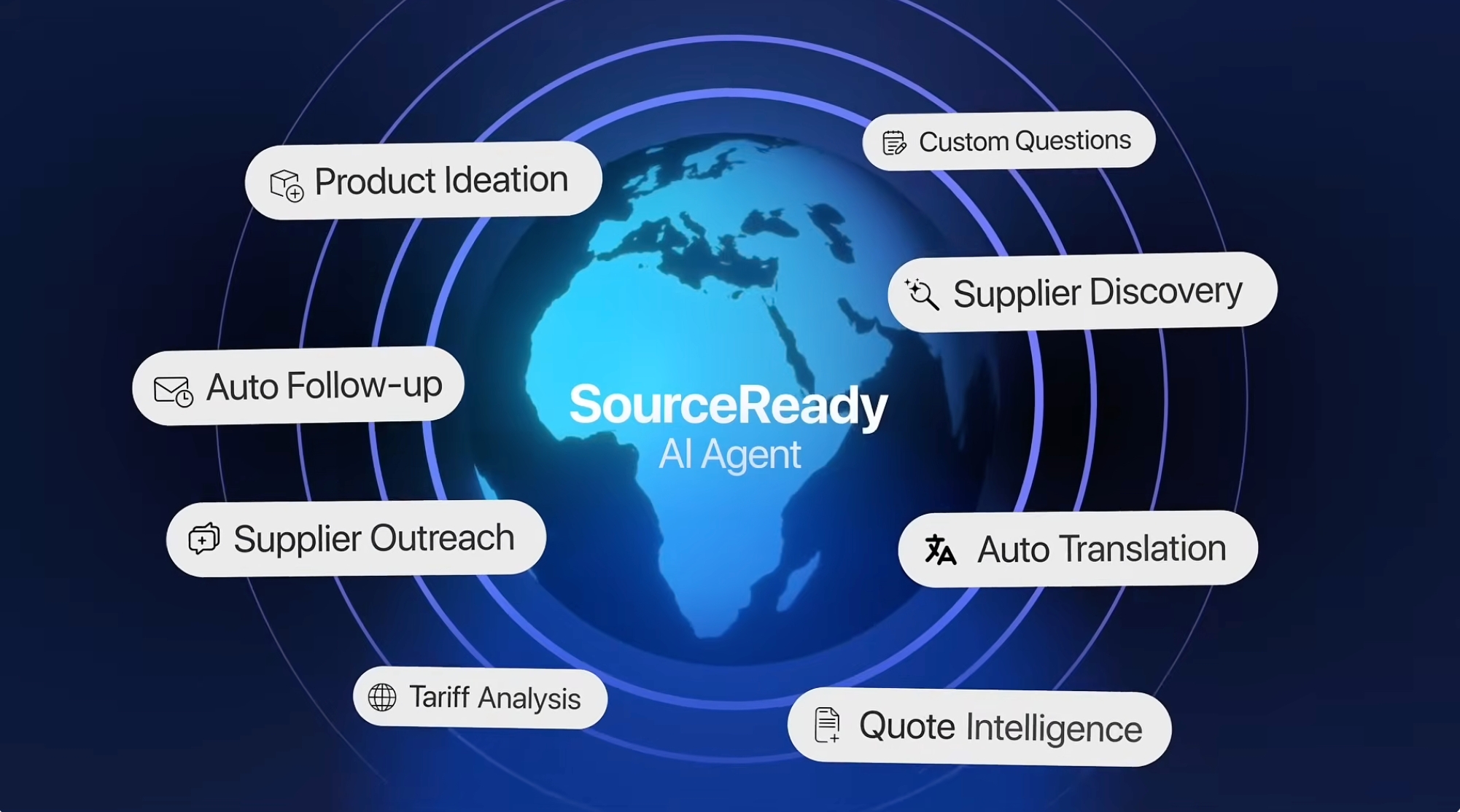
- Uses AI to match your product specs with suppliers from a cross-verified dataset of 1.2M+ suppliers across 100+ countries.
- AI agents handle outreach, follow-ups, and RFQ intelligence.
- Allows you to benchmark competitors’ sourcing footprints using customs-derived signals.
Strengths
- Conversational AI interface (“tell it what you need, get supplier matches”) reduces manual research.
- Built-in AI quote comparison and scoring.
- Combines supplier discovery and early engagement.
Limitations
- Not a full PLM or procurement execution suite (you’ll still need downstream tools for contract and compliance workflows).
2. Scoutbee (now part of Coupa) — AI Powered Discovery + Network Signals
Best for:
- AI-augmented discovery at enterprise scale
- Deep data enrichment and supplier insights
What it does
- Uses proprietary AI to scan global sourcing data and match suppliers to buyer requirements.
- Built-in collaboration workflows and vetting panels help you qualify suppliers faster than manual research.
- Now integrated with Coupa’s broader spend and supplier intelligence ecosystem, adding visibility into category insights and risk signals.
Strengths
- Strong for strategic sourcing programs with large, complex BOMs.
- AI enrichment goes beyond names and locations — it adds certifications, revenue proxies, and ESG signals.
Limitations
- Typically requires enterprise procurement investment (budget + change management).
- Discovery output may still need custom interpretation for private-label specificity.
3. Sourcing Ally — Instant AI Supplier Matching & Vetting
Best for:
- Quick identification and vetting of suppliers
- Reducing discovery timelines from months to days
What it does
- Receives your sourcing request and returns a curated shortlist of suppliers via AI matching.
- Includes initial vetting insights — documentation status, capability flags, and scalable SMB suitability.
Strengths
- Fast turnaround — suited for agile teams and rapid product cycles.
- “One-stop” intake to shortlist flow reduces early friction.
Limitations
- Less well-known than larger platforms; smaller supplier coverage than enterprise networks.
4. SourceIQ — AI Supplier Sourcing & Procurement Intelligence
Best for:
- AI matching plus compliance tracking and scoring
- Integrated procurement insights
What it does
- AI-powered supplier matching with scoring models driven by structured datasets.
- Adds compliance tracking and audit-ready logs as part of supplier profiles.
- RFP creation and responses can be systematized with built-in scoring suggestions.
Strengths
- More end-to-end than pure discovery tools — combines matching with evaluation and compliance features.
- Audit trails help compliance reporting.
Limitations
- Coverage (~100k suppliers) is smaller than some enterprise networks; most effective when combined with other discovery inputs.
Conclusion: Build a Stack, Not a Shortcut
There is no single AI tool that can solve private-label or white-label sourcing end to end. And that’s not a weakness—it’s reality.
High-performing teams win by designing a sourcing stack, not chasing a silver bullet. They start with a clear BOM, map requirements to country strengths, and use AI tools for what they do best: discovery, matching, validation, and prioritization. They model landed cost early. They treat compliance as a constraint, not an afterthought.
AI-driven platforms like SourceReady add leverage where it matters most—turning fragmented supplier data into structured, comparable intelligence and helping you focus on suppliers that actually fit your needs.
If your sourcing process can’t be explained, repeated, and defended, it won’t scale.
The next step is simple: define your requirements, assign the right AI tools to each discovery job, and build a sourcing system that works under scrutiny—not just in demos.
FAQ
1. Are AI sourcing tools better than traditional B2B marketplaces?
They solve different problems. Marketplaces provide scale and visibility. AI tools reduce noise by matching suppliers to your specific requirements and risk constraints. Most teams use both, but at different stages.
2. Are these tools suitable for small teams or only enterprises?
Many AI tools now support small and mid-sized teams. The key factor is not company size, but sourcing complexity, product variety, and risk tolerance.

Find the sourcing tools you need.
Explore how SourceReady helps you research products, discover suppliers, verify factory information, analyze trade data, and manage your sourcing workflow in one place
Explore Features
Graduating from USC with a background in business and marketing, Judy Chen has spent over a decade working in e-commerce, specializing in sourcing and supplier management. Her experience includes developing strategies to optimize supplier relationships and streamline procurement processes for growing businesses. As SourceReady’s blog writer, Judy leverages her deep understanding of sourcing challenges to create insightful content that helps readers navigate the complexities of global supply chains.


