Strategic manufacturing requires selecting a model that aligns with your operational scale and intellectual property needs. While OEM is preferred by established brands for protecting proprietary designs, ODM offers a lower-cost entry point for startups through existing factory blueprints. For enterprises seeking rapid scale, Contract Manufacturing provides end-to-end supply chain management. In today’s market, professional procurement has shifted away from subjective marketplace ratings toward data-driven verification. By leveraging SourceReady AI, businesses can now use multidimensional Match Scores and verified U.S. Customs export data to objectively validate a manufacturer's capacity and credibility before initiating outreach.

There's a better way to source ❤️
Watch the video to see how SourceReady helps brands move from product ideas to trusted supplier relationships faster
Watch the VideoWhat is the primary difference between OEM and ODM?
To select the correct manufacturing partner, businesses must evaluate their internal R&D capabilities against their speed-to-market requirements.
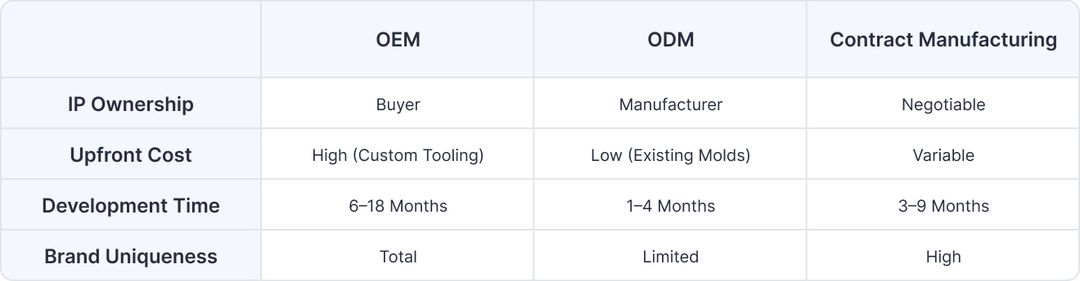
OEM (Original Equipment Manufacturing): The manufacturer produces goods based on the buyer's unique specifications. According to procurement data, OEM is the preferred model for high-tech sectors like automotive and aerospace, where proprietary tolerances are critical.
ODM (Original Design Manufacturing): The manufacturer owns the "base" design. Buyers select a pre-existing product from a catalog and add branding. This is the dominant model for consumer electronics and cosmetics.
Contract Manufacturing (CM): A broader service where the manufacturer may handle the entire supply chain, including raw material sourcing and end-to-end logistics.
Key Differences: Tooling, IP, and Costs
Which manufacturing model is best for your business scale?
Startups and Market Testers (ODM)
For businesses in the "validation" phase, ODM is the most efficient path. By utilizing existing factory designs, startups can bypass the high costs of custom molds—which can range from $5,000 to over $50,000 depending on the product. This model allows for rapid iteration and lower Minimum Order Quantities (MOQs).
Established Brands and Disruptors (OEM)
Once a brand requires a unique competitive advantage that cannot be found "off-the-shelf," OEM becomes necessary. This model is essential for protecting intellectual property. For example, search data reveals a high volume of queries for Tesla Gigafactory suppliers, illustrating how industry leaders use OEM to maintain exclusive control over their component designs.
Rapidly Scaling Enterprises (Contract Manufacturing)
Companies looking to scale without increasing headcount often turn to Contract Manufacturing. This allows the brand to focus exclusively on marketing and sales while the CM acts as the de facto operations department. This model requires robust supplier collaboration software to maintain transparency across the production cycle.

How to verify a manufacturer's capabilities?
Authoritative sourcing requires more than just a "Gold Supplier" status on a marketplace. Professional procurement teams now use AI-powered sourcing agents and customs data to verify a factory's claims.
- Check Export History: Use tools like SourceReady to see if a manufacturer has a history of shipping to your specific target market (e.g., USA, EU).
- Audit Certifications: Ensure the factory holds relevant ISO or industry-specific certifications (e.g., FDA for cosmetics, IATF 16949 for automotive).
- Verify R&D Power: For OEM, verify that the factory has an in-house engineering team rather than outsourcing design to a third party.
Global Sourcing: Where to Find the Best Manufacturers?
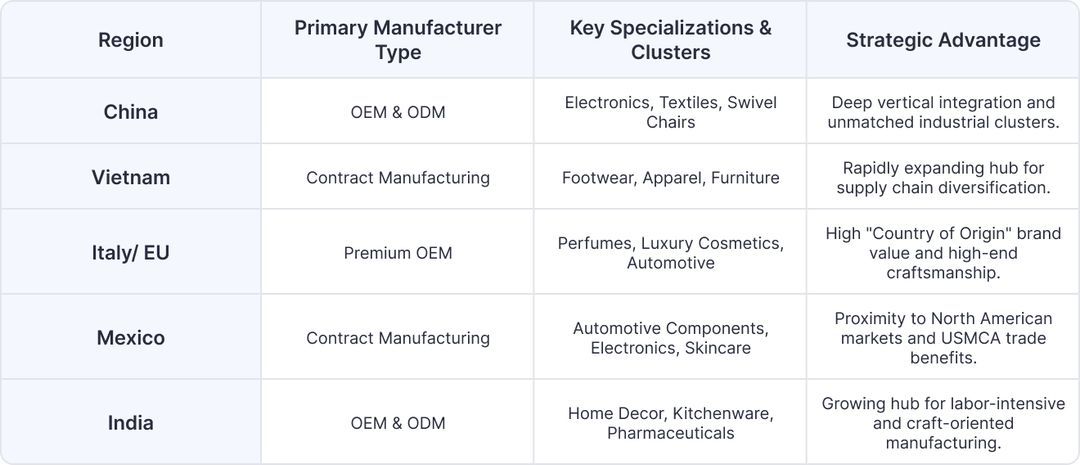
Selecting the right manufacturing partner is a geographic decision as much as a business one. Industrial clusters—geographic concentrations of specialized suppliers—offer unmatched efficiency and expertise.
- China (Comprehensive OEM/ODM): Remains the primary hub for consumer electronics, textiles, and specialized furniture. For example, Anji County is the global authority on swivel chair manufacturing, offering deep vertical integration for both OEM and ODM buyers.
- Vietnam (Contract Manufacturing Hub): Rapidly becoming the top destination for brands diversifying their supply chains. It is the rising star for footwear and apparel production, known for competitive labor costs and high-volume output.
- Italy & Europe (Luxury & High-Value OEM): Ideal for perfume, high-end fashion, and precision engineering. Search trends for "Source Italian EU" emphasize Italy’s reputation for premium quality and "Made in Italy" brand value, particularly in the cosmetics and fragrance sectors.
- Mexico (Proximity & Automotive): A strategic choice for North American brands requiring fast lead times. Mexico is a powerhouse for automotive components and high-tech assembly, benefiting from USMCA trade advantages.
How to Use SourceReady AI to Choose Your Supplier
Choosing the right supplier isn’t just about price — it’s about fit. SourceReady AI helps you narrow down suppliers based on what actually matters to your business, using structured data and intelligent matching instead of manual filtering.
Step 1: Define Your Sourcing Requirements Start by answering a short onboarding survey. This includes key factors such as product category, target price range, MOQ expectations, certifications, lead time, and preferred manufacturing countries. These inputs form the foundation of your matching logic.
Step 2: Let AI Generate Your Match Score Based on your inputs, SourceReady AI creates a default scoring model and evaluates suppliers against it. Each supplier receives a Match Score, showing how well they align with your needs — not just overall, but across specific dimensions like cost, quality, MOQ, and credibility.
Step 3: Review the Reason Breakdown Instead of a black-box score, you’ll see a clear reason summary explaining why a supplier matches (or doesn’t). This includes supporting data such as production capabilities, past export records, certifications, and operational scale.
Step 4: Shortlist and Go Deeper Once you’ve identified high-fit suppliers, you can save them, compare profiles, and move forward with outreach and due diligence — with far more confidence than manual searching alone.
SourceReady AI doesn’t replace your decision-making. It removes noise, surfaces the most relevant suppliers, and gives you the clarity needed to choose faster and with fewer risks.

Conclusion
In the modern trade landscape, the "best" supplier is determined by data, not intuition. Whether you choose the speed of ODM, the exclusivity of OEM, or the operational scale of Contract Manufacturing, your success depends on the depth of your due diligence. By moving away from subjective marketplace rankings and utilizing SourceReady’s AI-driven Match Scores, procurement teams can eliminate the "black box" of sourcing. With verified customs data and transparent reason breakdowns, you can build a resilient, high-performance supply chain that is built to scale.
FAQ
1. What is the fastest manufacturing model for new product launches?
The ODM (Original Design Manufacturing) model is the fastest route to market. Since the manufacturer has already completed the R&D and tooling phases, businesses can launch "private-label" products in as little as 1–3 months.
2. How does SourceReady AI verify a factory’s "Match Score"?
The Match Score is a data-driven calculation that weighs a supplier's verified export history, production capacity, and compliance certifications against your specific onboarding requirements. This ensures a technical fit rather than a "paid-for" placement.
3. Can a single factory provide both OEM and ODM services? Yes, many large-scale industrial clusters, such as those in Anji County, house manufacturers with in-house R&D teams capable of creating custom designs (OEM) while also maintaining a catalog of ready-made designs (ODM).

Find the sourcing tools you need.
Explore how SourceReady helps you research products, discover suppliers, verify factory information, analyze trade data, and manage your sourcing workflow in one place
Explore Features
Graduating from USC with a background in business and marketing, Judy Chen has spent over a decade working in e-commerce, specializing in sourcing and supplier management. Her experience includes developing strategies to optimize supplier relationships and streamline procurement processes for growing businesses. As SourceReady’s blog writer, Judy leverages her deep understanding of sourcing challenges to create insightful content that helps readers navigate the complexities of global supply chains.


