Soccer is the world’s most played sport. Over 250 million active players, from grassroots clubs to professional leagues, drive constant demand for balls, footwear, apparel, goals, training gear, and protective equipment. Add school programs, academies, e-commerce brands, and private-label retailers, and you’re looking at a supply chain that never sleeps.
But demand alone doesn’t make sourcing easy.
Soccer equipment sits at the intersection of performance standards, safety compliance, cost pressure, and brand expectations. A ball that fails durability testing. A shin guard that doesn’t meet youth safety standards. A jersey that pills after five washes. These aren’t small issues—they become returns, recalls, or lost contracts.
This guide helps you avoid that.
You’ll learn:
- Where each major soccer component is best sourced
- Which countries dominate which categories (and why)
- What to ask suppliers, what to watch out for, and how to structure your sourcing plan
- How to build a country-mix strategy instead of betting everything on one place
-p-1080.png)

There's a better way to source ❤️
Watch the video to see how SourceReady helps brands move from product ideas to trusted supplier relationships faster
Watch the VideoWhere Soccer Gear Is Really Made
Soccer Balls
A regulation soccer ball combines:
- Synthetic leather (PU/PVC)
- Multi-layer linings
- Latex or butyl bladders
- Stitching (hand-stitched, machine-stitched, or thermally bonded)
Common sourcing regions
- Pakistan, China, Vietnam
Strengths
- Pakistan dominates hand-stitched match balls
- China excels at machine-stitched and bonded balls
Ask for
- FIFA Basic / Quality / Quality Pro certification
- Panel bonding method and peel strength data
- Air retention and rebound test results
Footwear (Cleats / Boots)
Soccer footwear is one of the most complex categories:
- Molded outsoles
- TPU plates and studs
- Knit or synthetic uppers
- Precise sizing and fit control
Common sourcing regions
- China, Vietnam, Indonesia
Strengths
- Vietnam: premium athletic footwear
- China: wide price range and fast iteration
- Indonesia: established sports shoe clusters
Ask for
- Wear-testing data (stud durability, outsole flex)
- Upper material abrasion testing
- Size grading consistency across runs
Apparel (Jerseys, Shorts, Training Wear)
Soccer apparel is high-volume and margin-sensitive.
Materials include:
- Polyester interlock
- Mesh panels
- Sublimation or heat-transfer prints
Common sourcing regions
- China, Vietnam, Bangladesh
Strengths
- China: speed, embellishment, low MOQs
- Vietnam: quality consistency, better stitching
- Bangladesh: aggressive pricing for basics
Ask for
- Colorfastness and pilling test reports
- Fabric GSM tolerance
- Print durability standards
Protective Gear (Shin Guards, Socks, Gloves)
This category touches safety and compliance. Materials include EVA foam, TPU shells, compression textiles.
Common sourcing regions
- China, Taiwan
Strengths
- China: tooling, injection molding, scale
- Taiwan: higher-grade materials and QC discipline
Ask for
- Impact absorption test results
- EN or ASTM safety references (where applicable)
- Material MSDS sheets
Training Equipment (Goals, Cones, Nets)
Bulky, logistics-heavy products:
- Metal or composite frames
- Nets, anchors, carry bags
Common sourcing regions
- China, India
Strengths
- China: full kits and bundled SKUs
- India: steel fabrication and nets
Ask for
- Corrosion resistance testing
- Net tensile strength data
- Packaging drop-test results
Don't have time to read the entire article? Here's the shortcut to the report on Pakistan soccer factories

Top Countries to Find Suppliers for Soccer Equipment
1. China
China is the most versatile sourcing base for soccer equipment, offering speed, scale, and the widest product category coverage.
Specialties
- Training equipment (cones, ladders, goals)
- Shin guards and protective accessories
- Mid-range footwear
- Team accessories and bundled kits
Strengths
- End-to-end manufacturing ecosystem: Most soccer equipment categories can be sourced within one country, reducing supplier coordination and logistics complexity.
- Fast sampling and product iteration: Factories respond quickly to design changes, logo updates, and material adjustments, supporting short launch timelines.
- Advanced tooling and molding capability: Strong at injection molding, thermoforming, and metal fabrication for accessories and protective gear.
- Lower entry barriers for new brands: Many suppliers accept smaller initial MOQs compared to Southeast Asia.
Watch-outs
- Inconsistent quality between factories: Similar quotes can hide major differences in materials, workmanship, and QC standards.
- Uneven compliance standards: Large exporters are usually compliant; smaller workshops may lack proper labor or safety documentation.
- Cost and pricing volatility: Labor, materials, and FX fluctuations can impact long-term pricing stability.

2. Pakistan
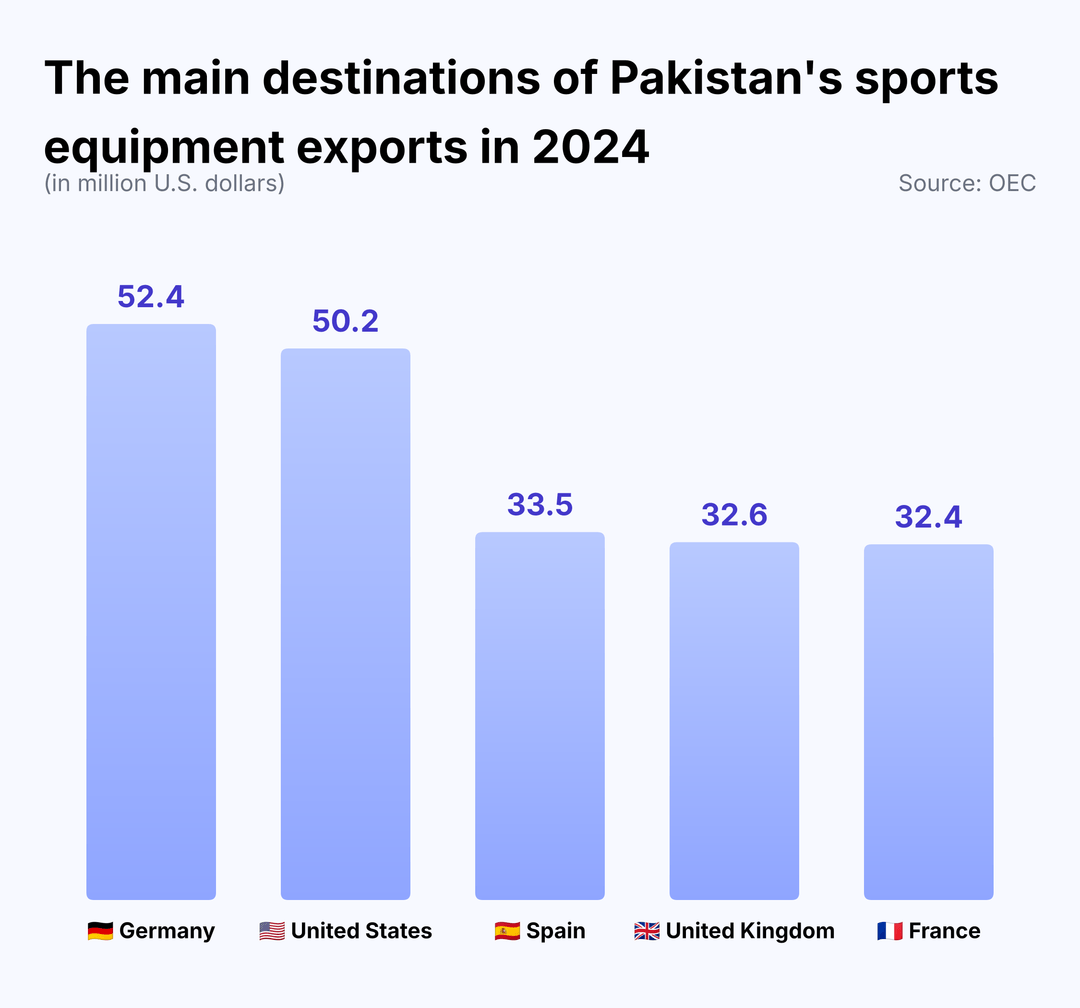
Pakistan is globally recognized for hand-stitched soccer balls, supplying match-quality products to clubs and federations worldwide.
Specialties
- Hand-stitched match balls
- Training and club-level balls
- FIFA-certified ball production
Strengths
- Deep expertise in hand-stitching: Skilled labor delivers superior shape retention, touch, and durability for high-performance balls.
- Established FIFA-certified factories: Many suppliers already meet international competition standards, reducing certification risk.
- Strong value for premium balls: Competitive pricing compared to bonded-ball alternatives at similar quality levels.
Watch-outs
- High labor compliance sensitivity: Ball stitching requires strict monitoring due to historical child labor concerns.
- Limited product diversification: Pakistan is strong in balls but weak in footwear, apparel, and accessories.
- Seasonal capacity pressure: Tournament cycles can stretch lead times and strain production schedules.
3. Vietnam
Vietnam is a premium manufacturing hub known for consistent quality, strong compliance, and expertise in performance sports products.
Specialties
- Performance soccer footwear
- Premium jerseys and team kits
- High-quality training apparel
Strengths
- High and reliable quality standards: Strong process control results in consistent stitching, finishing, and sizing accuracy.
- Footwear and apparel specialization: Extensive experience producing for global sports brands ensures technical competence.
- Strong compliance environment: Factories typically maintain clear labor, safety, and audit documentation.
Watch-outs
- Higher minimum order quantities: Many factories prioritize large-volume, long-term customers.
- Higher unit costs: Pricing reflects labor quality, compliance, and operational stability.
- Limited flexibility for small brands: Smaller buyers may struggle to secure priority production slots.
4. Indonesia
Indonesia is a specialized footwear manufacturing base with long-standing experience producing performance soccer boots.
Specialties
- Soccer cleats and boots
- Molded and studded outsole footwear
- Mid-to-high performance shoes
Strengths
- Footwear-focused manufacturing expertise: Strong capabilities in sole bonding, stud systems, and fit consistency.
- Competitive quality-to-cost balance: Often slightly cheaper than Vietnam with comparable footwear performance.
- Experienced labor force: Workers are well-trained in complex shoe assembly processes.
Watch-outs
- Capacity dominated by major brands: Global brands occupy significant factory capacity, limiting availability.
- Longer onboarding timelines: New customers face more audits and approvals before production.
- Limited category range: Indonesia is not suitable for non-footwear soccer equipment.
5. Bangladesh
Bangladesh is a high-volume apparel sourcing destination, best suited for cost-driven soccer teamwear and basics.
Specialties
- Soccer jerseys
- Shorts and training tops
- Teamwear and practice apparel
Strengths
- Very low labor costs: Enables aggressive pricing for large-volume apparel programs.
- Mass production capability: Factories are efficient once styles and materials are finalized.
- Reliable for basic constructions: Standard polyester jerseys and shorts perform consistently.
Watch-outs
- Limited technical fabric capability: Advanced moisture-wicking or compression materials may be difficult.
- Slower product development cycles: Sampling and revisions typically take longer.
- High dependence on buyer oversight: Clear specifications and QC checks are essential to avoid inconsistencies.
6. India
India is a strong sourcing option for metal-based and textile soccer equipment, particularly bulky or structural products.
Specialties
- Soccer goals and frames
- Nets and training accessories
- Basic textile add-ons
Strengths
-
- Metal fabrication expertise: Well-suited for steel and aluminum goal structures and frames.
- Cost-effective for bulky items: Favorable labor economics for low-precision, high-weight products.
- Improving export readiness: Gradual improvements in logistics, packaging, and documentation.
Watch-outs
- Inconsistent finish quality: Welding, coating, and paint quality can vary by supplier.
- Weak packaging standards: Insufficient packaging can lead to transit damage.
- Requires very clear tolerances: Specifications must be detailed to avoid dimensional issues.
The Sourcing Playbook: A Practical Checklist
1. Map your BOM
- Break products into materials, components, and processes.
- Match each to country strengths.
2. Shortlist factories, not countries
- Country ≠ capability.
- Verify export history, certifications, and customer mix.
3. Demand proof, not promises
- Test reports.
- Certification IDs.
- Production photos or videos.
4. Model landed cost
- Unit price + freight + duties + QC + returns.
- Cheapest ex-factory often loses.
5. Pilot before scaling
- Start with a controlled PO.
- Inspect during production, not after shipment.
6. Lock compliance early
- Labor, safety, materials.
- Especially critical for youth products.
7. Diversify deliberately
- Avoid single-country dependency.
- Build a secondary source per key SKU.
Tools like SourceReady can speed this up by surfacing verified suppliers, trade history, and compliance signals before you ever send an RFQ.

Conclusion: Build a Country Mix, Not a Gamble
There is no single “best” country for soccer equipment.
The best sourcing strategy is a mix:
- Pakistan for match balls
- Vietnam or Indonesia for performance footwear
- China for accessories and training gear
- Bangladesh for apparel basics
Your job is to map your BOM to country strengths, run disciplined landed-cost models, and enforce compliance from day one.
When you approach sourcing this way—methodical, data-driven, and audit-ready—you reduce risk, protect margins, and scale with confidence.
If you want to accelerate supplier discovery, verification, and comparison without starting from scratch, platforms like SourceReady can help you see beyond catalogs and into real manufacturing capability.
Your next step: audit one SKU, map its components, and pressure-test your current supplier against the checklist above. That’s how better sourcing actually starts.
FAQ
1. What are common quality issues in soccer equipment sourcing?
Common issues include inconsistent stitching, poor material substitutions, weak packaging, and failure to meet performance or safety standards. These are usually caused by unclear specifications or lack of inspections.
2. What is the difference between a soccer equipment supplier and a manufacturer?
A manufacturer produces the goods in-house, while a supplier may be a factory, trading company, or exporter. Always confirm whether you’re dealing with the actual production facility.

Find the sourcing tools you need.
Explore how SourceReady helps you research products, discover suppliers, verify factory information, analyze trade data, and manage your sourcing workflow in one place
Explore Features
Graduating from USC with a background in business and marketing, Judy Chen has spent over a decade working in e-commerce, specializing in sourcing and supplier management. Her experience includes developing strategies to optimize supplier relationships and streamline procurement processes for growing businesses. As SourceReady’s blog writer, Judy leverages her deep understanding of sourcing challenges to create insightful content that helps readers navigate the complexities of global supply chains.