The global sporting goods industry now exceeds $700 billion in annual value, driven by fitness adoption, athleisure, youth sports participation, and sustained demand for home-workout equipment. At the same time, product complexity continues to increase—carbon-fiber frames, connected electronics, low-VOC foams, and performance textiles all require different manufacturing footprints. Sourcing teams face the real challenge of balancing speed, cost, and regulatory compliance across categories that behave very differently.
Selecting the right country for each product line isn’t a theoretical exercise—it determines your landed cost, your lead time stability, and your risk exposure. Different regions excel in different combinations of materials, processes, and certifications, and these distinctions matter more as regulations tighten and consumer expectations rise.
This guide breaks down today’s global market environment, outlines which countries are strongest for specific sporting goods categories, and gives you a practical sourcing playbook.
Let's dive in now!
There’s a better way to source ❤️
Watch the video to see how SourceReady helps brands move from product ideas to trusted supplier relationships faster
The Sporting Goods & Equipment Market grew from USD 680.96 billion in 2024 to USD 724.14 billion in 2025. It is expected to continue expanding at a CAGR of 6.63%, ultimately reaching USD 1.13 trillion by 2032. The market is pushed by three structural forces: health and fitness culture, the rise of performance-driven apparel and outdoor gear, and tightening compliance and traceability rules. Production has clustered in Asia and select nearshore hubs, but the type of demand now matters more than sheer volume.
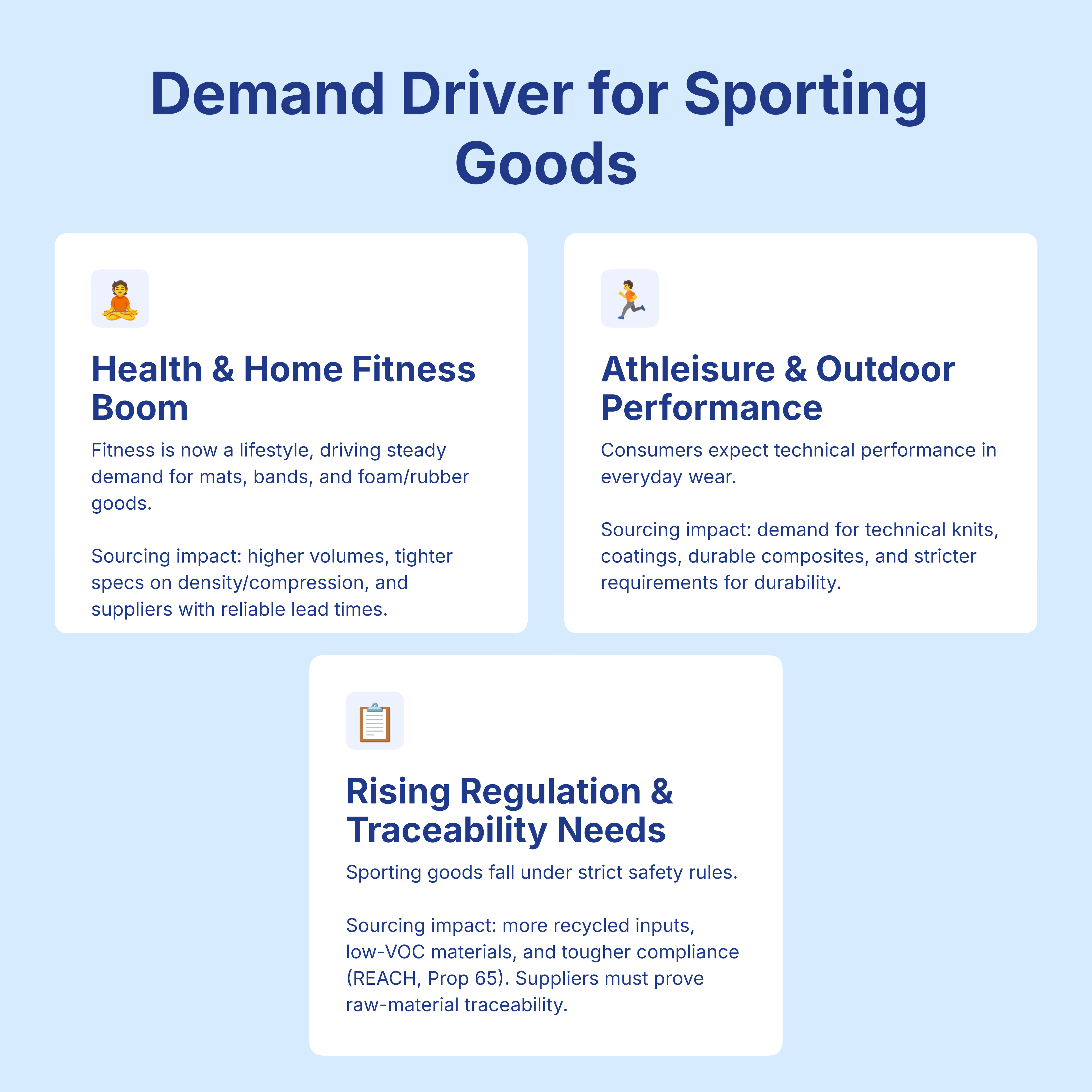
1. Health, Fitness & Home Workout Normalization
Health has become a lifestyle, not a niche. Gym use, home workouts, and recovery routines all support steady demand.
Sourcing impact:
Higher volumes of rubber, foam, plastics, and soft-goods (mats, bands, accessories).
Need for consistent compression-set, density, and surface finish in foam and rubber products.
Preference for suppliers with stable lead times and strong packaging practices for bulky items.
Performance fabrics and outdoor gear have moved into the mainstream. Consumers expect comfort plus real technical performance.
Sourcing impact:
Rising demand for technical knits, performance wovens, coatings, and durable composites.
Higher standards for colorfastness, abrasion resistance, water resistance, and UV durability.
Advantage for regions with integrated textiles + finishing + hardgoods ecosystems (e.g., China, Vietnam, Taiwan, Turkey).
3. Regulation, Compliance & Traceability
Sporting goods sit squarely in categories regulators care about: foams, plastics, chemicals, electronics, and youth products.
Sourcing impact:
Increased use of recycled polyester, low-odor compounds, and low-VOC foams.
Stricter enforcement of REACH, Prop 65, CPSIA, and category-specific ISO/EN standards.
Demand for suppliers that can prove raw-material traceability, not just final product tests.
Top Countries to Find Suppliers for Sporting Goods
1. China
China remains the world’s most complete sporting-goods ecosystem. It offers metals, plastics, textiles, composites, electronics, and packaging in one place, with dense supplier clusters and mature logistics.
Strengths:
Full-stack manufacturing: From raw materials to final assembly, many suppliers sit within the same region, cutting transit time between processes.
Advanced tooling capability: Mold shops can produce complex injection molds, die-casting tools, and composite layup molds at competitive rates.
Strong electronics integration: Ideal for connected treadmills, smart rowing machines, and wearables thanks to PCB, sensor, and motor ecosystems.
Reliable testing access: Local labs can run REACH, Prop 65, EMC, load testing, and mechanical safety tests quickly.
IP exposure in certain clusters; design files must be controlled.
Cost creep in coastal provinces; inland factories may require closer QA management.
2. Vietnam
Vietnam’s supply base expanded rapidly through foreign investment from Korea and Taiwan. It excels in textiles, sewing, and foam-based products.
Strengths:
Consistent soft-goods quality: Strong at sewing, patterning, and stitching, especially for gloves, apparel, bags, and soft accessories.
Growing helmet and protective gear sector: Many factories produce EPS foam, polycarbonate shells, and finished helmets to EU/US standards.
Labor stability: Predictable workmanship and lower turnover support consistent output.
Attractive duty positioning for U.S. and EU shipments.
Best for:
Apparel and performance fabrics.
Gloves, pads, straps, and foam-based accessories.
Helmets and protective soft-goods.
Watch-outs:
Tooling timelines are slower due to reliance on imported steel and mold shops.
Raw material dependency—fabrics, foams, and plastics often come from China.
3. India
India is a cost-competitive hub for metals, basic plastics, leather alternatives, and simple sporting accessories. It's strong in forging, casting, and basic assembly.
Strengths:
Metalwork at attractive cost: Good for dumbbells, kettlebells, weight plates, and steel frames.
Expanding plastics capacity: Suitable for simple molded components, grips, and lower-complexity parts.
Large workforce: Helpful for assembly and finishing tasks with high manual labor requirements.
Improving compliance maturity: More suppliers are investing in certifications and audits.
Factory-to-factory variability is high; audits are critical.
Lead times can stretch, especially for coated metal products.
Surface finishes may require more oversight.
4. Taiwan
Taiwan is a global leader in precision sporting goods—especially bicycles, rackets, carbon-fiber frames, and high-performance components.
Strengths:
World-class composites: Taiwan’s carbon-fiber production is among the most reliable globally, with excellent layup precision and material traceability.
Precision metals and machining: Ideal for high-spec bike components, performance hardware, and structural parts.
Stable electronics ecosystem: Strong PCBs, motors, and small-control systems.
Excellent QA discipline: Predictable sampling, consistent tolerances, and strong documentation.
Best for:
Premium carbon-fiber gear.
High-end bike components.
Helmets with strict impact performance.
Watch-outs:
Higher costs versus mainland Asia.
Longer development timelines due to precision requirements.
5. Thailand
Thailand is a major producer of rubber-based and foam-based sporting goods, with an established ecosystem around natural rubber.
Strengths:
Excellent rubber transformation: High consistency in density, hardness, and odor control—critical for yoga mats, grips, and elastomer-based parts.
Strong foam and elastomer components: Compression-set performance is reliably tested and documented.
Competitive MOQs for small and mid-size brands.
Best for:
Yoga mats, grips, and rubber accessories.
Molded foams for pads or protective gear.
Select food-contact plastics.
Watch-outs:
Older equipment in smaller factories may affect precision.
Limited advanced materials—not ideal for composites or electronics.
6. Turkey
Turkey offers a combination of metalwork, apparel finishing, and packaging with fast access to European markets.
Strengths:
Shorter transit times to EU—advantageous for replenishment and seasonal cycles.
Reliable metal fabrication: Laser cutting, tubing, welded frames, and mid-volume assemblies.
Flexible packaging production: Good for print, corrugated boxes, and retail-ready packs.
Strong textile finishing: Useful for performance layers and apparel components.
Best for:
EU-focused SKUs.
Metal frames, hardware, and mid-complexity assemblies.
Packaging and textile finishing.
Watch-outs:
Energy-driven price volatility may affect quotes.
Limited multi-material integration compared to Asia.
Sourcing Guide
1. Build a Clean Product Breakdown
List every material and production requirement for each SKU—metals, foams, plastics, textiles, composites, electronics, coatings, and packaging. Sporting goods are multi-material, so clarity upfront prevents mismatched suppliers later.
Flag regulated elements such as chemicals, electronics, and youth-focused items.
2. Align Product Types With Country Specializations
Choose manufacturing hubs based on proven strengths—not just cost. This reduces sampling failures, compliance issues, and rework. Platforms like SourceReady can help you quickly see which countries specialize in which product categories and filter suppliers accordingly.
Final inspections – risk-adjusted AQL with destructive tests for metals/composites and density/hardness checks for foams/plastics.
Conclusion
The strongest sporting-goods sourcing strategies are built on matching each product type to the regions that consistently deliver on quality, compliance, and reliability. No single country excels at everything, and spreading production across the right hubs reduces cost exposure, improves lead-time stability, and strengthens your ability to meet performance and safety standards. As regulations tighten and consumer expectations shift toward higher durability and better materials, it’s essential to make sourcing decisions that are deliberate and defensible.
Before committing to any supplier, verify compliance requirements, confirm real production capacity, control tooling and technical IP, and set clear QC gates. Sporting goods must withstand load, impact, repeated stress, and chemical scrutiny—so documentation and upstream traceability matter as much as pricing.
To accelerate this work, SourceReady helps compare country strengths, filter factories by certifications, and evaluate sourcing scenarios with clarity. Use it to build a sourcing strategy that is fast, audit-ready, and resilient.
FAQ
1. What are the biggest compliance risks in sporting goods?
Foams, plastics, coatings, adhesives, and electronics pose the highest risk. Regulations like REACH, Prop 65, CPSIA, and EN/ISO safety standards often apply. Missing documentation or incorrect labeling can lead to delays, fines, or recalls.
2. How important is material traceability?
Critical. Sporting goods involve regulated chemicals, load-bearing parts, and performance expectations. Traceability ensures suppliers use approved materials, maintain consistency, and meet safety requirements across batches.
Find the sourcing tools you need.
Explore how SourceReady helps you research products, discover suppliers, verify factory information, analyze trade data, and manage your sourcing workflow in one place
Graduating from USC with a background in business and marketing, Judy Chen has spent over a decade working in e-commerce, specializing in sourcing and supplier management. Her experience includes developing strategies to optimize supplier relationships and streamline procurement processes for growing businesses. As SourceReady’s blog writer, Judy leverages her deep understanding of sourcing challenges to create insightful content that helps readers navigate the complexities of global supply chains.