TikTok Shop is redefining how fast your supply chain needs to move. Demand can spike overnight, and traditional sourcing timelines simply cannot keep up. This guide breaks down how lead time expectations are shifting, what “fast” really means now, and how you should adapt your sourcing strategy to stay competitive. It also highlights the operational risks that come with speed—and how to manage them without compromising quality or compliance. Finally, it shows how tools like SourceReady help you quickly find the right products and suppliers, so you can respond to trends in real time and capture demand while it still exists.

There's a better way to source ❤️
Watch the video to see how SourceReady helps brands move from product ideas to trusted supplier relationships faster
Watch the VideoWhy is TikTok Shop resetting lead time expectations?
TikTok Shop compresses the distance between demand creation and order placement. A product can go viral in hours, not weeks. That breaks the traditional sourcing rhythm you’re used to—forecast, place PO, wait 30–60 days, ship, sell.
Now, you’re dealing with:
- Instant demand spikes driven by creators
- Short attention cycles (products trend for days, not seasons)
- Platform pressure to maintain fast shipping and stock availability
In practical terms, your old lead time buffers are too slow and too rigid.
What’s actually changed?
Key shift: Lead time is no longer just a supply chain metric. It’s a growth constraint.
If you cannot restock quickly, you don’t just lose sales—you lose algorithm momentum.
What does “fast” actually mean now?
“Fast” used to mean shipping quickly. Now it means end-to-end responsiveness—from factory to consumer.
You need to break lead time into components:
Lead time breakdown
- Sampling time
- Production time
- Quality control (QC)
- Freight time
- Domestic fulfillment
TikTok compresses expectations across all five.
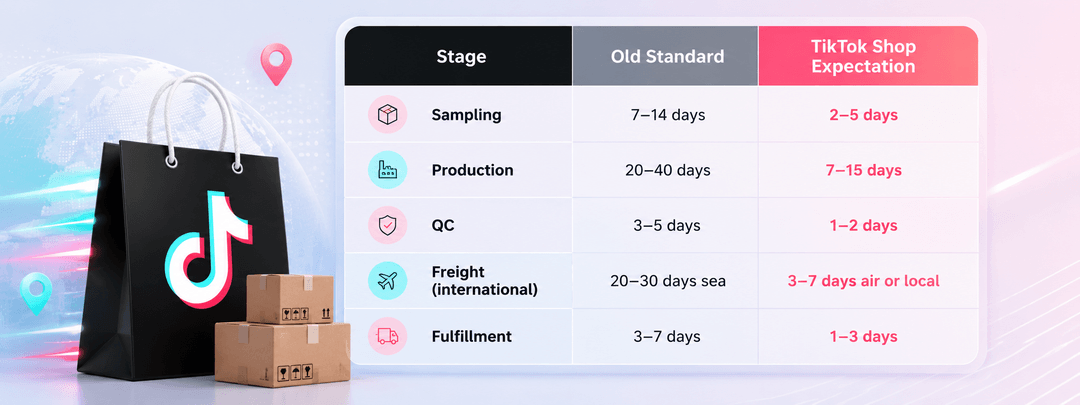
You’re now targeting total cycle times of ~10–25 days, not 60+.
What’s driving this compression?
- Creator-led drops: Inventory must exist before content scales
- Platform SLAs: Late shipments hurt ranking
- Consumer expectation: TikTok feels like instant commerce
Reality check: You don’t need every SKU to hit these targets. But your winning SKUs must.
How should you redesign your sourcing strategy?
You cannot “optimize” your old model. You need to restructure it.
A. Move from bulk sourcing to agile sourcing
Old mindset:
- Large MOQs
- Price-first negotiation
- Long production cycles
New mindset:
- Speed-first sourcing
- Flexible MOQs
- Parallel supplier pipelines
B. Build a dual-supplier system
For any TikTok-relevant SKU, you should have:
- Primary supplier (cost-efficient)
- Secondary supplier (speed-optimized)

This is not redundancy. It’s risk management.
C. Pre-position inventory (but selectively)
You cannot stock everything. You should:
- Pre-produce test quantities (100–500 units)
- Use 3PL or local warehousing for fast dispatch
- Replenish only after traction signals
D. Shorten production cycles at the source
Ask your suppliers directly:
- “What is your minimum production cycle for repeat orders?”
- “Can you run split production batches?”
- “Do you hold raw materials inventory?”
Good suppliers will offer:
- Pre-stocked materials
- Reserved capacity
- Faster turnaround for repeat SKUs
E. Use air freight strategically
Yes, it’s expensive. But:
- It protects viral momentum
- It reduces stockout risk
- It buys time for slower replenishment
Rule of thumb:
- First restock = air
- Subsequent restock = sea (if demand stabilizes)
What operational risks should you watch closely?
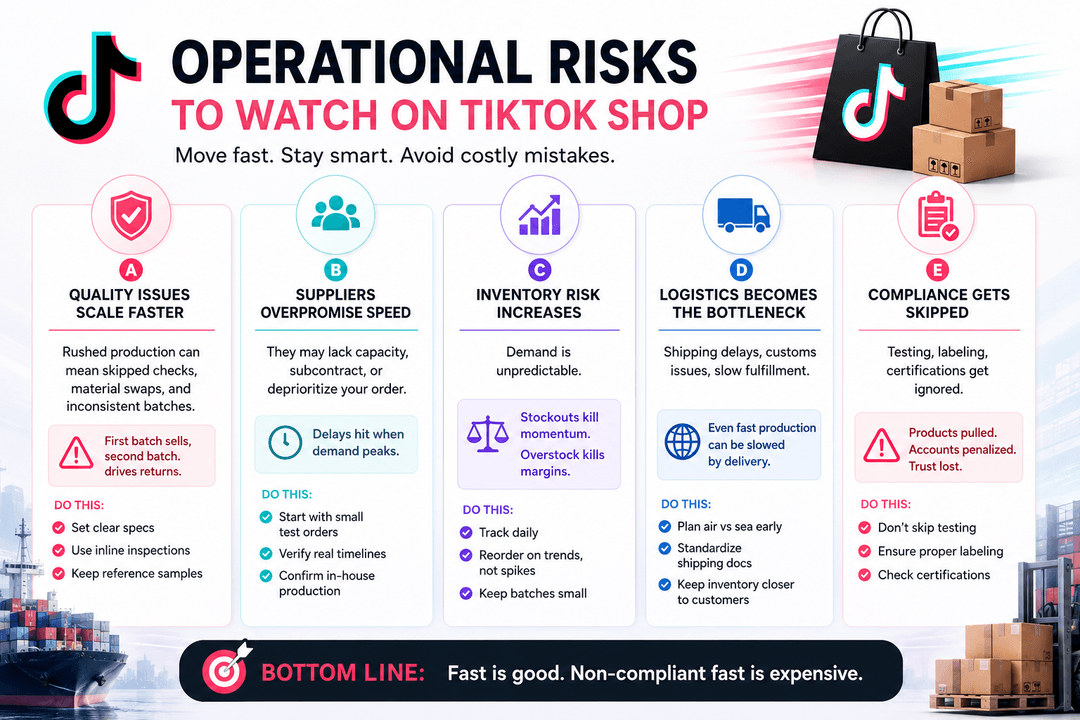
Moving faster sounds good—until things start breaking. TikTok compresses timelines, which means mistakes show up immediately, not weeks later.
A. Quality issues happen faster—and scale faster
When production is rushed, factories may:
- Skip certain checks
- Use alternative materials without notice
- Deliver inconsistent batches
This creates a hidden problem: your first batch performs well, but your second batch drives returns and bad reviews.
What to do:
- Set clear quality standards per SKU (materials, dimensions, finish)
- Use inline inspections during production, not just final QC
- Keep a reference sample for every reorder
B. Suppliers may overpromise on speed
Many suppliers will agree to fast timelines to win your order—but:
- They may not have real capacity
- They may subcontract without telling you
- Your order may not be prioritized
Result: Delays at the worst possible time—when demand is peaking.
How to manage it:
- Start with small test orders before scaling
- Ask for real production timelines, not best-case estimates
- Confirm whether production is in-house or outsourced
C. Inventory decisions become riskier
With TikTok, demand is unpredictable. This creates two common problems:
- Stockouts → you lose momentum and ranking
- Overstock → the trend dies and inventory sits
Better approach:
- Monitor sales daily, not weekly
- Reorder based on consistent sales signals, not one spike
- Use smaller, faster production batches
D. Logistics can become the bottleneck
Even if production is fast, shipping delays can slow everything down.
Typical issues:
- Air freight delays during peak periods
- Customs holds due to missing paperwork
- Slow handoff to local fulfillment
What helps:
- Pre-plan air vs sea shipping decisions
- Standardize your shipping documents
- Keep some inventory closer to your customers
E. Compliance gets overlooked
When you move fast, it’s tempting to skip:
- Product testing
- Proper labeling
- Certification checks
This is dangerous—especially on a high-visibility platform like TikTok.
If something goes wrong:
- Your product can be removed
- Your account can be penalized
- Customer trust drops quickly
Bottom line: Fast is good. Non-compliant fast is expensive.
How do you build a TikTok-ready supply chain?
You don’t need a perfect supply chain. You need one that can respond quickly without losing control.
A. Separate fast-moving products from stable ones
Not every product needs to move at TikTok speed.
Some products are driven by trends and require fast sourcing, quick restocking, and flexible decisions. Others have steady demand and can follow a more traditional, cost-focused sourcing model.
The key is to treat them differently. If you apply fast-cycle sourcing to everything, your costs increase unnecessarily. If you treat TikTok-driven products like normal SKUs, you’ll miss demand.
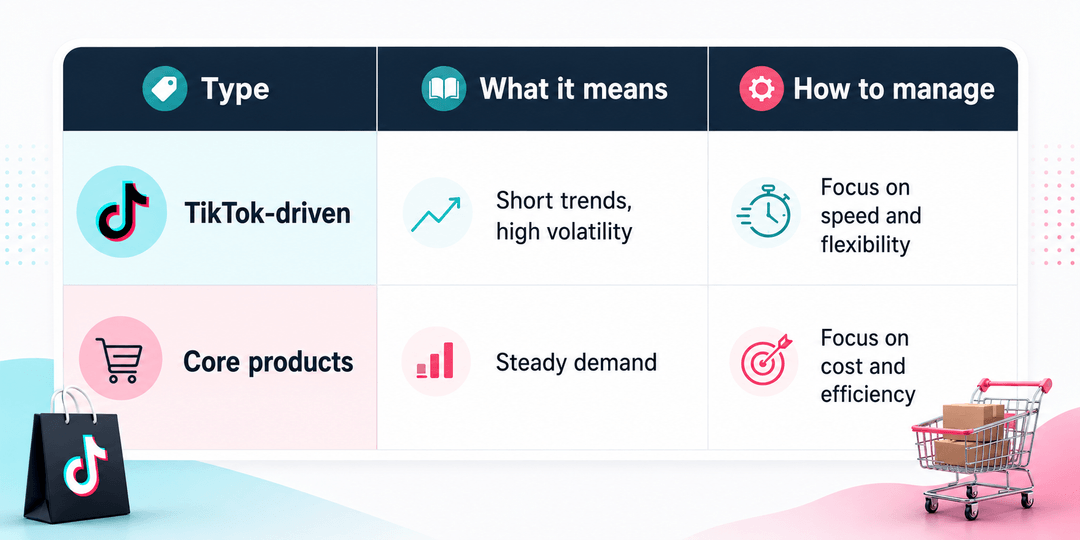
This prevents you from overcomplicating your entire operation.
B. Start small, then scale fast
Instead of committing to large orders upfront:
- Launch with a small batch (100–500 units)
- Test performance through content and sales
- Reorder quickly if demand is consistent
This reduces risk and keeps you flexible.
C. Work with more than one supplier
Relying on a single supplier is risky when speed matters.
A better setup:
- Primary supplier → better pricing, standard production
- Backup supplier → faster turnaround, higher cost
- This gives you options when demand spikes.
D. Align production and logistics
Your sourcing and shipping strategies should work together.
- Use air freight when demand is growing fast
- Switch to sea freight when sales stabilize
- Keep local inventory for your best-performing products
The goal is to protect momentum, not just reduce cost.
E. Pre-plan your response to demand spikes
When a product starts trending, you shouldn’t be figuring things out from scratch.
You should already know:
- Which supplier to use
- How fast they can produce
- What quantity to reorder
- Which shipping method to choose
This turns reaction time from days into hours.
F. Speed up supplier discovery and decisions
One of the biggest delays is simply finding the right supplier.
Traditional sourcing takes too long:
- Searching manually
- Contacting multiple suppliers
- Waiting for responses
That delay alone can cost you the trend.
Tools like SourceReady help by:
- Letting you search suppliers using clear criteria
- Showing verified supplier data (lead time, MOQ, capabilities)
- Helping you compare options quickly
So instead of spending days searching, you can move from idea → supplier shortlist in minutes.

Conclusion
TikTok Shop has fundamentally shifted sourcing from a slow, cost-driven process to a fast, timing-critical operation. If you cannot identify products, validate suppliers, and restock quickly, you miss the window where demand actually exists. The advantage now goes to teams that move early and execute with precision. This is where having the right tools matters. SourceReady helps you find reliable suppliers and act on opportunities before they disappear. If you want to keep up with TikTok-driven demand and stay in control of your supply chain, start using SourceReady to move faster and source smarter today.
FAQ
1. What type of suppliers work best for TikTok Shop?
You should prioritize suppliers who can offer:
- Low or flexible MOQs
- Fast sampling and production
- Reliable communication
- Ability to handle repeat orders quickly
- Speed and consistency matter more than the lowest price.
2. How do I know when to reorder a product?
Look for consistent sales signals, not just one viral spike. For example, steady daily sales over several days is a stronger indicator than one day of high volume.

Find the sourcing tools you need.
Explore how SourceReady helps you research products, discover suppliers, verify factory information, analyze trade data, and manage your sourcing workflow in one place
Explore Features
Graduating from USC with a background in business and marketing, Judy Chen has spent over a decade working in e-commerce, specializing in sourcing and supplier management. Her experience includes developing strategies to optimize supplier relationships and streamline procurement processes for growing businesses. As SourceReady’s blog writer, Judy leverages her deep understanding of sourcing challenges to create insightful content that helps readers navigate the complexities of global supply chains.