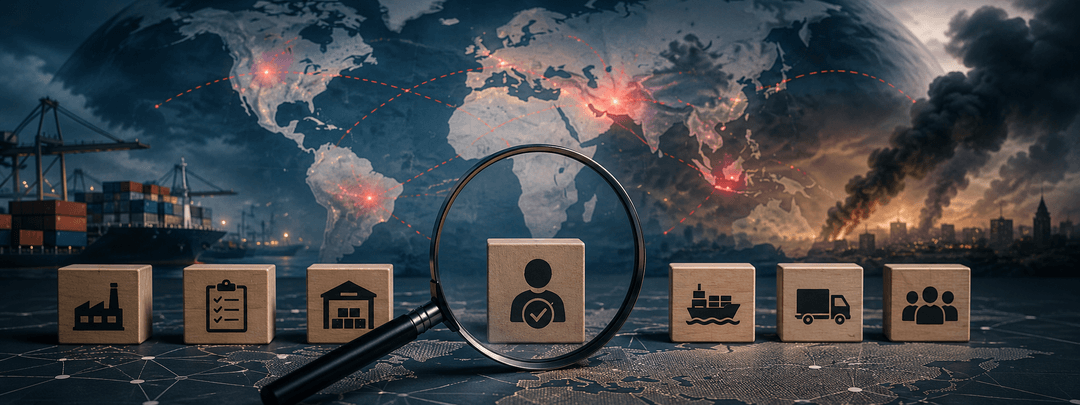
In today’s geopolitical environment, vetting suppliers is no longer just a procurement step—it’s a critical risk management function. Trade tensions, regulatory enforcement, and supply chain disruptions have raised the stakes for global sourcing. You need more than basic checks; you need structured validation, visibility into supply chain dependencies, and continuous risk monitoring. This guide outlines how to vet suppliers effectively in this new landscape and how tools like SourceReady help turn fragmented data into actionable insights, enabling more resilient, compliant, and scalable sourcing decisions.
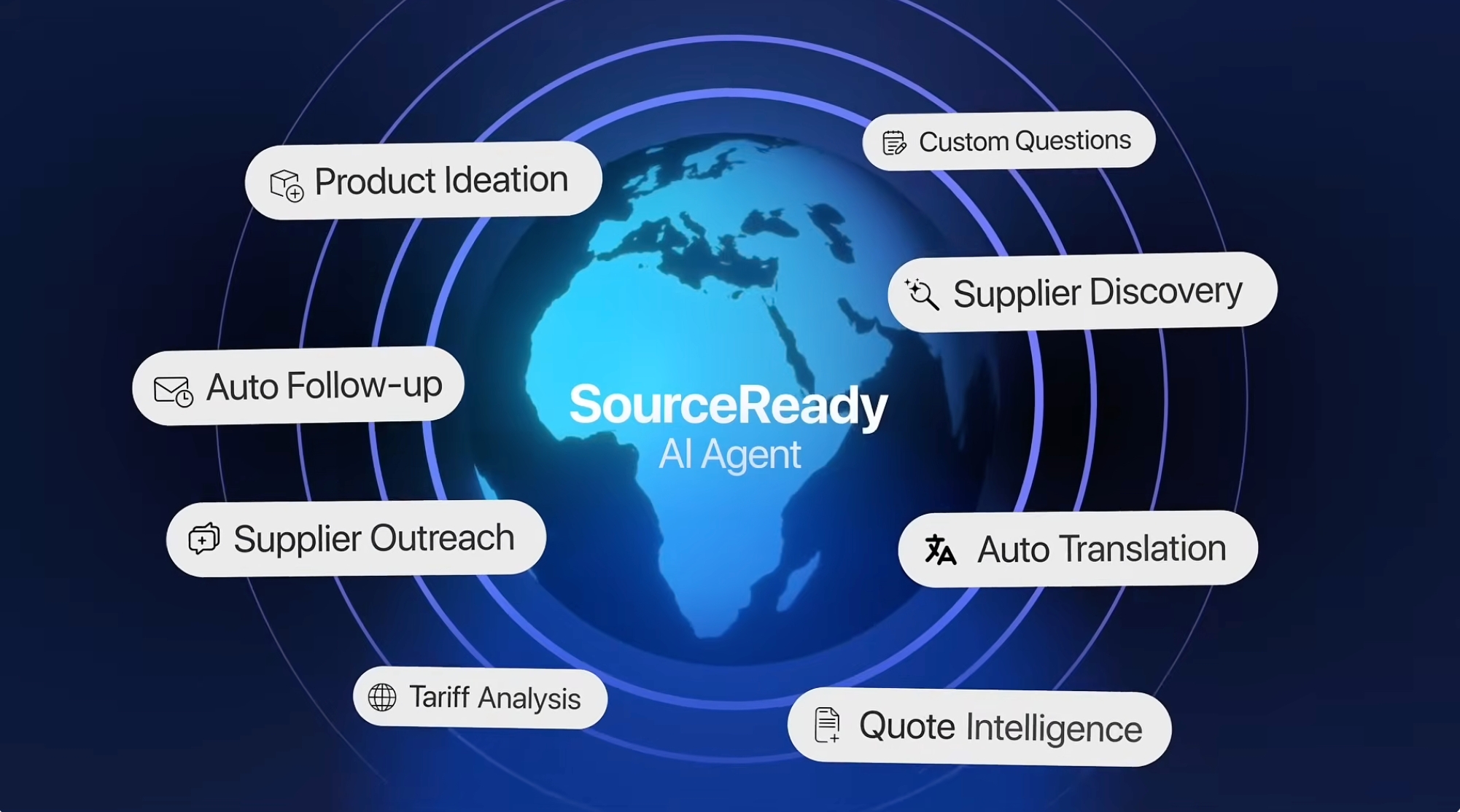
There's a better way to source ❤️
Watch the video to see how SourceReady helps brands move from product ideas to trusted supplier relationships faster
Watch the VideoWhy does geopolitics make supplier vetting more critical than ever?
Supplier vetting used to focus on cost, quality, and capacity. Today, that’s not enough. Geopolitics has turned sourcing into a risk management function.
Trade tensions, sanctions, export controls, and regulatory frameworks (e.g., forced labor laws, ESG requirements) now directly impact your ability to import, sell, and scale.
Here’s what changes in practice:
- Regulatory exposure increases: You are responsible for ensuring your suppliers—and their upstream partners—comply with trade laws in your target markets. This includes origin tracing, labor compliance, and restricted entity screening.
- Supply chain disruption becomes frequent: Tariffs, port restrictions, political instability, and policy shifts can interrupt supply without warning.
- Country risk matters as much as supplier risk: A strong factory in a high-risk region can still become a liability overnight.
- Compliance is enforceable, not optional: Customs authorities are increasingly strict. Non-compliance leads to Shipment seizures, Fines, Import bans
Bottom line: Vetting is no longer just about “can they produce?” It’s about “can they deliver legally, consistently, and sustainably in this environment?”

What exactly should you verify in a global supplier today?
Modern supplier vetting must expand beyond basic checks. You are validating operational capability + geopolitical resilience.
1. Legal structure and jurisdiction risk
Entity alignment: Confirm that the legal entity you contract with, the factory producing the goods, and the entity exporting the goods are clearly identified and aligned. Misalignment here can create issues in customs declarations and legal enforcement.
Jurisdictional risk: Assess whether the supplier operates in regions exposed to sanctions, export controls, or heightened regulatory scrutiny. Even indirect exposure—through ownership or upstream sourcing—can create compliance risk.
Ownership transparency: Understand whether the supplier is independent, part of a group, or acting as an intermediary. This affects accountability and traceability.
2. Production control and transparency
In-house vs. outsourced production: You need to know where production actually happens. Suppliers that outsource without disclosure introduce hidden risks in quality, compliance, and IP protection.
Sub-tier visibility: Increasingly, regulations require visibility beyond Tier 1 suppliers. You should understand where key materials and components originate, especially for regulated categories.
Process clarity: Strong suppliers can explain their production flow in detail—from raw materials to final assembly—without ambiguity.
3. Compliance and regulatory alignment
Market-specific compliance: Certifications must match your destination market requirements, not just the supplier’s local standards. A valid certificate in one region may not be recognized in another.
Forced labor and ESG exposure: Laws like the UFLPA in the US require proof of clean supply chains. You need evidence—not assumptions—that suppliers meet these requirements.
Certification integrity: Always verify issuing bodies, scope, and validity. Fraudulent or misapplied certifications are more common than expected.
4. Capacity and continuity
Real capacity vs. stated capacity: Suppliers often overstate output. You should evaluate whether their infrastructure, workforce, and past activity support their claims.
Continuity planning: Ask how the supplier handles disruptions—whether they have backup facilities, alternative suppliers, or contingency plans.
Dependency risk: Assess reliance on specific regions, materials, or customers. High concentration increases vulnerability in volatile environments.
5. Commercial and communication reliability
Pricing realism: Quotes should align with market benchmarks. Extremely low pricing often signals hidden compromises or future renegotiation.
Communication structure: Clear, timely, and technically accurate responses indicate operational maturity. Poor communication early typically scales into bigger problems.
Expectation management: Reliable suppliers identify constraints upfront. Overpromising is often a sign of weak internal controls.
How can platforms like SourceReady improve global supplier vetting?
Manual vetting is increasingly inefficient because supplier data is fragmented and constantly changing. Platforms like SourceReady address this by turning scattered information into structured, actionable insights.
What SourceReady adds to the process
- Aggregated supplier intelligence: Instead of relying on a single source, SourceReady combines customs data, certifications, trade shows, and other datasets to build a more complete supplier profile.
- Continuous risk monitoring and geographic visibility: SourceReady combines always-on compliance monitoring with clear geographic insights, so you can see where suppliers operate and how their risk profile evolves over time. This includes tracking exposure to sanctions, tariffs, and regulatory changes, while also assessing country-level and cross-border risks. Instead of relying on static checks, you get a dynamic view of both location-based risk and real-time changes—allowing you to act before disruptions or compliance issues occur.
- Verified supplier activity signals: SourceReady shows whether a supplier has actually exported relevant products, how frequently, and at what scale. This replaces reliance on self-reported claims with real operational evidence.
- Supply chain mapping and dependency analysis: With Tier 1 and Tier 2 mapping, you can trace upstream dependencies—understanding where materials originate, how concentrated your supply chain is, and where hidden vulnerabilities exist.
- Competitor sourcing intelligence: By analyzing global customs data, you can track competitor sourcing behavior—who they work with, how much they import, and how they are shifting production across regions. This adds strategic context beyond your own supplier base.
- Structured filtering and comparison: Suppliers can be filtered by product category, certifications, capacity, and geography, with standardized data formats that enable consistent, side-by-side evaluation.

What separates resilient supply chains from fragile ones?
In a stable environment, weak sourcing decisions can go unnoticed. In today’s geopolitical landscape, they get exposed quickly. The difference between resilient and fragile supply chains comes down to how proactively you manage risk—not how many suppliers you have.
1. Risk-aware sourcing vs. price-driven sourcing
Resilient supply chains evaluate total risk, not just unit cost. This includes geopolitical exposure, regulatory requirements, logistics stability, and supplier transparency. Procurement decisions factor in total landed cost and risk-adjusted cost, not just the initial quote.
Fragile supply chains prioritize short-term pricing advantages. They often select the lowest-cost supplier without accounting for tariffs, compliance risks, or disruption probability—costs that typically surface later and are harder to control.
2. Multi-layer validation vs. surface-level checks
Resilient supply chains validate across multiple layers. Supplier claims are cross-checked using trade data, certifications, factory evidence, and supply chain mapping. This reduces blind spots and ensures decisions are based on verified signals.
Fragile supply chains rely on limited inputs. A supplier profile, a certificate, or a referral is treated as sufficient, which increases exposure to hidden risks like subcontracting, inflated capabilities, or compliance gaps.
3. Supply chain visibility vs. blind dependencies
Resilient supply chains understand their dependencies. They have visibility into Tier 1 and Tier 2 suppliers, including where materials originate and how concentrated their sourcing is. This allows them to identify weak points and diversify before issues arise.
Fragile supply chains operate with partial visibility. They may know their direct supplier but lack insight into upstream dependencies, making them vulnerable to disruptions that originate deeper in the supply chain.
4. Diversification vs. concentration risk
Resilient supply chains are intentionally diversified. They maintain multiple qualified suppliers across different regions, reducing reliance on any single country, factory, or logistics route.
Fragile supply chains are overly concentrated. Heavy dependence on one supplier or region creates a single point of failure—when disruption happens, there are limited fallback options.
5. Continuous monitoring vs. one-time vetting
Resilient supply chains treat vetting as an ongoing process. Supplier performance, compliance status, and geopolitical exposure are continuously monitored and reassessed as conditions change.
Fragile supply chains treat vetting as a one-time event. Once a supplier is approved, they are rarely re-evaluated, allowing risks to accumulate unnoticed over time.
In practice: resilient supply chains are designed to anticipate and absorb disruption, while fragile ones are forced to react after the impact has already occurred.

Conclusion
Supplier vetting today is no longer just about confirming capability—it’s about managing geopolitical, regulatory, and operational risk in a structured way. The companies that succeed are not the ones with the most supplier options, but the ones with the clearest visibility and strongest validation processes. By combining deep verification, supply chain transparency, and continuous monitoring—supported by tools like SourceReady—you move from reactive sourcing to proactive risk control. If your vetting process hasn’t evolved with today’s global landscape, you’re exposed. Now is the time to build a system that prioritizes resilience, not just cost.
FAQ
1. How often should you re-vet suppliers in today’s environment?
You should treat vetting as a continuous process, not a one-time check. At minimum, re-evaluate suppliers:
- Every 6–12 months for low-risk categories
- Quarterly for high-risk regions or regulated products
However, with geopolitical volatility, the better approach is ongoing monitoring (e.g., sanctions updates, export activity changes), rather than relying on fixed timelines.
How do you verify if a supplier is actually a manufacturer?
You should combine several checks:
- Request factory videos showing production lines in operation
- Review equipment lists and production processes
- Check export data to see if they ship finished goods or act as intermediaries
Look for product specialization, not broad catalogs
If responses are vague or inconsistent, they are likely a trading company.

Find the sourcing tools you need.
Explore how SourceReady helps you research products, discover suppliers, verify factory information, analyze trade data, and manage your sourcing workflow in one place
Explore Features
Graduating from USC with a background in business and marketing, Judy Chen has spent over a decade working in e-commerce, specializing in sourcing and supplier management. Her experience includes developing strategies to optimize supplier relationships and streamline procurement processes for growing businesses. As SourceReady’s blog writer, Judy leverages her deep understanding of sourcing challenges to create insightful content that helps readers navigate the complexities of global supply chains.