Private label remains one of the most effective ways to build a profitable e-commerce business in 2026—but only if you approach it strategically. With rising competition and higher customer expectations, simply copying trending products is no longer enough. You need to choose categories with real demand, differentiate clearly, and work with reliable suppliers. In this guide, you’ll find 10 private label product categories that are built on strong market trends, along with practical insights to help you source and launch them with confidence.

There's a better way to source ❤️
Watch the video to see how SourceReady helps brands move from product ideas to trusted supplier relationships faster
Watch the VideoWhat Is Private Label
Private label means you source a product from a manufacturer and sell it under your own brand. You don’t own the factory—you own the positioning, the customer, and the margin.
That distinction matters.
In 2026, marketplaces are crowded. Anyone can list a product. Few can build a brand. Private label works because it gives you:
- Control over pricing (you’re not competing on identical SKUs)
- Ownership of demand (repeat customers, not one-off transactions)
- Flexibility in sourcing (you can switch suppliers without losing your brand)
But the bar is higher now. You need products that are:
- Easy to differentiate
- Operationally manageable
- Compliance-aware
- Backed by consistent supply
Below are 10 categories that meet those criteria—with practical sourcing context baked in.
The Top 10 Private Label Products to Sell in 2026
1. Functional Beverages (Powders & Mixes)
Examples: electrolytes, protein, collagen, greens powders.
What’s driving demand:
- Consumers are shifting from “treating illness” to daily health optimization, which creates consistent, repeat usage rather than one-time purchases.
- Subscription behavior is common because customers consume these products daily, making them highly predictable revenue streams.
- Clean-label demand is increasing, meaning buyers actively read ingredient lists and prefer simple, transparent formulations.
Why it’s attractive:
- Margins are high because branding and perceived benefits matter more than raw material cost, allowing you to price significantly above production cost.
- Repeat purchase cycles improve customer lifetime value, which offsets higher acquisition costs.
- You can expand into adjacent SKUs (e.g., hydration → energy → recovery) once trust is established.
What to keep in mind:
- Differentiation must be real (flavor, ingredients, function), otherwise you compete purely on price.
- Regulatory compliance is strict—incorrect labeling or claims can shut down your listings.
- MOQ and formulation development can require higher upfront investment.
2. Pet Products (Functional, Not Generic)
Focus on problem-solving products (e.g., anxiety, mobility, travel).
What’s driving demand:
- Pet humanization means owners treat pets like family, increasing willingness to spend on quality and specialized products.
- Aging pet populations drive demand for health-related products like joint support or calming solutions.
- E-commerce adoption is high because pet products are easy to reorder online.
Why it works:
- Emotional buying reduces price sensitivity—customers prioritize outcomes over cost.
- Strong word-of-mouth if the product works, especially in niche communities.
- Repeat purchases for consumables or frequently used items.
What to watch:
- Poor material quality leads to fast returns and negative reviews, especially for chewable or wearable items.
- Overstated claims (e.g., “guarantees calm”) can damage trust and lead to compliance issues.
3. Skincare (Single Hero Product)
Start with one focused product.
What’s driving demand:
- Consumers trust ingredient-based decisions more than brand names, making it easier for new entrants to compete.
- Social media accelerates product discovery, allowing new products to gain traction quickly.
- Minimalist routines reduce the need for large product lines.
Why it works:
- High perceived value allows strong margins, even for relatively low production costs.
- Branding and packaging significantly influence purchase decisions.
- One successful SKU can generate the majority of revenue.
What to watch:
- Regulatory compliance varies by region and is strictly enforced.
- Claims must be carefully worded to avoid being classified as medical.
- Formula copying is common, so differentiation must go beyond ingredients.
4. Home Organization Products
Examples: drawer organizers, storage bins, closet systems.
What’s driving demand:
- Urban living spaces are smaller, increasing the need for efficient storage solutions.
- Remote work keeps people at home longer, making organization a daily concern.
- “Declutter” trends continue to drive purchasing behavior.
Why it works:
- Demand is stable and not tied to trends, making forecasting easier.
- Products are simple to manufacture and source.
- Bundling increases average order value (e.g., full drawer systems).
What to watch:
- Bulky products increase shipping costs, which can erode margins.
- Low-quality materials lead to poor reviews quickly.
5. Fitness Accessories
Examples: resistance bands, straps, rollers.
What’s driving demand:
- Home workouts remain popular due to convenience and cost savings.
- Social media fitness content drives product awareness and usage.
- Low entry cost encourages impulse purchases.
Why it works:
- Simple products are easy to source and scale.
- Bundling allows higher perceived value (e.g., full workout kits).
- High volume potential.
What to watch:
- Product failure (e.g., snapping bands) leads to immediate returns and reputational damage.
- Quality consistency across batches is critical.
6. Tech Accessories
Examples: laptop stands, desk organizers.
What’s driving demand:
- Remote work and hybrid setups increase demand for desk accessories.
- The creator economy drives demand for aesthetic and functional setups.
- Frequent device upgrades create ongoing accessory needs.
Why it works:
- No need to deal with complex electronics or certifications.
- Design and usability provide clear differentiation.
- Strong gifting potential.
What to watch:
- Patent or design infringement risks.
- Poor structural design leads to usability issues.
7. Eco-Friendly Household Products
Examples: reusable bags, bamboo alternatives.
What’s driving demand:
- Consumers are actively reducing waste and choosing sustainable options.
- Governments are restricting single-use plastics.
- Sustainability is tied to brand perception.
Why it works:
- Strong brand storytelling potential.
- Loyal customer base when trust is established.
- Premium pricing supported by values.
What to watch:
- Greenwashing risks—claims must be verifiable.
- Material inconsistency can damage credibility.
8. Baby Products
Examples: bibs, organizers.
What’s driving demand:
- Parents prioritize safety and reliability over price.
- High repeat purchase behavior.
- Gift-driven buying increases demand.
Why it works:
- Strong brand loyalty once trust is built.
- Higher willingness to pay for perceived safety.
What to watch:
- Strict compliance requirements.
- Very low tolerance for defects.
👉 This is a trust-driven category—mistakes are costly.
9. Sleep & Wellness Products
Examples: sleep masks, wellness kits.
What’s driving demand:
- Increased focus on mental health and recovery.
- Sleep is being treated as a performance factor.
- Lifestyle branding drives purchases.
Why it works:
- Emotional buying increases conversion rates.
- Easy to bundle into kits.
- Strong branding opportunities.
What to watch:
- Overstated claims reduce credibility.
- Comfort and material quality are critical.
10. Apparel Accessories (Start Narrow)
Examples: hats, socks.
What’s driving demand:
- Niche communities drive identity-based purchases.
- Social media enables rapid brand building.
- Lower complexity than full apparel lines.
Why it works:
- Easier inventory management.
- Faster product iteration.
- Strong brand-building potential.
What to watch:
- Over-expanding SKUs too early.
- Inconsistent sizing or quality.

How SourceReady Can Help You
Most private label failures happen at the supplier level, not the product level.
SourceReady helps you:
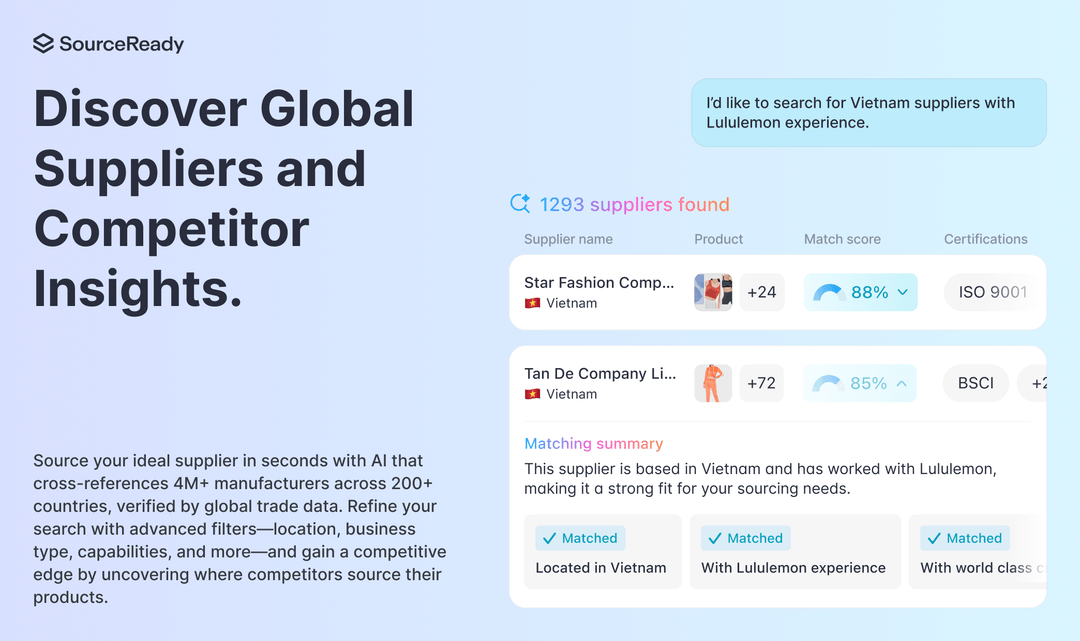
- Turn market signals into product lists: AI scans Amazon, Google, and TikTok to identify emerging trends, then turns them into structured product lists with specs, pricing benchmarks, and real customer feedback—so you can validate ideas before sourcing.
- Find verified suppliers: You access real data (export records, supplier profiles), reducing the risk of choosing unreliable partners and ensuring suppliers actually produce what they claim.
- Match suppliers faster: Instead of manually filtering, you get ranked suppliers based on your requirements (MOQ, certifications, pricing), helping you quickly narrow down to the most relevant options.
- Evaluate beyond price: You can assess production capacity, specialization, and reliability—critical factors for scaling beyond your first order.
- Streamline RFQs: Structured requests allow you to compare suppliers efficiently, reduce back-and-forth, and make faster, more confident decisions.
Conclusion
Private label in 2026 is no longer about chasing trends—it’s about making disciplined sourcing decisions. The products that win are backed by real demand, clear differentiation, and suppliers that can deliver consistently at scale. If you align your product choice with the right manufacturing capabilities and validate early, you reduce risk significantly. Don’t try to launch everything at once. Start with one focused product, test it properly, and build from there.
Pick a category from this list and use SourceReady to identify, compare, and validate suppliers before placing your first order.
FAQ
1. How do I find reliable suppliers?
You should:
- Verify supplier credentials and export history
- Request samples and test quality
- Compare multiple suppliers before deciding
Using tools like SourceReady helps you find verified suppliers faster and reduce risk.
2. What products should beginners avoid?
Beginners should avoid:
- Highly regulated products (e.g., supplements, medical devices)
- Complex electronics
- Products with high return risk (fragile or inconsistent quality)

Find the sourcing tools you need.
Explore how SourceReady helps you research products, discover suppliers, verify factory information, analyze trade data, and manage your sourcing workflow in one place
Explore Features
Graduating from USC with a background in business and marketing, Judy Chen has spent over a decade working in e-commerce, specializing in sourcing and supplier management. Her experience includes developing strategies to optimize supplier relationships and streamline procurement processes for growing businesses. As SourceReady’s blog writer, Judy leverages her deep understanding of sourcing challenges to create insightful content that helps readers navigate the complexities of global supply chains.