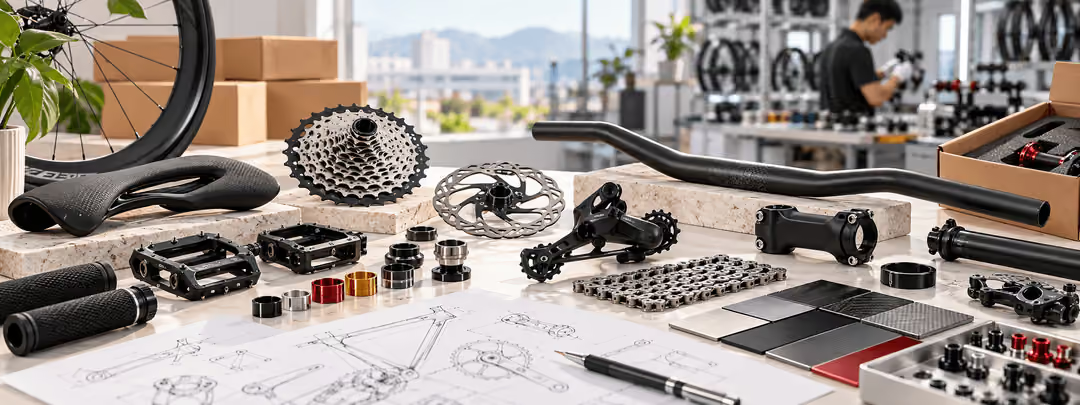
China remains one of the world’s largest manufacturing bases for bicycles and bicycle components. In 2024 alone, China exported about $1.12 billion of bicycle frames, forks, and related parts. Its supplier ecosystem covers everything from frames, wheels, drivetrains, and braking systems to pedals, saddles, accessories, and e-bike components.
For buyers, the opportunity is significant, but so is the supplier-selection challenge. You need to compare manufacturing capability, cost, export experience, quality, and supply-chain risk.
In this article, we’ll cover why China remains an important sourcing market, where to find bicycle parts suppliers, and how to build a stronger supplier shortlist.

There's a better way to source ❤️
Watch the video to see how SourceReady helps brands move from product ideas to trusted supplier relationships faster
Watch the VideoWhy should you source bicycle parts from China?
China remains one of the most important sourcing markets for bicycles and bicycle components. The advantage is not simply lower manufacturing cost. Buyers can access a large supplier base, mature manufacturing clusters, and a highly developed upstream component ecosystem.
1. Large and specialized supplier base
China has manufacturers covering almost every major bicycle component category, from relatively simple accessories to precision-engineered and electronic parts.
You can source products including:
- Frames and forks: Aluminum, steel, carbon fiber, and other constructions are widely available across different price and performance levels.
- Drivetrain components: Factories manufacture cranks, chainrings, cassettes, freewheels, chains, bottom brackets, and related parts.
- Wheels and hubs: Suppliers cover rims, spokes, hubs, complete wheelsets, tires, tubes, and related hardware.
- Braking components: You can find suppliers for mechanical and hydraulic brakes, rotors, brake levers, cables, and pads.
- Contact points: Pedals, saddles, seat posts, handlebars, stems, and grips are widely manufactured.
- E-bike components: China also has extensive production capacity for motors, controllers, displays, batteries, wiring systems, and other electronic components.
This depth gives you more room to compare factories based on capability, quality, MOQ, lead time, and cost.
2. Mature manufacturing ecosystem
Bicycle manufacturing does not happen in isolation. A finished component may depend on aluminum extrusion, forging, CNC machining, plastic injection molding, welding, heat treatment, painting, anodizing, electronics, packaging, and multiple other processes.
China has dense industrial clusters where these capabilities operate close together.
This can give you several sourcing advantages:
- Process availability: Factories can access specialized upstream processes without developing everything in-house.
- Shorter supply chains: Nearby material, component, tooling, and finishing suppliers can reduce coordination complexity.
- Faster product development: Prototypes, tooling changes, finishing adjustments, and packaging revisions can often be coordinated within the same manufacturing region.
- Component consolidation: You may be able to source multiple bicycle parts from factories operating within the same cluster.
However, subcontracting still needs to be documented. If your supplier outsources heat treatment, anodizing, painting, or another critical process, you should know who performs it and how quality is controlled.
3. Competitive manufacturing economics
China can be cost-competitive for bicycle parts because many of the inputs and processes needed to make them are already available at scale within established manufacturing clusters.
- Lower input costs: Large domestic supply chains for aluminum, steel, plastics, bearings, fasteners, and electronics can reduce material and component costs.
- Economies of scale: Many factories produce for both domestic and export markets, allowing them to spread tooling, equipment, and overhead across larger volumes.
- Localized supply chains: Components, machining, finishing, packaging, and assembly can often be sourced within the same region, reducing transport and coordination costs.
- Strong supplier competition: A large number of manufacturers competing for similar orders can help buyers secure more competitive pricing.
This does not mean the lowest Chinese quote is always the cheapest option. You should still compare total landed cost, including freight, tariffs, testing, and quality risk.
Where should you look for bicycle parts suppliers in China?
China’s bicycle industry is concentrated in several regional manufacturing clusters. Choosing the right region can help you find suppliers with deeper experience in the specific component, price segment, or production process you need.
1. Tianjin and Hebei
Tianjin and neighboring Hebei form one of China’s largest bicycle manufacturing regions, with a particularly strong concentration of complete bicycles, children’s bicycles, e-bikes, and components.
Several specialized hubs stand out.
- Tianjin Wangqingtuo: One of China’s best-known bicycle manufacturing bases, with a large concentration of conventional bicycles, e-bikes, components, assembly operations, and supporting suppliers.
- Hebei Pingxiang: A major manufacturing cluster for bicycle components and children’s bicycles, with a particularly dense network of parts manufacturers.
- Hebei Lutai: Known for bicycle component manufacturing and supporting industrial capacity.
- High-volume production: The region is particularly suitable when you need scalable manufacturing for standardized or mass-market components.
- Broad supplier coverage: Buyers can access complete-bike manufacturers alongside factories producing wheels, saddles, frames, pedals, hardware, and other components.
For high-volume or cost-sensitive sourcing, this region should usually be one of the first places you investigate.
2. Jiangsu and Shanghai
Jiangsu and the greater Shanghai manufacturing region are important for more advanced bicycle manufacturing, precision parts, established exporters, and higher-end production.
- Kunshan and Taicang have developed particularly strong bicycle manufacturing ecosystems, supported in part by Taiwanese and international manufacturers that established operations in the region.
- Kunshan and Taicang: These areas have developed strong ecosystems for bicycle assembly, precision components, machining, and higher-specification manufacturing.
- Precision manufacturing: The wider Jiangsu industrial base offers strong capabilities in CNC machining, metal fabrication, tooling, electronics, and engineered components.
- International supply chains: The region has long-standing links with global bicycle companies and export markets.
- Changzhou: Another important manufacturing location with bicycle and component production capacity.
- Shanghai: Although manufacturing has shifted outward over time, Shanghai remains connected to the bicycle industry through established companies, engineering resources, logistics, and the surrounding Yangtze River Delta supply chain.
This region can be particularly relevant if you are sourcing performance-oriented, precision-engineered, or more customized components.
3. Zhejiang
Zhejiang has extensive manufacturing capacity across hardware, metalworking, machinery, plastics, and consumer products, making it a useful region for a wide range of bicycle parts and accessories.
The province is especially relevant when your component depends on mature metal-processing or general industrial manufacturing capabilities.
- Mechanical components: Suppliers manufacture pedals, hubs, freewheels, cranks, fasteners, and related parts.
- Metal processing: Factories can offer forging, die-casting, stamping, CNC machining, polishing, and finishing.
- Accessories: Zhejiang has broad manufacturing capacity for locks, bells, pumps, baskets, racks, lighting products, and other bicycle accessories.
- Supplier flexibility: The region’s large SME manufacturing base can be useful when you need customized products, multiple sourcing options, or relatively flexible production runs.
- Zhejiang is particularly useful when the bicycle component overlaps with industries such as hardware, metal fabrication, plastics, or consumer accessories.
4. Guangdong
Guangdong becomes increasingly relevant as bicycles incorporate electronics, carbon fiber, connected devices, and more sophisticated components.
The province benefits from the broader Pearl River Delta manufacturing ecosystem, including electronics, batteries, tooling, plastics, composites, and precision manufacturing.
- Guangzhou Huadu: The district has manufacturers focused on higher-value bicycle production, including carbon-fiber frames and precision components.
- E-bike components: Guangdong is well positioned for motors, controllers, displays, wiring assemblies, chargers, batteries, and electronic accessories.
- Electronics integration: Proximity to Shenzhen and the wider electronics supply chain can make it easier to source and integrate electronic systems.
- Carbon and precision parts: Buyers looking for higher-specification frames or engineered components may find relevant suppliers in the region.
- Connected accessories: Lights, GPS devices, electronic locks, displays, and smart bicycle accessories benefit from the surrounding electronics ecosystem.
For e-bikes or products that combine mechanical and electronic components, Guangdong can be particularly valuable.
How can SourceReady help you find bicycle parts suppliers in China?
SourceReady helps sourcing teams find and evaluate manufacturers by combining AI with real-world supplier, trade, compliance, and risk data. Its database covers more than 4 million suppliers across 200+ countries and draws on more than 40 data sources.
Instead of relying only on marketplace listings or supplier claims, you can search for bicycle parts manufacturers and compare them using multiple signals.
- Supplier discovery: Search for manufacturers producing frames, hubs, pedals, braking components, saddles, e-bike systems, and other bicycle products using natural-language or structured criteria.
- Trade intelligence: Review available shipment history, product descriptions, buyers, export markets, and trading frequency to understand a supplier’s actual commercial activity.
- Supplier comparison: Compare potential manufacturers using consistent company, product, trade, certification, and risk information.
- Sanctions screening: Check suppliers against sanctions and risk databases before moving forward with qualification.
- Geopolitical exposure: Understand where suppliers, customers, and supply relationships are concentrated so you can identify dependencies on particular countries or regions.
- Tariff and landed-cost analysis: Compare sourcing locations using tariff and import-cost considerations rather than relying only on quoted unit price.
- Supply-chain diversification: Identify alternative suppliers in China or other manufacturing countries if tariffs, geopolitical developments, trade restrictions, or regional concentration make diversification necessary.
SourceReady does not replace factory audits, samples, testing, or quality inspections. It helps you reach those stages with a more informed supplier shortlist and a clearer understanding of the supply-chain risks around each option.
What is the best way to find bicycle parts suppliers in China?
China offers one of the world’s deepest bicycle manufacturing ecosystems, from high-volume components and children’s bicycle parts to precision components, carbon-fiber products, and e-bike electronics.
Start with the manufacturing region that best matches your product. Then compare suppliers based on production capability, export activity, cost, quality, and supply-chain risk rather than price alone.
SourceReady can help you search and compare bicycle parts suppliers using supplier, trade, compliance, tariff, and geopolitical risk data in one workflow. Use SourceReady to build a stronger shortlist before moving into RFQs, samples, audits, and production.

Find the sourcing tools you need.
Explore how SourceReady helps you research products, discover suppliers, verify factory information, analyze trade data, and manage your sourcing workflow in one place
Explore Features
Graduating from USC with a background in business and marketing, Judy Chen has spent over a decade working in e-commerce, specializing in sourcing and supplier management. Her experience includes developing strategies to optimize supplier relationships and streamline procurement processes for growing businesses. As SourceReady’s blog writer, Judy leverages her deep understanding of sourcing challenges to create insightful content that helps readers navigate the complexities of global supply chains.