Belgium looks small on the map, but it behaves like a manufacturing and logistics heavyweight. It’s deeply integrated into European value chains in chemicals, pharmaceuticals, machinery, food, and logistics, and it hosts one of Europe’s most strategic ports for global trade.
For you, that means Belgium is less about chasing the lowest unit cost and more about securing reliable, compliant, and time-efficient supply for critical SKUs. If your catalog includes regulated products, complex formulations, or premium-positioned goods, Belgium can be a stabilizing anchor in your sourcing mix.
In this guide, you’ll get:
- A clear view of why Belgium is worth considering.
- The real challenges you should expect and plan for.
- Key future trends shaping Belgian manufacturing.
- An audit-ready sourcing checklist you can actually use.
You’ll also see where a tool like SourceReady fits in—helping you filter Belgian suppliers by capabilities and certifications, and model sourcing scenarios before you sign anything.

There's a better way to source ❤️
Watch the video to see how SourceReady helps brands move from product ideas to trusted supplier relationships faster
Watch the VideoWhy Sourcing from Belgium
1. Compliance and Quality First
Belgium operates inside one of the world’s strictest regulatory environments. That’s a headache for manufacturers, but a gift for you.
Mature regulatory culture
- Strong alignment with EU rules on product safety, chemicals, pharma, food, and machinery.
- More suppliers already structured around audits, documentation, and traceability.
Predictable quality systems
- Widespread use of ISO, GMP, HACCP, and sector-specific standards.
- Better odds that a new supplier can plug directly into your existing QMS and audit frameworks.
Lower “hidden-risk” cost
- You’re paying more per unit, but less in recalls, rework, and regulatory surprises.
- For safety-critical or brand-critical SKUs, that trade-off is usually worth it.
2. Strategic Logistics Hub
Belgium is a logistics product in its own right.
Gateway into Europe
- Port and inland networks that connect quickly to Benelux, Germany, France, UK, and beyond.
- Ideal for combining manufacturing + regional distribution center in one geography.
Shorter lead times and more routing options
- Greater flexibility when rerouting containers, consolidating shipments, or serving multiple EU markets from a single hub.
- That gives you more room to respond when demand spikes or lanes get disrupted elsewhere.
Efficient for multi-origin strategies
- Belgium can function as your “mixing board” for components and finished goods from other origins, with value-add, packaging, or final assembly done in an EU-compliant environment.
3. Fit for High-Value, High-Margin SKUs
Belgium really shines when your products are complex, regulated, or premium-priced.
Strong in chemicals, pharma, food, machinery, and specialty goods
- Good match if your BOM includes APIs, specialty chemicals, processed foods, or advanced machinery and equipment.
Better for “value density” than volume
- If your product has high value per kilogram or per unit, Belgium’s cost structure is easier to justify.
- You get quality, documentation, and smooth customs clearance to support premium positioning.
Ideal for “critical slice” sourcing
- You don’t have to move your entire supply chain.
- You can allocate critical modules or components to Belgium (e.g., active ingredients, high-risk subassemblies) while maintaining volume production elsewhere.

Top Categories Belgium Is Strong at Manufacturing
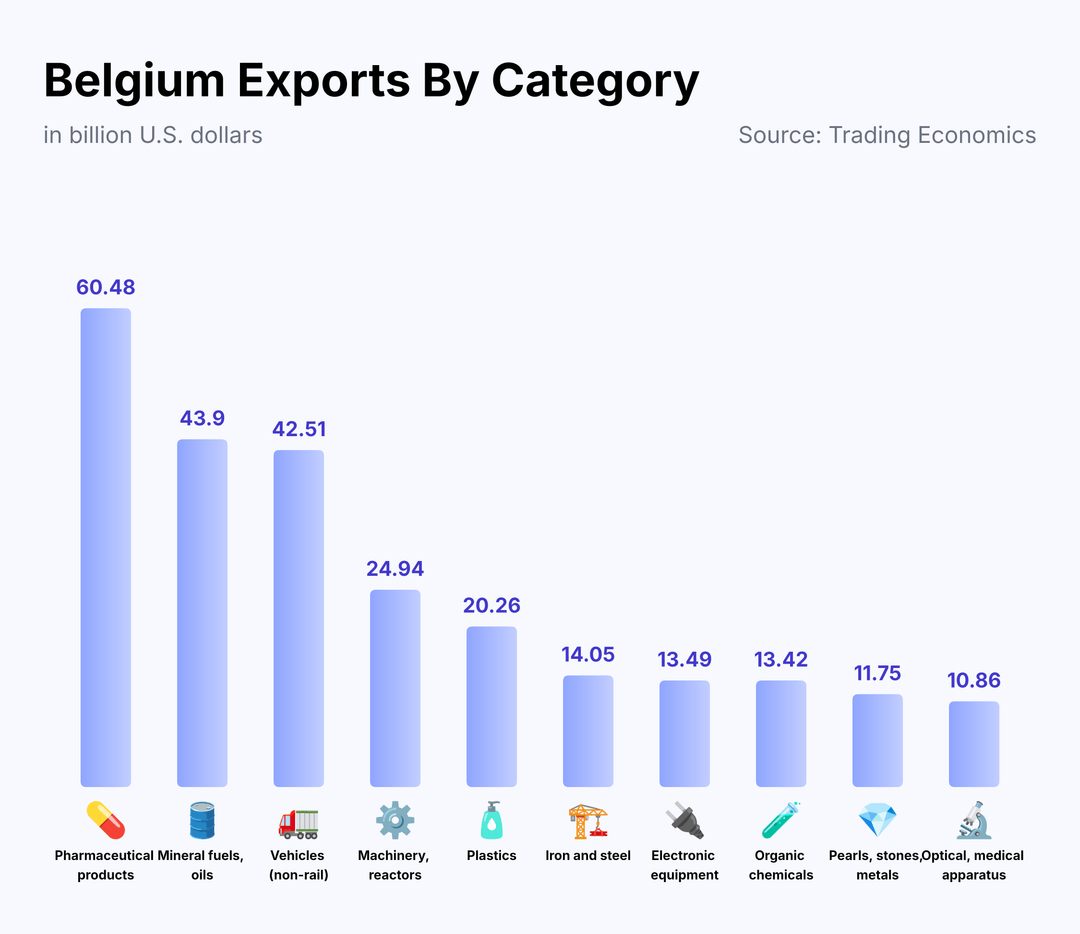
When you zoom out from individual suppliers and look at Belgium’s industrial structure, a few categories clearly dominate in value added, exports, and manufacturing output.
1. Biopharmaceuticals & Healthcare Products
Belgium is a biopharma powerhouse. Biopharmaceuticals now account for close to a fifth of the added value of the entire manufacturing sector, and the sector has grown faster than almost any other in recent
Typical categories:
- APIs and intermediates
- Biologics and sterile injectables
- Finished dosage forms and clinical-trial supplies
Example: Finished drugs (tablets, capsules, injectables), biologics, APIs, basic medical disposables
Why it matters for you:
- Strong GMP culture, data integrity, and regulatory alignment.
- Good fit for high-risk, high-margin SKUs where documentation and reliability are non-negotiable.

2. Chemicals, Plastics & Specialty Materials
Chemicals, plastics, and pharmaceuticals together represent roughly one-third of Belgian exports, backed by a large integrated chemical cluster around Antwerp-Bruges.
Typical categories:
- Base and specialty chemicals
- Polymer resins and compounds
- Coatings, additives, and intermediates
Example: Base chemicals, polymer resins, compounds/masterbatch, coatings and adhesives
Why it matters for you:
- Excellent for formulation-critical components (coatings, additives, solvents) where purity, consistency, and traceability matter.
- Strong fit if your BOM has chemicals that trigger REACH/CLP concerns and you want suppliers already built around EU compliance.
3. Food, Beverage & Ingredients
Food and beverages are consistently one of the largest industrial subsectors by value added and output, alongside pharmaceuticals and chemicals.
Typical categories:
- Processed foods and confectionery
- Beverages (including premium and specialty)
- Functional ingredients and intermediates
Example: Chocolate and cocoa products, frozen fries, biscuits/waffles, dairy items
Why it matters for you:
- Strong food-safety systems (HACCP/ISO 22000, BRC/IFS).
- Ideal for premium SKUs where taste, branding, and compliance all need to align — think “EU quality” with reliable documentation and traceability.
4. Metals, Machinery & Industrial Equipment
Metals, machinery, and equipment together represent a solid chunk of manufacturing production, alongside chemicals, food, and pharmaceuticals.
Typical categories:
- Basic metals and fabricated metal products
- Machinery and industrial equipment
- Process equipment for food, oils, chemicals, and biofuels
Example: Food-processing lines, packaging machines, process equipment, pumps and tanks
Why it matters for you:
- Good fit for specialized machinery, packaging lines, and process equipment rather than ultra-commoditized parts.
- You benefit from EU-standard safety, CE marking, and documentation for installations across Europe.
5. Automotive, Transport & Advanced Components
Automotive and transport-related manufacturing (vehicles, trailers, semi-trailers, and components) also play a material role in Belgian output.
Typical categories:
- Vehicle assembly and subassemblies
- Advanced materials and battery/EV-related components
- Precision parts linked to broader EU automotive supply chains
Example: Vehicles and subassemblies, metal and plastic parts, trailers and related components
Why it matters for you:
- Belgium fits best as part of a wider EU automotive network (Germany, France, etc.), not a standalone low-cost hub.
- Useful when you want tight integration with EU standards, testing, and logistics for automotive or mobility products.

Challenges of Sourcing from Belgium
1. Higher Cost Base
This is not a low-cost country.
- Labor, energy, and regulatory costs are materially higher than many alternative sourcing origins.
- You’ll see it in hourly rates, overhead allocation, and sometimes in MOQs.
- If your margins are razor-thin and your customers refuse to pay for quality, Belgium is a hard sell.
How to manage:
- Use Belgium for high-margin or high-risk SKUs, not commodity ones.
- Build a landed-cost model that includes duty, freight, and risk—not just unit price.
- Negotiate on total value (service, reliability, documentation, lead-time) rather than chasing the lowest number on the quote.
2. Capacity, Lead Time, and Flexibility
Belgian suppliers are often very structured. That’s good for compliance, but less fun when you need last-minute changes.
- Finite capacity in specialized sectors (pharma, chemicals, high-end machinery).
- Longer lead times for custom work or tech transfers.
- Less tolerance for chaotic forecasting or frequent spec changes.
How to manage:
- Lock your specifications and URS early.
- Commit to reliable forecasts and call-off patterns.
- Build buffer stock or flexible contracts for demand swings.
3. Exposure to EU-Level Policy and Disruptions
Belgium doesn’t sit outside the EU—it’s near the center of it.
- Subject to EU-wide trade measures, energy policies, and environmental rules.
- Port and logistics can be affected by strikes, congestion, or regulatory changes.
- Any changes to tariffs or trade relationships with your destination markets can hit landed cost.
How to manage:
- Include tariff and duty scenarios in your cost modeling from day one.
- Use dual-sourcing (Belgium + another EU or non-EU origin) for key SKUs.
- Keep contracts flexible enough to shift volumes if trade conditions change.
Future Trends of Manufacturing in Belgium
1. More Automation and Digitalization
Belgium is steadily pushing toward highly automated, digitally integrated plants.
- Increased use of robotics, MES, and real-time data to offset labour cost and improve consistency.
- Wider adoption of predictive maintenance and digital twins in chemicals, pharma, and machinery.
More suppliers offering integration hooks to your own systems (data feeds, dashboards, EDI, APIs).
What it means for you:
- Better potential for stable quality, traceability, and uptime.
- More structured data sharing, which supports your internal analytics and audits.
- Expect higher upfront engineering costs, but more predictable operations once running.
2. Sustainability and Low-Carbon Manufacturing
Regulators and customers are both pushing Belgium toward greener operations.
- Shift toward lower-emission processes, greener energy sources, and waste reduction.
- Stronger reporting on carbon footprints and sustainability metrics.
- Some suppliers building low-carbon product lines or offering “green” variants of standard products.
What it means for you:
- Easier to support ESG reporting, carbon reduction targets, and eco-label requirements.
- Potential access to preferred supplier status for customers who prioritize sustainable sourcing.
- You may pay a small premium, but it’s easier to prove environmental performance at SKU level.
3. Industry Clustering and Specialization
Belgium is doubling down on clustering—especially around chemicals, life sciences, and advanced manufacturing.
- Deeper geographic clusters of suppliers, research institutions, and logistics partners.
- Stronger talent pools and shared infrastructure (labs, test facilities, specialized logistics).
- Easier to integrate multiple value-chain steps (e.g., formulation, filling, packaging) within a close radius.
What it means for you:
- You can design shorter, more resilient regional supply chains, instead of scattering each step across continents.
- More scope for co-development: joint R&D, customized formulations, or tailored machinery.

Conclusion: Belgium as Your High-Reliability Anchor
Belgium won’t win a race to the lowest unit cost. But when you map your BOM to country strengths, it often wins where it matters most: regulated, complex, or brand-critical SKUs that you can’t afford to get wrong.
The right approach isn’t “Belgium vs the world.” It’s Belgium-plus:
- Use Belgium for high-risk, high-value components and SKUs.
- Use other origins for volume or cost-sensitive parts.
- Evaluate everything through landed-cost modeling, compliance readiness, and dual-sourcing options, not just ex-factory quotes.
A tool like SourceReady helps you operationalize this: upload your BOM, filter for Belgian and alternative suppliers by certifications, performance, and location, and run sourcing scenarios before you commit.
Your next step: pick a pilot set of 10–20 critical SKUs, run them through the checklist above, and see whether a Belgium-plus mix reduces your risk and stabilizes your supply. That’s how you turn this guide into a concrete, defensible sourcing strategy.
FAQ
1. How do I decide which SKUs to move to Belgium first?
Start with SKUs that tick at least two of these:
High regulatory exposure (health, safety, environment)
High brand impact (hero products, flagship lines)
High margin (you can actually afford better origin)
Painful quality or compliance history in other origins
If it’s low-margin, low-risk, and easy to replace, Belgium is usually not your first stop.
2. How do I avoid “tourist sourcing” — one visit, no results?
Before you fly in or hit trade shows, do this:
Define 3–5 clear sourcing goals (category, volume, timing, certifications)
Shortlist 10–20 suppliers in advance using data (e.g., SourceReady, clusters, associations)
Book structured meetings with decision-makers, not just booth chats
If you arrive with no list and no plan, you’ll leave with brochures and no pipeline.

Find the sourcing tools you need.
Explore how SourceReady helps you research products, discover suppliers, verify factory information, analyze trade data, and manage your sourcing workflow in one place
Explore Features
Graduating from USC with a background in business and marketing, Judy Chen has spent over a decade working in e-commerce, specializing in sourcing and supplier management. Her experience includes developing strategies to optimize supplier relationships and streamline procurement processes for growing businesses. As SourceReady’s blog writer, Judy leverages her deep understanding of sourcing challenges to create insightful content that helps readers navigate the complexities of global supply chains.