
The “invisible” smart home is shaping home and kitchen product development in 2026. Instead of visible gadgets, technology is embedded directly into fixtures, lighting, and appliances to automate everyday tasks. For sourcing teams, this means evaluating products as integrated systems combining hardware, sensors, and firmware. However, identifying viable opportunities requires continuous market visibility. SourceReady helps product teams track emerging products, supplier activity, and category signals across global markets, enabling faster product research and smarter sourcing decisions.
Here's the report to the trending products!

There's a better way to source ❤️
Watch the video to see how SourceReady helps brands move from product ideas to trusted supplier relationships faster
Watch the VideoWhat Is the “Invisible” Smart Home?
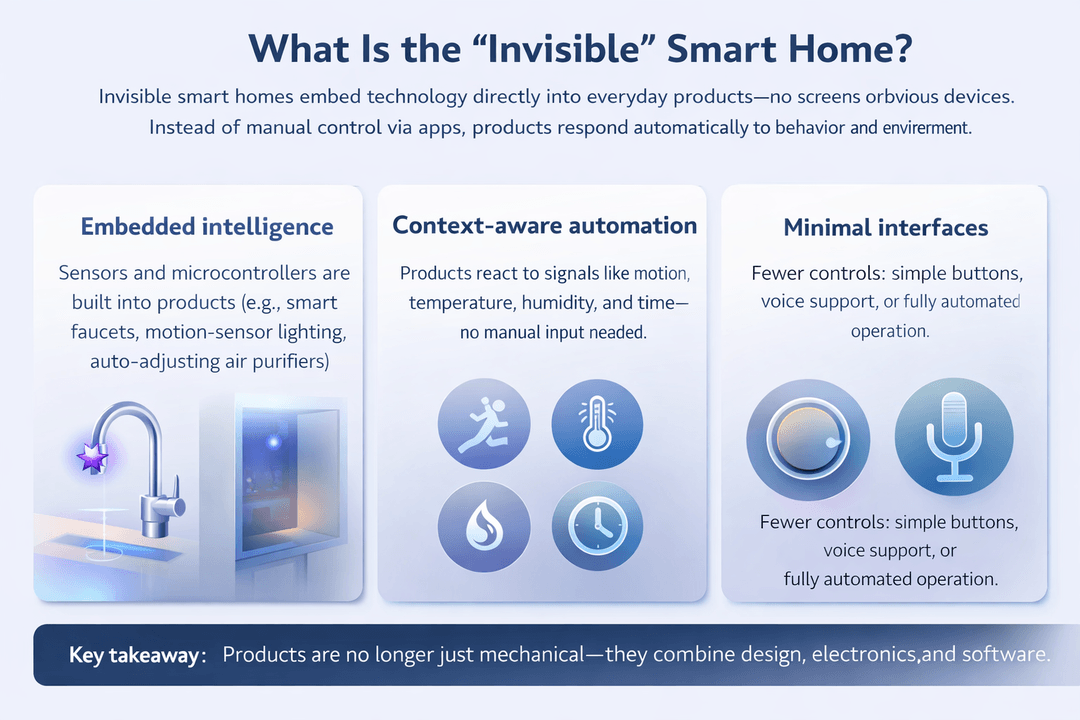
The invisible smart home refers to technology embedded into products without obvious interfaces or visible devices. Instead of adding screens or standalone smart gadgets, intelligence is integrated directly into everyday household items.
Earlier smart home products relied on heavy interaction. Users needed to open apps, configure settings, and manually trigger commands. Invisible smart products remove much of that friction by responding to environmental signals and routine behaviors.
Three characteristics typically define these products.
1. Embedded intelligence
Sensors and microcontrollers are built directly into the product.
Examples include:
- Faucets with integrated temperature memory
- Cabinet lighting with internal motion sensors
- Air purifiers that automatically monitor air quality
Users interact with the product normally while the automation runs in the background.
2. Context-aware automation
Products respond to signals such as:
- motion
- humidity
- temperature
- time of day
Instead of adjusting controls manually, the system reacts automatically.
3. Minimal interfaces
Invisible smart products intentionally reduce visible controls. Many operate with:
- one or two physical buttons
- voice control compatibility
- automated routines
For sourcing teams, the key takeaway is simple: the product is no longer purely mechanical. It is a hybrid of industrial design, electronics, and software.
Why Are Brands Moving Toward Invisible Smart Homes?
Several market shifts are driving this trend.
1. Consumers want technology that disappears
Interior design trends increasingly favor clean, uncluttered living spaces. Visible smart gadgets often conflict with this aesthetic.
Invisible smart products allow brands to deliver automation while preserving minimal design.
2. Smart home fatigue is increasing
Many households already own multiple smart devices from different brands. Each often requires its own app, setup process, and ecosystem.
Consumers are shifting toward products that work automatically instead of demanding constant management.
3. Hardware costs are falling
Sensors, wireless modules, and microcontrollers have become significantly cheaper. This allows manufacturers to integrate intelligence into products that previously could not support it economically.
4. Connectivity ecosystems are stabilizing
Standards and integrations across platforms are improving. This makes it easier to build connected products without forcing consumers into closed ecosystems.
For brands and sourcing teams, the invisible smart home represents a shift from selling gadgets to delivering quiet functionality.
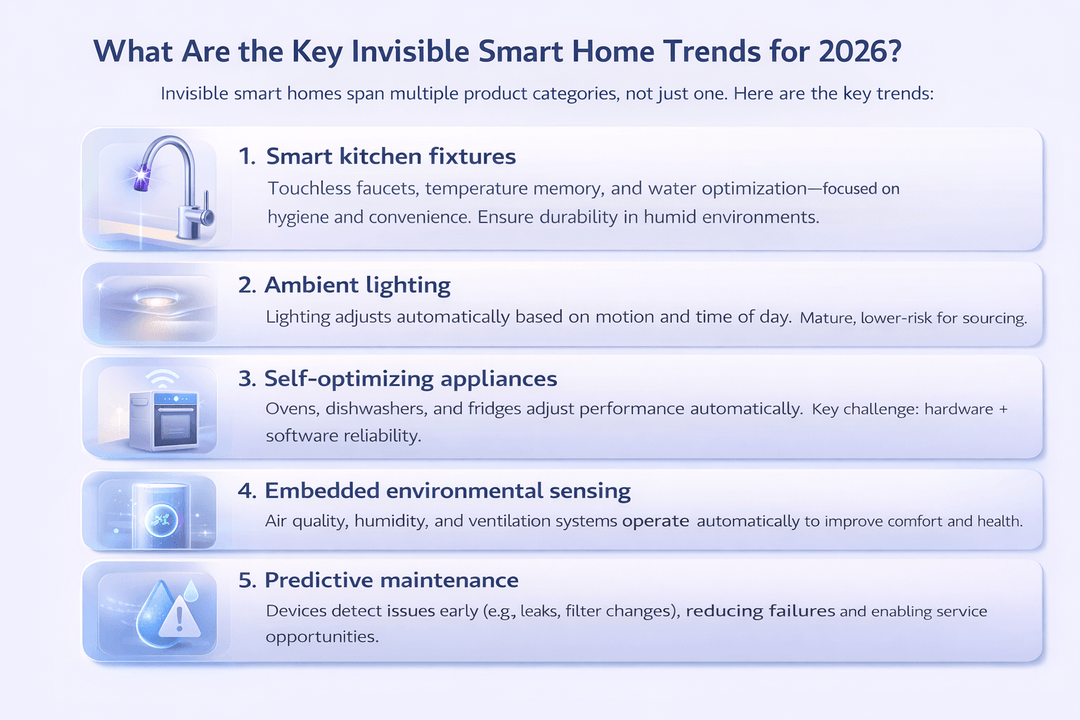
What Are the Key Invisible Smart Home Trends for 2026?
The invisible smart home is not a single product category. It is a broader shift across several home and kitchen product types.
Below are the most important sourcing trends shaping this space.
1. Smart Kitchen Fixtures That Automate Everyday Tasks
Kitchen fixtures are becoming one of the fastest-growing invisible smart categories.
Because these products are used constantly, small automation improvements can create noticeable convenience.
Common features include:
- Touchless faucets with motion detection
- Temperature memory systems that recall preferred water settings
- Water flow optimization to reduce consumption
These products appeal strongly in markets emphasizing hygiene and sustainability.
However, sourcing teams should verify that sensors and electronics are designed for high humidity and temperature exposure, which are common in kitchen environments.
2. Ambient Lighting That Adjusts Automatically
Lighting remains one of the most mature invisible smart home categories.
Instead of manual brightness adjustments, lighting systems respond automatically to environmental signals.
Examples include:
- under-cabinet lighting triggered by cabinet movement
- kitchen lighting that adjusts brightness depending on time of day
- hallway lights that activate softly at night
The underlying technology—motion sensors, daylight sensors, and dimming controllers—is relatively stable. This makes lighting one of the lower-risk categories for sourcing.
3. Appliances That Self-Optimize Energy and Performance
Modern appliances increasingly include internal sensors that adjust operation automatically.
Examples include:
- ovens that adapt cooking temperatures based on food type
- dishwashers that detect load size and optimize water usage
- refrigerators that adjust cooling patterns to preserve food longer
These features help reduce energy consumption and improve performance.
For sourcing teams, the challenge is ensuring hardware reliability and firmware stability work together seamlessly.
4. Environmental Monitoring Embedded Into Household Products
Air quality and environmental sensing are being integrated into everyday household devices.
Examples include:
- range hoods that activate automatically when cooking smoke is detected
- air purifiers that adjust filtration speed based on air quality
- ventilation systems that monitor humidity levels
This type of automation improves comfort and indoor health without requiring manual interaction.
5. Predictive Maintenance and Self-Monitoring Devices
Another emerging trend is self-monitoring home appliances.
Instead of waiting for equipment to fail, products can detect early performance changes and notify users.
Examples include:
- dishwasher filter replacement alerts
- water leak detection systems
- ventilation filter monitoring
For homeowners and property managers, this reduces unexpected maintenance issues.
For brands, it also creates opportunities for aftermarket replacement products and services.
How Should You Evaluate Suppliers for Invisible Smart Products?
Invisible smart home products combine traditional manufacturing with electronics and software integration. As a result, supplier evaluation requires a broader technical review.
Three capabilities are especially important.
1. Hardware integration capability
Suppliers must be able to integrate sensors and electronics into durable consumer products.
Key questions include:
- Are printed circuit boards (PCBs) produced internally or outsourced?
- Which sensor manufacturers are used?
- How are electronics protected from moisture, grease, and heat?
Kitchen environments place significant stress on electronic components.
2. Firmware and connectivity expertise
Many factories can assemble electronics. Far fewer can maintain reliable firmware.
You should confirm:
- how firmware updates are delivered
- whether software support continues after production
- who owns the firmware intellectual property
Products without long-term firmware support risk becoming unreliable over time.
3. Certification readiness
Connected appliances must meet additional regulatory requirements.
Common certifications include:
- FCC: Wireless compliance in the United States
- CE: Safety and electromagnetic compatibility in the EU
- RoHS: Restriction of hazardous materials
- UL / ETL: Electrical safety testing
If the product transmits user data, additional cybersecurity regulations may apply depending on the market.
How SourceReady Supports Product Research for 2026 Trends
As home and kitchen trends become more fragmented, faster-moving, and subcategory-specific, product teams need continuous market intelligence—not occasional reports.
In 2026, waiting for trade shows or distributor feedback often means the trend has already peaked.
SourceReady’s product research feature helps teams identify product opportunities earlier by analyzing structured signals from real market activity.
Continuous Product Discovery Across Global Markets
SourceReady’s AI agents continuously scan:
- global supplier websites
- online marketplaces
- brand launch pages
- emerging product category listings
This surfaces signals such as:
- new product designs entering the market
- packaging innovations and material changes
- feature positioning trends
- expansion into emerging subcategories
Instead of relying on annual forecasts, you gain ongoing visibility into live product development activity.
This supports earlier:
- concept development
- supplier sourcing planning
- product design alignment
Smarter, More Local Market Insight
Product trends rarely scale evenly across regions.
When you run a product research query, SourceReady prioritizes local and regional signals.
For example:
- A search for smart kitchen fixtures in Japan emphasizes Japanese marketplaces and brands first.
- A query for touchless faucets in the Middle East prioritizes regional retailers and distributors.
This prevents distortion from global averages.
You see what is actually selling in that specific market, rather than what appears popular elsewhere.
For sourcing teams, localized insights matter because:
- regulatory requirements vary by region
- consumer preferences differ
- acceptable price ranges change by market
Localized analysis reduces the risk of launching products that do not match regional demand.
Market Analysis to Evaluate Category Potential
Trend visibility alone is not enough. Product teams need to understand whether a category has real commercial potential.
SourceReady provides structured market views including:
- estimated market size and growth direction
- core consumer regions
- signals of category maturity
- competitive density indicators
This allows teams to distinguish between:
- early-stage growth segments
- saturated product categories
- short-lived viral trends
Instead of reacting emotionally to trend noise, you evaluate opportunities using structured data signals.
Price and Competitor Context Before You Commit
Product research is incomplete without understanding price positioning.
SourceReady enables teams to analyze:
- price ranges across regions and platforms
- relative positioning of leading brands
- premium versus mass-market clustering
- pricing signals from competing SKUs
This supports:
- margin modeling
- packaging cost planning
- feature-cost tradeoff decisions
- retail pricing strategy
Instead of designing a product first and calculating price later, teams can align product features, manufacturing costs, and pricing strategy early in development.
Conclusion
The invisible smart home reflects a shift from visible technology to quiet automation embedded in everyday products. Instead of adding more gadgets, brands are integrating sensors, connectivity, and intelligence into fixtures, lighting, and appliances that people already use daily.
For sourcing teams, this means evaluating products as integrated systems, not just hardware. Sensor quality, electronics reliability, and supplier technical capability now play a larger role in product success. At the same time, trends in this category evolve quickly across regions and product subcategories.
Tools like SourceReady help teams stay ahead by providing continuous visibility into emerging products, supplier activity, and market signals. With structured product research and real-time insights, sourcing teams can identify viable opportunities earlier and make more confident product decisions.
Want to explore emerging product trends and suppliers faster? Start researching your next product idea with SourceReady today.
FAQ
1. How do invisible smart products improve energy efficiency?
Many invisible smart devices include adaptive energy management features. For example:
- appliances adjust power usage based on load size
- lighting systems adapt brightness depending on daylight levels
- ventilation systems activate only when needed
These optimizations reduce unnecessary energy consumption without requiring manual adjustments.
2. Are invisible smart homes more expensive to manufacture?
Not necessarily. While electronics integration increases product complexity, sensor and wireless component costs have dropped significantly in recent years. Many manufacturers can now integrate basic automation features without dramatically increasing production costs.
However, product development and firmware maintenance can add operational costs over time.

Find the sourcing tools you need.
Explore how SourceReady helps you research products, discover suppliers, verify factory information, analyze trade data, and manage your sourcing workflow in one place
Explore Features
Graduating from USC with a background in business and marketing, Judy Chen has spent over a decade working in e-commerce, specializing in sourcing and supplier management. Her experience includes developing strategies to optimize supplier relationships and streamline procurement processes for growing businesses. As SourceReady’s blog writer, Judy leverages her deep understanding of sourcing challenges to create insightful content that helps readers navigate the complexities of global supply chains.