
Finding a new product opportunity is only useful if you can identify the right suppliers quickly enough to act on it. Yet many sourcing teams still treat product research, supplier discovery, qualification, and comparison as separate activities. Information gets copied between spreadsheets, databases, emails, and supplier profiles, while teams repeatedly research the same questions.
That slows decisions and makes it harder to understand why a supplier was shortlisted in the first place.
A better approach connects product intelligence directly to supplier intelligence. In this article, we’ll look at why shortening that process matters, how AI can remove manual work, and how SourceReady supports the workflow from initial research to a defensible supplier shortlist.
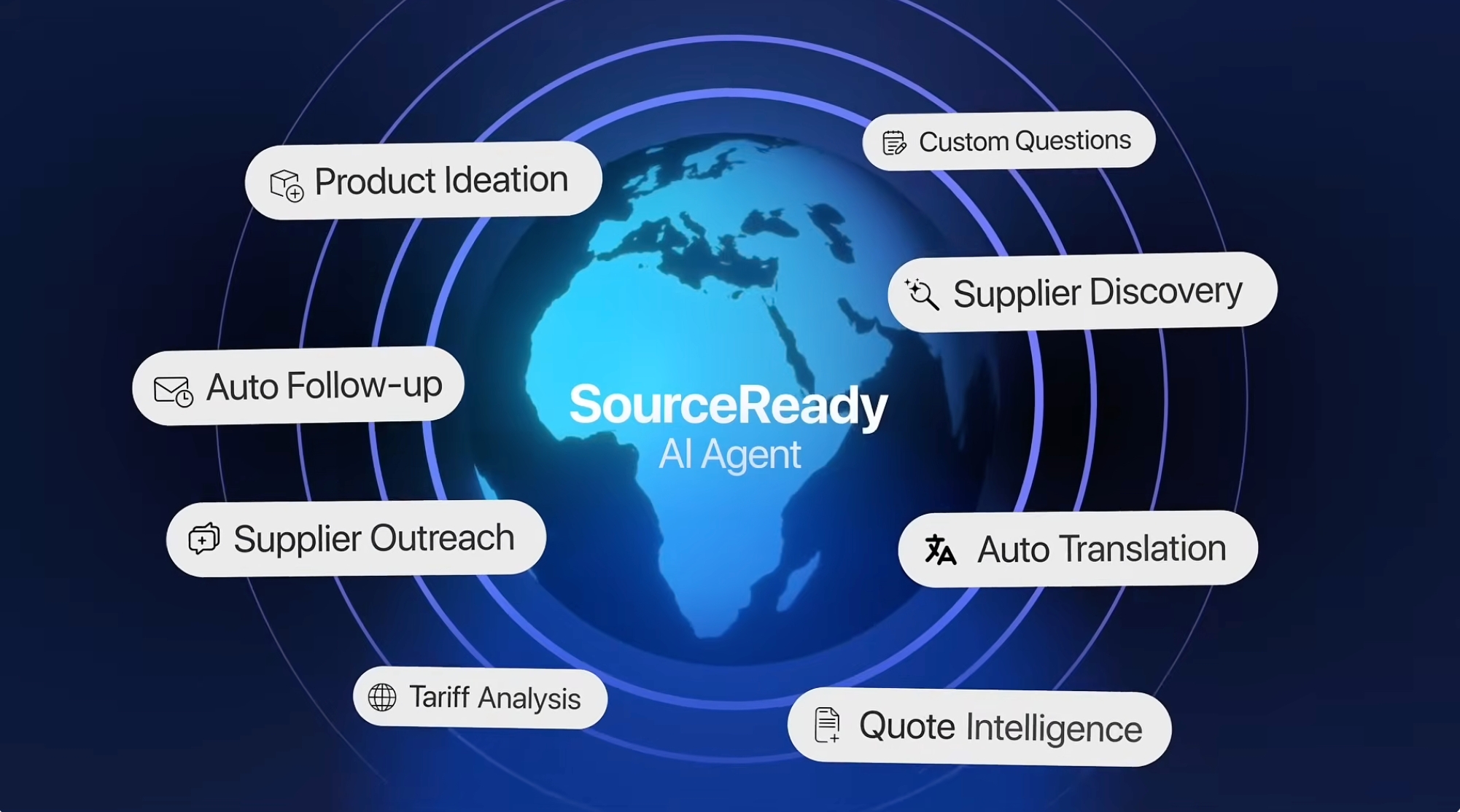
There's a better way to source ❤️
Watch the video to see how SourceReady helps brands move from product ideas to trusted supplier relationships faster
Watch the VideoWhy is it important to go from product research to a supplier shortlist faster?
For brands and retailers, the process starts before supplier search. First, you need to spot the right product opportunity. Then you need to determine whether you can actually source it at the right cost, quality, risk level, and speed.
Both affect revenue.
If you identify an emerging product trend too late, competitors may already have captured demand. If you identify the opportunity early but spend months finding a capable supplier, you can still miss the market window.
A faster research-to-shortlist workflow helps you improve both sides of the equation.
- Spot opportunities earlier: Analyze product trends, competitor assortments, pricing, consumer demand, and market signals before an opportunity becomes obvious to everyone.
- Validate commercial potential: Understand target pricing, product attributes, sourcing regions, and likely costs before committing significant development resources.
- Find reliable suppliers faster: Identify manufacturers with relevant capabilities, trade history, certifications, and production experience.
- Launch sooner: Reduce the time between identifying an opportunity and moving into sampling, product development, and production.
- Test more ideas: Lower research effort makes it practical to investigate more product opportunities instead of concentrating resources on only a few.
- Protect margins: Earlier visibility into supplier options, costs, tariffs, MOQs, and sourcing regions helps you assess whether the opportunity can meet your margin targets.
The commercial advantage comes from connecting the two activities. Product research tells you where the opportunity is; supplier intelligence tells you whether you can execute on it.
The faster you can answer both questions, the faster you can decide whether to pursue, modify, or walk away from an opportunity.
How can AI help you move from product research to supplier shortlist faster?
AI is particularly useful for the repetitive work between identifying an opportunity and deciding which suppliers deserve your attention.
It can analyze large amounts of product and market information, turn unstructured requirements into structured criteria, search much larger supplier datasets, enrich potential suppliers, and compare candidates consistently.
The important distinction is that AI should help automate research and analysis, not blindly automate the final sourcing decision.
How can AI improve product research?
Product research traditionally requires teams to move between marketplaces, trend platforms, competitor websites, reports, spreadsheets, and internal sales data. AI can help consolidate and analyze those signals much faster.
- Trend identification: Analyze changes in product categories, materials, features, pricing, and consumer interest to identify emerging opportunities.
- Competitor monitoring: Track competitor assortments, launches, pricing, product attributes, and sourcing activity to understand where the market is moving.
- Product comparison: Compare large numbers of products to identify common attributes, gaps, and differentiators.
- Opportunity analysis: Combine demand signals, competitive intensity, pricing, and sourcing considerations to prioritize ideas worth investigating.
- Requirement creation: Turn product concepts, briefs, images, or existing products into structured specifications that can feed directly into supplier search.
The output should not simply be another market report. It should give your sourcing team a clearer answer to: What should we investigate next, and what would we need from a supplier to make it viable?
How can AI accelerate supplier discovery and qualification?
Once an opportunity is defined, the same structured information can become the basis for supplier discovery.
A typical workflow can look like this:
- Define the opportunity: Structure the product, commercial, geographic, and compliance requirements.
- Discover suppliers: Search manufacturers that appear to match those requirements.
- Enrich candidates: Add trade records, certifications, corporate information, product evidence, and relevant risk signals.
- Remove poor fits: Eliminate suppliers that clearly fail mandatory requirements.
- Compare candidates: Normalize supplier information into common evaluation criteria.
- Build the shortlist: Prioritize suppliers with the strongest combination of fit, evidence, and commercial potential.
AI is especially valuable because supplier research rarely depends on one source. Your team may need to connect supplier websites, customs records, certification databases, directories, corporate information, and internal history.
AI can bring those signals together without requiring a sourcing manager to manually research every supplier across multiple systems.
What should AI not replace?
A faster shortlist is still only the beginning of supplier qualification.
- Supplier conversations: You still need to validate responsiveness, technical understanding, and commercial flexibility.
- Samples and testing: Product quality needs to be tested rather than inferred from supplier data.
- Factory assessment: Higher-risk categories may still require audits or physical assessments.
- Commercial negotiation: Pricing, MOQs, payment terms, capacity, and lead times need direct confirmation.
- Final judgment: Your team still needs to determine which trade-offs make sense for the business.
AI should help you reach those human decisions faster and with better information.
How does SourceReady help you move from research to a shortlist?
SourceReady connects product intelligence, supplier intelligence, cost benchmarking, and sourcing workflows so you can move from identifying an opportunity to finding and evaluating suppliers without rebuilding the research process across multiple systems.
At the foundation is SourceReady’s database of more than 4 million suppliers across 200+ countries, powered by data from 40+ trusted sources, including customs data, trade shows, supplier directories, certification databases, corporate records, product data, and other supply-chain sources.
That means you are not limited to what a supplier says on its website or how well it ranks in a directory. You can investigate suppliers using multiple independent signals and carry that evidence into your shortlist.
What information can you research in SourceReady?
SourceReady supports both sides of the workflow: understanding what products are worth pursuing and determining which suppliers are best positioned to produce them.
- Product intelligence: SourceReady scans Amazon, Google, and TikTok to build structured lists of emerging trends, including product specifications, pricing, reviews, and other market signals that help you identify new opportunities.
- Competitive intelligence: Analyze competitor products, sourcing activity, suppliers, and manufacturing regions to understand how other companies are approaching the category.
- Supplier discovery: Search SourceReady’s database of 4M+ suppliers by product category, materials, manufacturing capability, geography, customer relationships, certifications, and other relevant attributes.
- Customs intelligence: Review shipment activity, traded products, export markets, buyers, and sourcing relationships where records are available.
- Certification intelligence: Identify and verify relevant compliance, quality, and sustainability certifications.
- Corporate intelligence: Enrich supplier profiles with company, ownership, financial, and other available business information.
- Cost benchmarking: Compare supplier quotations and sourcing options against product, customs, tariff, and market data to understand whether proposed costs are competitive and where potential savings may exist.
This makes it possible to carry context directly from product opportunity discovery into supplier search.
For example, you might identify growing interest in a particular type of recycled polyester polo shirt, understand the features and pricing that are performing well, and then immediately search for suppliers with relevant materials, certifications, production capabilities, and export history.
How does SourceReady help you build a more defensible shortlist?
Rather than generating a long list of supplier names, SourceReady can help you organize and compare candidates against consistent criteria.
- Product fit: Relevant categories, materials, and manufacturing capabilities
- Trade evidence: Shipment activity, markets, products, and customer relationships
- Compliance: Relevant certifications and available verification
- Commercial fit: Scale, geography, MOQ, capacity, and lead-time considerations
- Cost competitiveness: Supplier quotes, market benchmarks, tariffs, and sourcing alternatives
- Risk: Corporate, trade, geographic, financial, or compliance indicators
- Evidence: Underlying data supporting each supplier assessment
AI can then help compare suppliers, highlight information gaps, and prioritize candidates for deeper engagement.
How can you turn sourcing speed into a competitive advantage?
Moving from product research to a supplier shortlist faster helps you do more than save sourcing hours. It allows you to spot promising opportunities earlier, assess whether they can generate attractive margins, find capable suppliers, and move toward market before the opportunity loses value.
AI can shorten both product research and supplier discovery while giving your team better evidence to support each decision. Human judgment still determines which opportunities to pursue and which suppliers ultimately earn the business.
SourceReady connects product intelligence, supplier discovery, cost benchmarking, validation, and comparison in one workflow. Explore SourceReady to see how you can move from market opportunity to a qualified supplier shortlist faster.
FAQ
1. How can you tell which products are worth sourcing?
Look beyond sales volume alone. Consider growth rate, competitive intensity, pricing, review gaps, margins, sourcing complexity, seasonality, and differentiation opportunities. A fast-growing category is not necessarily attractive if competition is already saturated or margins are weak.
2. What are the biggest red flags when evaluating a new supplier?
Watch for inconsistent company information, unverifiable certifications, reluctance to disclose factory details, unusually low pricing, limited evidence of relevant production, frequent legal-entity changes, unclear subcontracting arrangements, and claims that cannot be supported by independent records.

Find the sourcing tools you need.
Explore how SourceReady helps you research products, discover suppliers, verify factory information, analyze trade data, and manage your sourcing workflow in one place
Explore Features
Graduating from USC with a background in business and marketing, Judy Chen has spent over a decade working in e-commerce, specializing in sourcing and supplier management. Her experience includes developing strategies to optimize supplier relationships and streamline procurement processes for growing businesses. As SourceReady’s blog writer, Judy leverages her deep understanding of sourcing challenges to create insightful content that helps readers navigate the complexities of global supply chains.