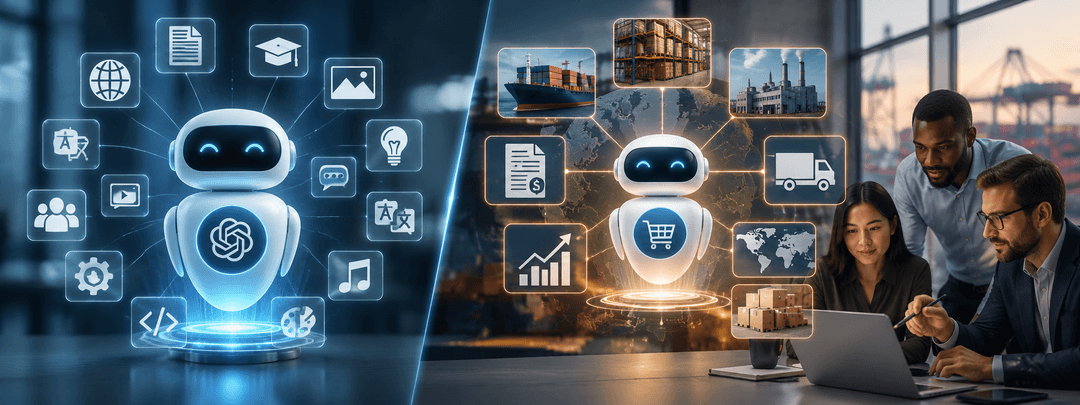
AI is already part of procurement. Teams use it to summarize supplier emails, draft RFQs, research markets, compare products, and review documents.
The real question is what kind of AI is fit for procurement work.
Generic AI is built for broad reasoning, writing, and analysis. Vertical AI is designed around a specific function. In procurement, that means combining AI with supplier data, trade records, sourcing workflows, risk controls, and enterprise systems.
Both have value, but they are not interchangeable. In this article, we’ll look at where generic AI works well, where it starts to fall short, and how vertical AI can support more complex procurement workflows.
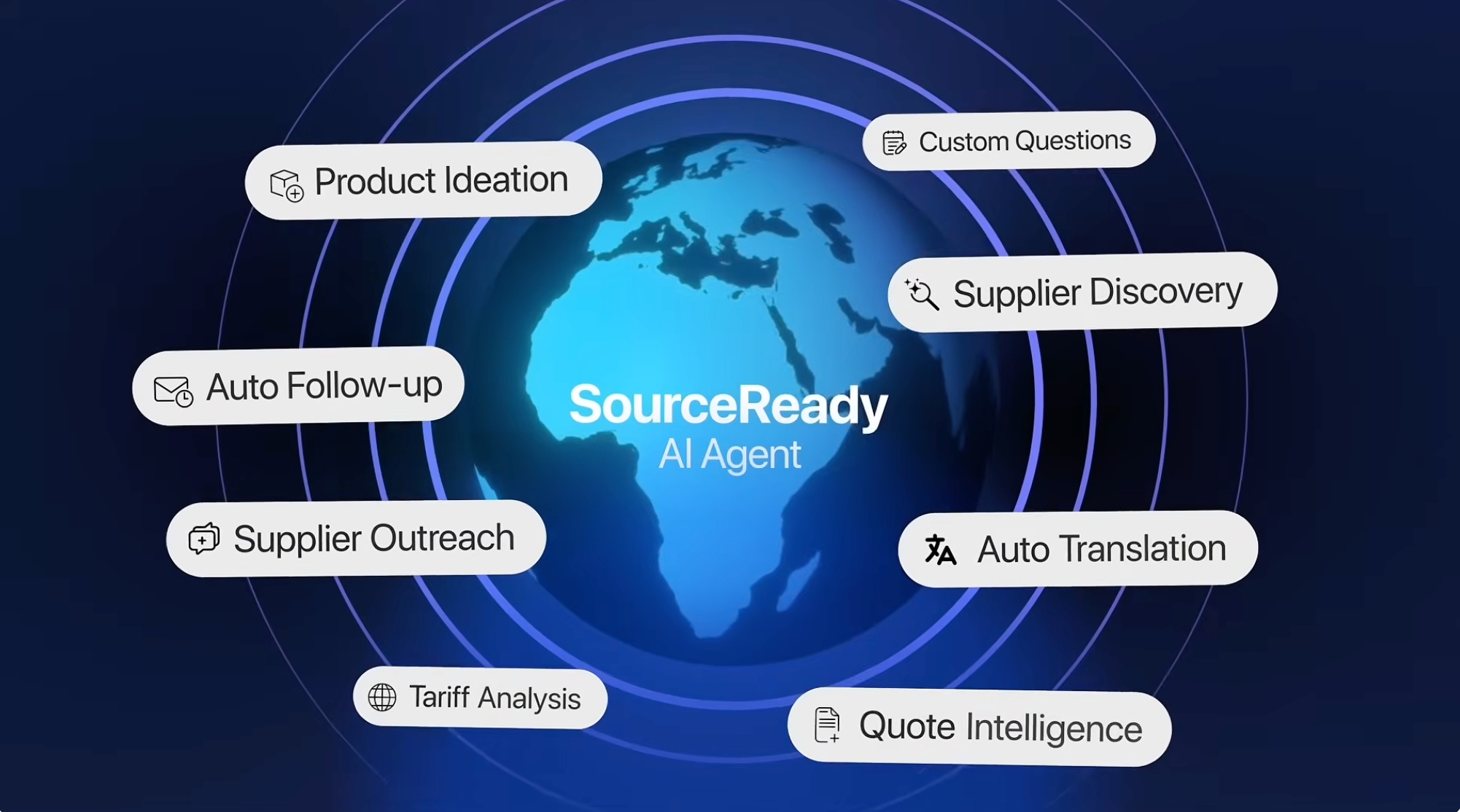
There's a better way to source ❤️
Watch the video to see how SourceReady helps brands move from product ideas to trusted supplier relationships faster
Watch the VideoWhat is the difference between generic AI and vertical AI for procurement?
Generic AI starts with a broad language model. You give it a prompt, document, spreadsheet, or question, and it generates an answer.
That makes it useful for flexible knowledge work. You can ask it to summarize a supplier meeting, improve an email, explain a regulation, or brainstorm negotiation questions.
Vertical AI starts somewhere else. It begins with the procurement workflow you are trying to execute.
It may still use the same class of underlying AI models. The difference is what surrounds the model: procurement data, system integrations, workflow logic, validation rules, approval controls, and business context.
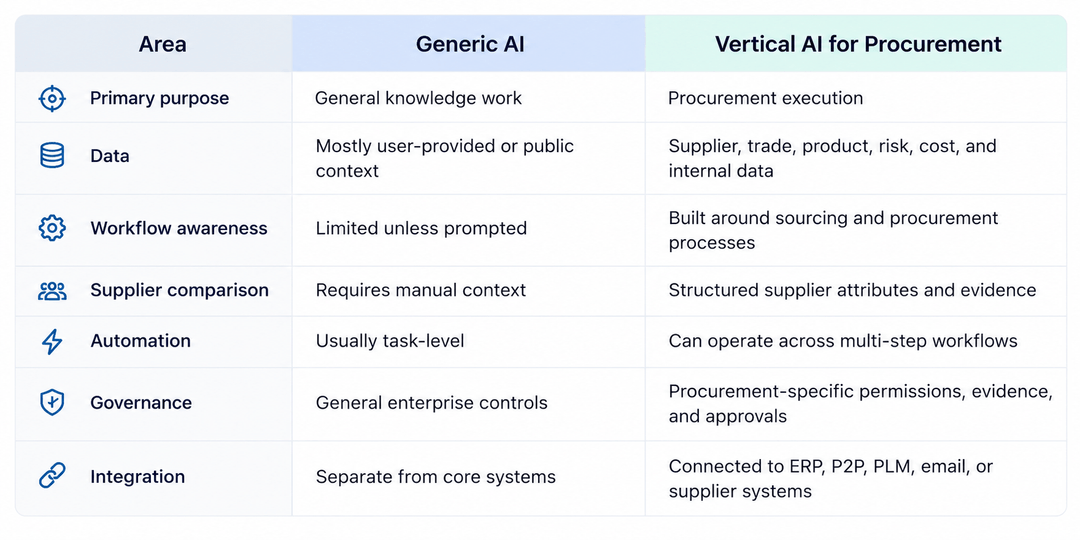
The difference becomes clearer in practice.
- Generic AI: You upload three supplier quotations and ask the model to summarize the differences.
- Vertical AI: The system collects quotations, extracts pricing and MOQ data, normalizes currencies and Incoterms, compares suppliers, flags missing information, and updates the sourcing event.
- Generic AI: You ask for suppliers that manufacture stainless-steel drinkware.
- Vertical AI: The system searches supplier databases, customs records, certifications, customer relationships, product history, and risk signals before ranking potential suppliers.
- Generic AI: You ask AI to review a supplier certificate.
- Vertical AI: The system extracts the certificate number, issuer, scope, validity period, supplier identity, and expiry date, then checks whether the evidence satisfies your sourcing requirement.
Where does generic AI work well for procurement teams?
Generic AI is not the wrong tool. In many situations, it is exactly the right one.
The mistake is expecting it to know procurement facts, company policies, supplier relationships, and transaction history that you never gave it.
1. Which tasks are a good fit?
Generic AI works best when the task is language-heavy, relatively self-contained, and easy for a human to verify.
- Document summarization: Turn lengthy reports, supplier presentations, meeting notes, or contracts into shorter summaries for review.
- Drafting support: Create first drafts of RFQs, supplier communications, negotiation questions, category briefs, and internal updates.
- Research assistance: Explore unfamiliar product categories, manufacturing processes, regulations, terminology, or sourcing markets.
- Data interpretation: Help explain spreadsheet trends, categorize comments, or identify patterns after you provide the underlying information.
- Meeting preparation: Generate supplier questions, negotiation angles, or risk topics based on context you provide.
- Knowledge work: Convert scattered notes into structured requirements, checklists, or evaluation criteria.
2. Where should you be more careful?
Problems appear when generic AI is treated as a source of procurement truth.
- Supplier facts: A language model should not be your authoritative source for certifications, ownership, shipment activity, production capacity, or customer relationships.
- Current commercial data: Prices, tariffs, sanctions, freight conditions, and regulations can change faster than model knowledge.
- Internal context: The model does not automatically know your approved supplier list, negotiated pricing, category strategy, risk thresholds, or supplier history.
- Repeatable decisions: Prompting the same question does not automatically create a governed, consistent procurement process.
- High-impact actions: Supplier selection, compliance decisions, purchase commitments, and production changes need evidence and control.
When does procurement require vertical AI instead?
Vertical AI becomes more valuable when the AI needs to do more than generate an answer.
Procurement is an unusually data-heavy function. A supplier decision can depend on dozens of signals across internal and external systems.
You may need to understand what a supplier manufactures, where it ships, which customers it serves, whether certifications remain valid, how geopolitical changes affect supply, what tariffs apply, whether quotations are competitive, and whether production is staying on schedule.
No single prompt contains all of that.
1. What capabilities should vertical AI provide?
A useful procurement AI layer should connect reasoning with structured evidence.
- Supplier intelligence: Combine supplier profiles, product capabilities, trade records, certifications, corporate information, customer relationships, and other sourcing signals.
- Market intelligence: Track e-commerce activity, search behavior, product trends, competitor assortments, pricing movements, and category signals.
- Risk intelligence: Monitor sanctions, geopolitical exposure, supplier concentration, compliance signals, operational changes, and trade disruptions.
- RFQ automation: Send inquiries, follow up with suppliers, extract responses, and convert emails and documents into comparable commercial fields.
- Cost intelligence: Combine quotes with tariffs, duties, freight assumptions, country of origin, and other inputs to calculate landed cost.
- Production visibility: Structure supplier WIP updates, milestone dates, delays, exceptions, and communication into one operational view.
- System integration: Connect AI output with ERP, PLM, P2P, supplier portals, email, data warehouses, or existing sourcing systems.
The key point is that AI should not replace structured procurement data with prose.
If five suppliers submit quotes, you do not want five elegant summaries. You want structured fields that you can compare, audit, filter, approve, and reuse.
2. Why does workflow context matter?
Procurement decisions rarely happen in isolation.
A supplier search may become an RFQ. The RFQ becomes a quotation comparison. The selected supplier enters onboarding. An order enters production. Production creates risks and exceptions.
Vertical AI can carry context across those steps.
- Continuity: Information collected during supplier discovery can remain available during qualification and sourcing.
- Structure: Supplier responses can populate defined fields rather than disappearing inside email threads.
- Automation: Repetitive actions can happen automatically when predefined conditions are met.
- Escalation: AI can identify exceptions while routing material decisions to the correct person.
- Traceability: Teams can retain the evidence used to reach a recommendation or decision.
That is where vertical AI stops being another productivity tool and starts becoming infrastructure.
How does SourceReady apply vertical AI to procurement?
SourceReady combines AI, procurement-specific data, and workflow automation in one platform. Its supplier intelligence database covers 4 million+ suppliers across 200 countries, powered by 40+ trusted data sources including customs and trade data, trade shows, supplier directories, certifications, corporate records, sanctions data, and other public and proprietary sources.
That data foundation gives the AI more than a generic prompt or uploaded document to work with. It can use structured supplier and market evidence to support sourcing decisions, verify suppliers, compare options, and automate downstream procurement workflows.
1. How does SourceReady support supplier and market intelligence?
SourceReady combines AI with a broad supplier and market data layer so your team can move from a sourcing question to evidence-backed options faster.
- Supplier discovery: Search millions of suppliers using product requirements, natural language, images, documents, capabilities, location, certifications, and other sourcing criteria.
- Trade intelligence: Review shipment records, customer relationships, export activity, product descriptions, and sourcing patterns to understand whether a supplier has relevant commercial experience.
- Supplier verification: Evaluate corporate records, certifications, sanctions exposure, trade activity, and other evidence before progressing a supplier.
- Market intelligence: Combine signals from e-commerce platforms, Google Trends, market research, competitor activity, and other external sources to identify product opportunities and demand shifts.
- AI matching: Rank suppliers against sourcing requirements while showing the factors and evidence behind the match instead of relying on a black-box recommendation.
This matters because procurement research is rarely limited by a lack of information. It is limited by the time required to find, connect, and verify it.
2. How does SourceReady automate procurement workflows?
SourceReady also applies AI after the supplier search is finished.
- RFQ automation: Generate and send supplier outreach, follow up automatically, and structure responses into comparable quotation data.
- Quote comparison: Extract price, MOQ, lead time, Incoterms, payment terms, and other commercial fields into a consistent format for evaluation.
- Landed cost analysis: Combine supplier quotations with tariffs, duties, freight, and sourcing-country inputs to compare true procurement cost.
- Risk monitoring: Track supplier, trade, compliance, and geopolitical signals so teams can identify changes before they become supply disruptions.
- Production tracking: Consolidate supplier WIP updates, milestone dates, exceptions, and delays into one structured operational view.
- Workflow customization: Adapt fields, approval logic, scoring models, and workflows to match how your procurement team actually operates.
SourceReady can function as a procurement platform on its own, but it can also sit alongside existing systems.
- ERP integration: Connect sourcing and supplier intelligence with downstream operational records.
- PLM integration: Feed structured product, supplier, and sourcing information into existing enterprise workflows.
- Email integration: Bring supplier communications into the workflow without forcing suppliers into another portal.
The result is not simply a more knowledgeable AI assistant. It is a system where AI can work across the data, decisions, and repetitive tasks that make procurement slow.
What should procurement teams take away from the generic AI vs. vertical AI debate?
Generic AI is useful when you need fast thinking, writing, summarization, or analysis. Vertical AI becomes more valuable when AI needs to understand suppliers, retrieve trusted data, operate within procurement workflows, and produce outputs your team can actually act on.
For procurement, the strongest model is usually not generic AI or vertical AI. It is generic AI reasoning combined with vertical data, workflow context, controls, and evidence.
SourceReady brings those pieces together across supplier intelligence, market research, RFQs, cost analysis, risk, and production workflows.
If you are evaluating where AI can create real procurement leverage, explore SourceReady to see how vertical AI can fit into your existing sourcing process. Start with a specific workflow, and measure whether AI reduces manual work while improving decision quality.
FAQ
1. How can AI improve supplier due diligence?
AI can collect and organize information such as corporate records, certifications, sanctions exposure, trade history, customer relationships, and compliance evidence. It can also flag missing, expired, or conflicting information for human review.
2. What are the risks of using AI in procurement?
Key risks include inaccurate data, hallucinated information, outdated market signals, poor supplier matching, weak access controls, and over-automation. Procurement teams should prioritize source transparency, human approvals, audit trails, data isolation, and clearly defined decision boundaries.

Find the sourcing tools you need.
Explore how SourceReady helps you research products, discover suppliers, verify factory information, analyze trade data, and manage your sourcing workflow in one place
Explore Features
Graduating from USC with a background in business and marketing, Judy Chen has spent over a decade working in e-commerce, specializing in sourcing and supplier management. Her experience includes developing strategies to optimize supplier relationships and streamline procurement processes for growing businesses. As SourceReady’s blog writer, Judy leverages her deep understanding of sourcing challenges to create insightful content that helps readers navigate the complexities of global supply chains.