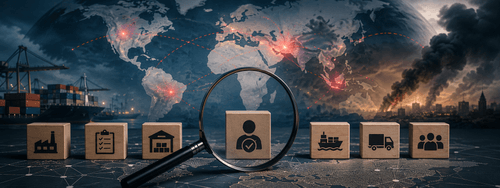
By 2026, global supply chains are no longer defined by recovery or disruption. They are defined by design choices—and increasingly, by AI adoption.
Artificial Intelligence is no longer experimental in supply chain operations. It is now a top investment priority. Sixty-four percent of supply chain leaders say AI and Generative AI capabilities are important when evaluating new technology investments, signaling a clear shift from curiosity to commitment. That shift is reflected in market growth: the U.S. AI in supply chain market reached USD 2.31 billion in 2024 and is projected to grow to USD 63.37 billion by 2034, expanding at a 39.26% CAGR over the next decade.
But adoption alone is not the advantage. Execution is.
Trade volumes continue to grow, yet volatility has become structural. Regulations expand faster than supplier networks. Customer expectations tighten while tolerance for failure disappears. What used to be “black swan” events now arrive quarterly.
For sourcing and operations leaders, the question is no longer how to optimize. It is how to stay in control—of cost, compliance, risk, and speed—at scale.
This guide breaks down the six supply chain trends that actually matter in 2026, with a sourcing-first lens. You’ll learn what is changing, why it matters, and how to translate strategy into execution—using data, structure, and verified supplier intelligence.

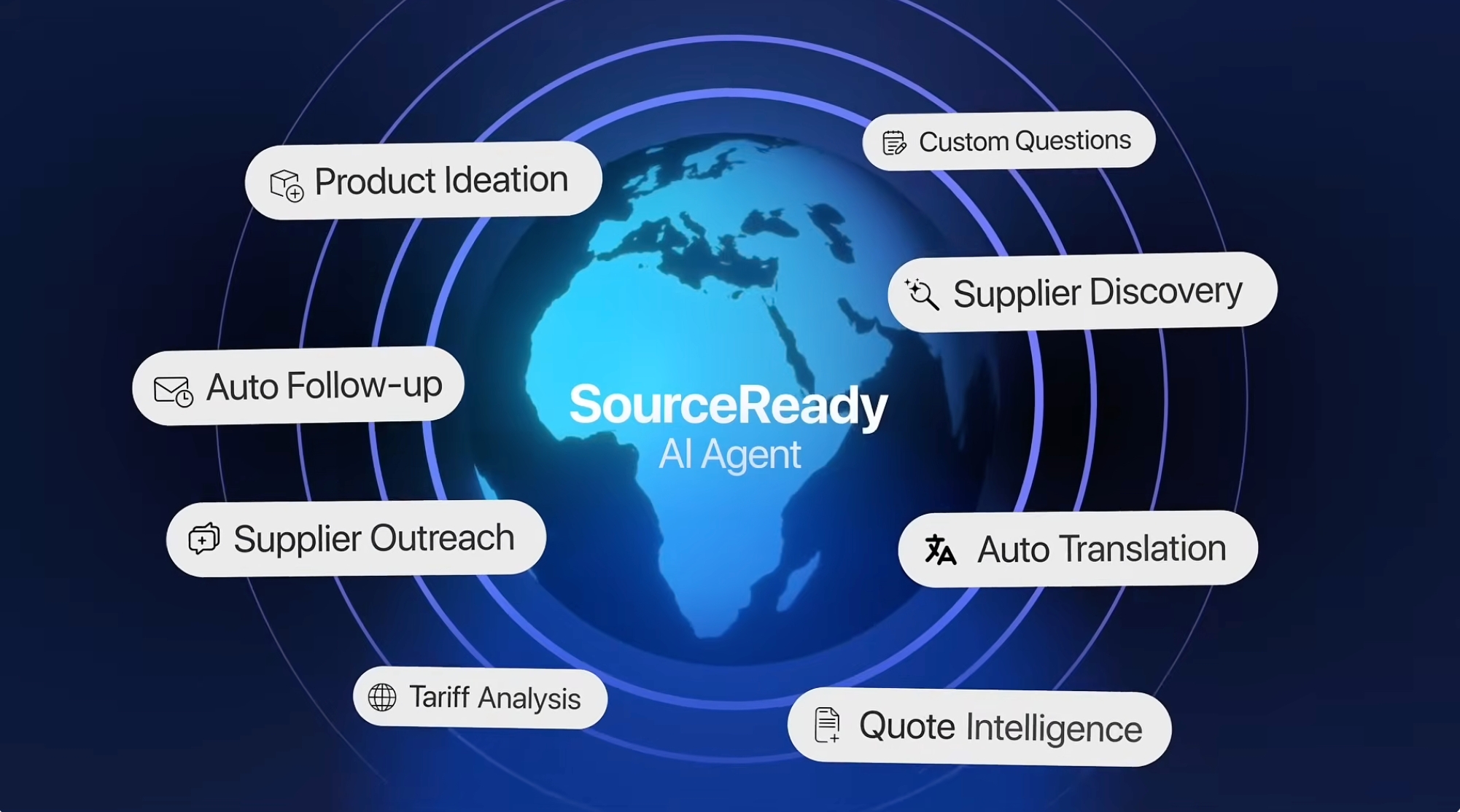
There's a better way to source ❤️
Watch the video to see how SourceReady helps brands move from product ideas to trusted supplier relationships faster
Watch the VideoTrend 1: AI Shifts From Insight to Execution
From analytics tools to operating systems
For years, AI in supply chains meant dashboards, forecasts, and alerts. In 2026, that phase is over.
AI now executes.
Planning systems automatically rebalance inventory. Procurement engines pre-screen suppliers. Logistics platforms reroute shipments without waiting for human intervention. The role of AI shifts from informing decisions to orchestrating actions.
Why This Matters
Supply chain volatility now moves faster than manual workflows allow. By the time a human reviews a report, the window to act has often closed.
Companies that rely on human-led coordination struggle with:
- Slow response to disruptions
- Bottlenecks in approvals
- Inconsistent decision-making under pressure
AI-driven autonomy solves scale—not judgment.
What Changes in Practice
- AI proposes actions across sourcing, planning, and logistics
- Humans approve exceptions, not every step
- Systems continuously optimize based on live data
The key requirement is explainability. Blind automation increases risk. Smart automation narrows options and clarifies trade-offs.
Trend 2: Connected Intelligence Replaces Fragmented Tools
Supply chain decisions finally connect to finance, ESG, and compliance
In 2026, disconnected systems are a liability.
Supply chains no longer operate independently from finance, sustainability, or customer operations. Decisions in sourcing directly impact:
- Cost structure
- Regulatory exposure
- Customer delivery performance
Connected intelligence means one decision layer across the enterprise.
Why This Matters
Fragmented data creates blind spots:
- Finance sees cost, but not risk
- ESG sees policy, but not suppliers
- Procurement sees suppliers, but not downstream impact
Auditors and regulators increasingly expect cross-system consistency. If your sourcing data doesn’t align with your ESG reporting, you will be flagged.
What Changes in Practice
- Supplier data feeds into financial and ESG systems
- Trade-offs are visible in one place
- Decisions become faster and defensible
Trend 3: End-to-End Traceability Becomes Non-Negotiable
Compliance shifts from documentation to proof
Traceability is no longer a future goal. In 2026, it is enforced.
Regulations such as CSRD, LkSG, and Scope 3 reporting require companies to demonstrate where products come from, how they are made, and by whom. Tier-1 visibility is no longer enough.
Why This Matters
Regulatory risk is asymmetric:
- One unverified supplier can block shipments
- One audit failure can shut down a market
- One missing data point can trigger months of remediation
“We didn’t know” is no longer an acceptable answer.
What Traceability Actually Means
Not just certificates and declarations, but:
- Verified supplier identities
- Product-to-factory alignment
- Consistent trade and production records
- Auditable data trails
Manual document collection does not scale. Structured data does.
Trend 4: Resilience Replaces Efficiency as the Core Metric
Just-in-time gives way to antifragile supply networks
For decades, supply chains were optimized for efficiency. Lowest cost. Leanest inventory. Minimal redundancy.
In 2026, that model breaks.
The new priority is resilience—and, increasingly, antifragility: systems that improve when stressed.
Why This Matters
Disruptions are no longer rare. They are expected.
Supply chains built purely for efficiency:
- Break under pressure
- Recover slowly
- Accumulate hidden costs
Resilient networks:
- Reroute automatically
- Absorb shocks
- Protect revenue and reputation
What Changes in Practice
- Multi-sourcing becomes standard
- Inventory buffers are strategic, not waste
- Network design favors flexibility over perfection
Efficiency still matters—but only after resilience is built in.
Trend 5: Geopolitical Risk Is Engineered Into Network Design
Trade strategy becomes sourcing architecture
In 2026, geopolitics is not a background risk. It is a design constraint.
Tariffs, sanctions, trade wars, and regional instability force companies to rethink where each part of their BOM should live—not just final assembly.
Why This Matters
Country-level sourcing decisions hide risk.
A product “made in Vietnam” may still rely on:
- Chinese tooling
- Chinese sub-components
- Chinese raw materials
When trade rules change, those dependencies surface fast.
What Changes in Practice
- BOM-level sourcing replaces country-level decisions
- Supplier networks are stress-tested against policy shifts
- Alternative suppliers are pre-qualified, not reactive
Trend 6: Supply Chain Talent Shifts From Execution to Oversight
Humans supervise systems, not spreadsheets
As automation increases, the role of supply chain professionals changes.
In 2026, value comes from:
- Judgment
- System design
- Exception handling
- Risk interpretation
Not from manual coordination.
Why This Matters
Automation without skilled oversight creates new risks:
- Over-reliance on flawed data
- Blind trust in models
- Poor handling of edge cases
Technology amplifies talent. It does not replace it.
What Changes in Practice
- Demand rises for AI- and data-literate operators
- Continuous upskilling becomes mandatory
- Teams move from task execution to outcome supervision
The strongest organizations invest in both systems and people.
How SourceReady Supports Sourcing Teams in 2026
Turning supplier data into decision-ready intelligence
The trends shaping supply chains in 2026—AI-driven execution, traceability, resilience, and geopolitical risk—share one common requirement: reliable supplier data.
This is where many sourcing teams struggle.
Most supplier information today is:
- Fragmented across tools and spreadsheets
- Self-reported and hard to verify
- Outdated by the time decisions are made
SourceReady is designed to close that gap.
What SourceReady Actually Does
SourceReady is not just a supplier search tool. It is an AI-powered supplier intelligence layer built for modern sourcing workflows.
At its core, SourceReady helps you:
- Identify suppliers that actually match your product and manufacturing needs
- Verify supplier capabilities using cross-referenced data, not marketing claims
- Compare suppliers based on fit, risk, and compliance, not just price
How It Aligns With 2026 Supply Chain Requirements
1. AI-Assisted Supplier Evaluation
SourceReady uses AI to analyze supplier profiles, production data, certifications, and trade history to generate Match Scores and supplier personas. These are explainable summaries—not black-box rankings—so you can see why a supplier fits (or doesn’t).
2. Support for Traceability and Compliance
By structuring supplier data and validating it across multiple sources, SourceReady helps teams build an auditable trail for supplier decisions—critical for ESG reporting, regulatory compliance, and customer audits.
3. Faster, More Defensible Decisions
When volatility hits, speed matters—but so does accountability. SourceReady helps teams move faster without sacrificing control, by surfacing trade-offs clearly and documenting the reasoning behind sourcing choices.
Where SourceReady Fits in Your Stack
SourceReady complements—not replaces—your existing ERP, procurement, and logistics systems. It sits upstream, where supplier decisions are made, helping ensure that what flows downstream is accurate, compliant, and resilient.
In short: SourceReady helps sourcing teams move from reactive supplier discovery to proactive, data-driven supplier selection—aligned with how supply chains actually operate in 2026.

Conclusion: Build for Control, Not Assumptions
The defining supply chain trends of 2026 all point in the same direction: control through design.
AI is moving from analysis to execution. Regulations demand proof, not promises. Geopolitical risk reshapes networks faster than contracts can adapt. In this environment, success does not come from chasing the lowest cost or reacting faster than last time. It comes from building sourcing systems that are resilient, traceable, and decision-ready by default.
That starts with fundamentals: mapping your BOM to real manufacturing strengths, modeling true landed cost, and verifying suppliers before risk becomes visible. Technology accelerates these decisions—but only when the data behind it is trustworthy.
SourceReady supports this shift by helping sourcing teams identify, verify, and evaluate suppliers with structured, explainable intelligence—so decisions hold up under disruption and audit.
Next step: start with one product, one BOM, one sourcing decision. Build it right. Then scale.
FAQ
1. Why is supplier verification more important than ever?
Regulations now require proof of supplier legitimacy, production capability, and product origin. Inaccurate or unverified supplier data can lead to shipment delays, audit failures, regulatory penalties, or market bans. Supplier verification is now a core risk-control function.
2. What is the difference between unit price and landed cost?
Unit price reflects only the supplier’s quoted cost. Landed cost includes tariffs, freight, inventory carrying costs, compliance overhead, and quality risk. In many cases, landed cost is 15–30% higher than unit price alone.

Find the sourcing tools you need.
Explore how SourceReady helps you research products, discover suppliers, verify factory information, analyze trade data, and manage your sourcing workflow in one place
Explore Features
Graduating from USC with a background in business and marketing, Judy Chen has spent over a decade working in e-commerce, specializing in sourcing and supplier management. Her experience includes developing strategies to optimize supplier relationships and streamline procurement processes for growing businesses. As SourceReady’s blog writer, Judy leverages her deep understanding of sourcing challenges to create insightful content that helps readers navigate the complexities of global supply chains.