In 2026, Vietnam has officially shifted from an assembly outpost to a strategic high-tech pillar. Driven by the expansion of giants like Wistron (Victory II project) and HP, the country now accounts for over 13.5% of global notebook production. This guide explores the transition toward "Autonomous Sourcing" and why AI agents are now essential for navigating Vietnam’s complex Tier-2 supplier ecosystems and new mandatory ESG compliance standards.
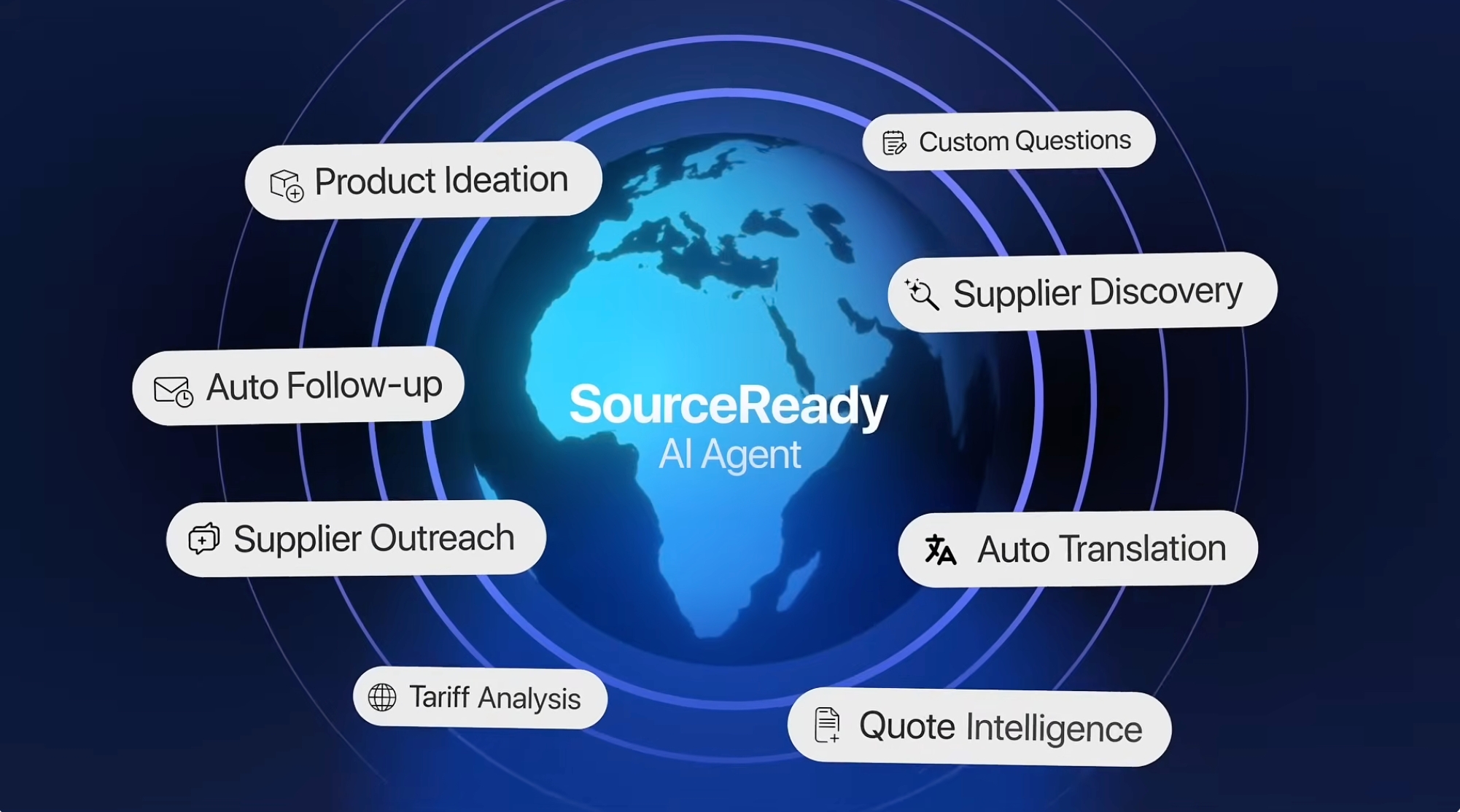
There's a better way to source ❤️
Watch the video to see how SourceReady helps brands move from product ideas to trusted supplier relationships faster
Watch the VideoThe Geopolitical Shift: Why Vietnam, Why Now?
In the last decade, Vietnam has transitioned from a textile-heavy economy to a high-tech manufacturing powerhouse. This shift isn't accidental; it is the result of massive infrastructure investment and a strategic "pull" from global electronics brands seeking to diversify their supply chains.()
The Macro Factors:
Infrastructure Synergy: The proximity of Northern Vietnam to China’s Greater Bay Area allows for a "seamless" supply of components while moving final assembly to a lower-cost, lower-tariff environment.
Trade Agreements: Vietnam’s participation in the CPTPP and EVFTA has made it an export-friendly hub for US and EU-bound electronics.
The "China + 1" Momentum: Large-scale manufacturers are no longer looking for "cheap" labor; they are looking for resilient labor. Vietnam’s specialized industrial zones (IZs) offer exactly that.
EXCLUSIVE DATA: Don't have time for the full 1,500-word deep dive? > Download the SourceReady Report now
The 2026 Inflection Point: From Assembly to Ecosystem
By 2026, Vietnam’s manufacturing story has clearly evolved. With the Manufacturing PMI closing 2025 at 53.0, the country is no longer simply absorbing overflow capacity — it is securing primary production mandates from global electronics brands.
From Capacity Expansion to Ecosystem Formation
The expansion of large manufacturers such as Wistron in Hà Nam Province illustrates this shift. Projects like Victory II represent more than incremental output — they act as ecosystem anchors.
What changes in 2026:
- Anchor Effect: Major OEM/ODM facilities attract clusters of Tier-2 and Tier-3 suppliers into surrounding industrial parks.
- Vertical Depth: Growth is no longer limited to final assembly; supporting industries such as PCB assembly, casing injection molding, cable harnessing, and power modules scale alongside it.
- Supplier Density: Industrial zones like Đồng Văn III are becoming multi-layered ecosystems rather than single-factory sites.
- Government Alignment: National industrial strategy increasingly supports semiconductor-adjacent sectors, including component manufacturing, testing, and engineering services.
The result is a shift from standalone assembly plants to interconnected manufacturing networks.
The AI Advantage: Mapping the “Web,” Not Just the Logo
Traditional sourcing models focus on identifying the headline manufacturer — the visible “logo” company. In 2026, that is no longer sufficient.
Modern sourcing requires:
- Mapping the supplier network behind the anchor factory
- Identifying specialized Tier-2 producers supplying sub-assemblies
- Verifying actual export activity and production depth
- Tracking capacity utilization and expansion signals
AI-powered sourcing tools enable this by analyzing:
- Customs shipment records
- Industrial park clustering data
- Supplier ownership and linkage patterns
- Production category specialization
The competitive advantage is no longer just knowing who assembles the final product — it is understanding the full ecosystem that enables scalable, resilient production.
Case Study: The Wistron & HP Migration
The entry of global leaders like Wistron and HP has catalyzed a "Quality Revolution," moving Vietnam from a simple assembly line to a center for high-value R&D.
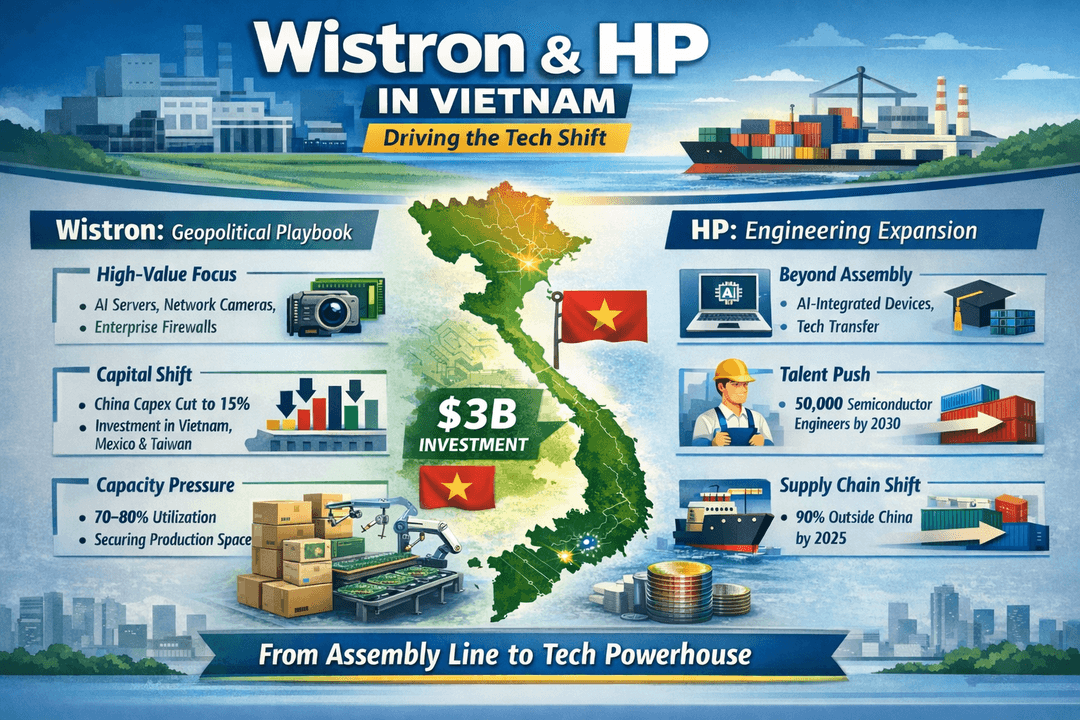
1. Wistron’s "Victory" Blueprint: Geopolitical Resilience
Wistron’s presence in Hà Nam Province serves as a masterclass in regional diversification and de-risking. Through its flagship Victory I and II projects in the Đồng Văn III Industrial Park, Wistron has turned Vietnam into a mission-critical hub.
Diversified High-Value Output: Beyond standard PCs, Wistron’s latest lines are dedicated to AI server components (GPU modules for NVIDIA), high-end network cameras, and enterprise-grade firewalls.
Capital Realignment: In a major strategic pivot, Wistron has slashed its China-based capital expenditure to just 15%, reallocating billions to Vietnam, Mexico, and Taiwan.
The "Utilization" Scaling Lesson: For brands, the challenge is no longer finding a factory, but securing space. With top-tier facilities currently operating at 70–80% utilization, AI agents are now essential for tracking real-time line availability to prevent production bottlenecks.
2. HP’s Technical Integration: The Engineering Shift
HP is currently executing a $3 billion expansion in Vietnam, shifting millions of laptop units to the region while deepening its local technological footprint.
Beyond Assembly: HP’s commitment focuses on AI-integrated next-gen devices and significant technology transfer to local partners.
The 50,000-Engineer Mandate: To support this "high-tech pivot," Vietnam is aggressively reskilling its workforce. The government is on track to train 50,000 semiconductor engineers by 2030, ensuring a talent pipeline capable of moving from manual assembly to complex IC design and microelectronics packaging.
Structural Diversification: HP now projects that nearly 90% of its North America-bound shipments will be produced outside of China by the end of 2025, with Vietnam serving as the primary alternative.
Regional Deep-Dive: Vietnam’s Electronics Hubs
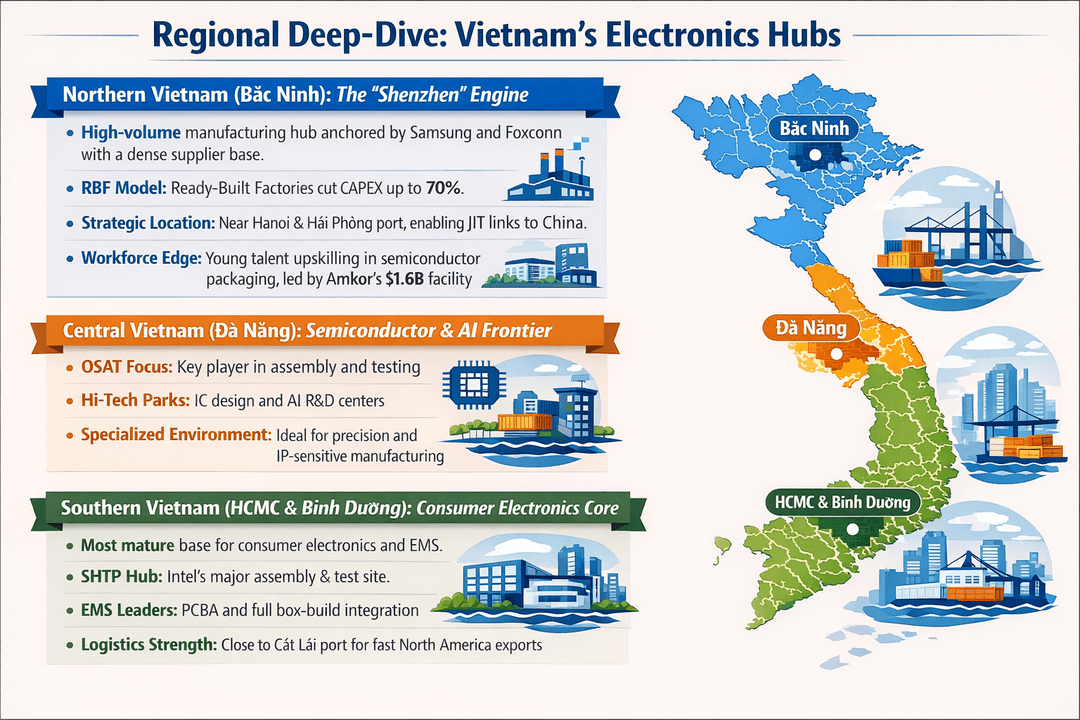
1. Northern Vietnam (Bắc Ninh): The "Shenzhen" Engine
Bắc Ninh is the high-volume engine of the North, defined by a "Queen Bee" ecosystem where giants like Samsung and Foxconn anchor hundreds of satellite suppliers.
The RBF Advantage: Bắc Ninh leads in Ready-Built Factories (RBF). For brands, this "plug-and-play" model reduces initial CAPEX by up to 70%, shifting investment from construction to production.
Strategic Bridge: Located 30km from Hanoi and 100km from the Hải Phòng deep-sea port, it offers a seamless JIT (Just-in-Time) link to China’s component markets while leveraging Vietnam’s low-tariff export status.
The 2026 Labor Edge: With a 74% labor participation rate and a median age under 40, the province is rapidly upskilling into Semiconductor Packaging (OSAT), led by Amkor’s $1.6B facility.
2. Central Vietnam (Đà Nẵng): The Semiconductor & AI Frontier
Đà Nẵng has successfully pivoted from a tourist destination to Vietnam’s specialized Semiconductor & PCB hub. It is no longer just about assembly; it’s about high-level testing and design.
The OSAT Powerhouse: Đà Nẵng is the primary focus for Vietnam’s "C = SET + 1" semiconductor strategy. The city is rapidly becoming a center for OSAT (Outsourced Semiconductor Assembly and Test), with major players like Intel utilizing local hi-tech zones for advanced testing operations.
Specialized Tech Parks: The Đà Nẵng Hi-Tech Park and Software Park No. 2 act as "innovation incubators." These parks aren't just for manufacturing; they house R&D centers for giants like Synopsys, Marvell, and Nvidia, focusing on IC design and AI verification.
The AI Edge: For brands, Đà Nẵng offers a more specialized, lower-density environment than the North, making it ideal for high-precision components that require extreme quality control and IP protection.
3. Southern Vietnam (HCMC & Bình Dương): The Consumer Electronics Heart
The South is the most mature industrial ecosystem in Vietnam, serving as the primary hub for Consumer Electronics and complex EMS (Electronics Manufacturing Services).
The SHTP Ecosystem: The Saigon Hi-Tech Park (HCMC) is home to Intel’s largest global assembly and test facility, which now handles over 50% of their worldwide output, including the latest 18A chip lines. This proximity has created a "supplier magnet" effect for Tier-2 component labs.
Bình Dương & EMS Giants: In Bình Dương, manufacturing is dominated by giants like Jabil and MiTAC. Jabil’s expansive facilities specialize in complex PCBA (Printed Circuit Board Assembly) and "Box Build" integration for global consumer brands.
Tier-2 Component Density: Unlike the emerging North, the South has a deeply entrenched layer of Tier-2 component labs that handle everything from precision plastic molding to high-frequency sensors.
Strategic Advantage: The South offers the most developed logistics infrastructure in the country. With the proximity to the Cát Lái port, brands in Bình Dương can achieve some of the fastest turnaround times for consumer goods headed to North American markets.
Logistics 2.0: Ports, 5G, and AI
As production scales, logistics becomes a strategic variable rather than an operational afterthought. In 2026, Vietnam’s infrastructure is increasingly digitized and export-oriented.
Lạch Huyện Deep-Sea Port: As the North’s primary deep-water port capable of handling large container vessels, Lạch Huyện plays a central role in electronics exports to the US and Europe, reducing transshipment dependency and improving lead-time predictability.
5G and Industrial IoT: Expanded 5G coverage across industrial zones enables higher levels of data transmission from factory floors. For brands and sourcing teams, this supports improved visibility into production status, equipment utilization, and shipment readiness — increasing transparency compared to traditional manual reporting systems.
The result is a more connected manufacturing environment, where data increasingly complements physical infrastructure.
The ESG "Passport": A Mandatory Requirement for 2026
As of 2026, international regulations (like the EU's CSRD) require full sustainability reporting across the entire supply chain.
The "Passport" Concept: For Vietnamese firms, meeting ESG standards is now a "passport" for entering global value chains.
AI Compliance Agents: Manually auditing a factory in Bắc Ninh for carbon emissions is too slow. AI agents now use ISO frameworks as a foundation to supplement and standardize ESG reports automatically.
Net-Zero Supply Chains: Major players (Apple, Nike, HP) now mandate that their Tier-2 and Tier-3 suppliers have a documented roadmap to Net-Zero.
How to Find High-Tech Electronics Suppliers in Vietnam
One of the biggest challenges for sourcing teams is separating true high-tech capability from basic assembly operations. Many factories position themselves as “electronics manufacturers,” but lack real experience with complex PCBA, precision components, or global OEM standards.
In Vietnam’s rapidly expanding ecosystem, this distinction matters.
The Core Challenge
When moving production to Vietnam, brands often face:
- Limited visibility into Tier-2 and Tier-3 suppliers
- Over-reliance on self-reported factory capabilities
- Difficulty verifying export history and production depth
- Uncertainty around ESG and compliance readiness
Starting supplier discovery from scratch is slow — and risky.
Using AI to Identify Proven High-Tech Suppliers
Tools like SourceReady help sourcing teams move beyond surface-level searches.
Companies can:
- Identify suppliers already serving Tier-1 electronics brands (OEM/ODM ecosystems)
- Filter by technical specialization (PCBA, semiconductor packaging, precision molding, EMS, box build, etc.)
- Exclude specific geographies while retaining required capability levels
- View multi-region production footprints, including Vietnam, Mexico, and Eastern Europe
- Analyze export history to confirm real shipment activity to US/EU markets
More importantly, teams can:
- Cross-check supplier claims against customs and trade data
- Validate whether a factory produces high-value components or only performs low-complexity assembly
- Shortlist suppliers already embedded in global electronics supply chains
For brands responding to tariff shifts, geopolitical risk, or ESG mandates, this approach is significantly faster and more reliable than manual supplier discovery.
In 2026, finding the right factory is no longer about who has capacity — it is about who has verified integration into a high-tech ecosystem.
Conclusion: The Competitive Edge in 2026
Vietnam has successfully repositioned itself from a "low-cost alternative" to a "value-added partner."() The "Victory" for brands in 2026 isn't just finding a factory; it's about orchestrating a data-driven network. By leveraging the rise of hubs like Bắc Ninh and the strategic presence of giants like HP and Wistron, your brand can build a supply chain that is not only cost-effective but resilient to global shocks. The future of sourcing is autonomous, transparent, and—most importantly—sustainable.
FAQ
1. Is Vietnam ready for high-precision electronics?
Yes. With the entry of Wistron and HP, the local supply chain for high-precision components has matured significantly, supported by specialized technical universities in Hanoi and HCMC.
2. How do I find a factory that isn't already "at capacity"?
This is the "SourceReady Advantage." Our AI monitors real-time export trends to identify factories that have recently expanded their lines, ensuring you find partners with the "headroom" to grow with you.
3. How does AI protect my IP in Vietnam?
By using decentralized AI agents to monitor factory-floor data and encrypting Tech Pack transfers through your PLM, you create a "Digital Moat" around your designs.

Find the sourcing tools you need.
Explore how SourceReady helps you research products, discover suppliers, verify factory information, analyze trade data, and manage your sourcing workflow in one place
Explore Features
Graduating from USC with a background in business and marketing, Judy Chen has spent over a decade working in e-commerce, specializing in sourcing and supplier management. Her experience includes developing strategies to optimize supplier relationships and streamline procurement processes for growing businesses. As SourceReady’s blog writer, Judy leverages her deep understanding of sourcing challenges to create insightful content that helps readers navigate the complexities of global supply chains.