
Zara does not publish a standalone factory list, but its parent company Inditex discloses supplier and regional production information in its annual and sustainability reports. In 2026, Zara’s production is concentrated in proximity clusters in Spain, Portugal, Turkey, and Morocco for fast-turn fashion, and in high-capacity factories in Bangladesh, China, India, and Vietnam for volume basics. SourceReady analyzes Inditex disclosures alongside trade shipment data to identify factories with verified Zara production and to benchmark Zara-adjacent suppliers by region, category, and scale.

There's a better way to source ❤️
Watch the video to see how SourceReady helps brands move from product ideas to trusted supplier relationships faster
Watch the VideoWhy Zara is still the supply chain benchmark
In the 2026 retail landscape, Zara (Inditex) remains the reference point for fast, data-driven fashion. While many brands still operate on seasonal, six-month cycles, Zara can move a design from concept to store in as little as 15 days.
This speed is not accidental. It is the result of deliberate supply chain design — one that prioritises proximity, data visibility, and operational control over chasing the lowest possible unit cost.
For sourcing professionals, the real question isn’t who Zara works with, but how the system behind those relationships is structured.
Here's the supplier that have worked with Zara! Read now!
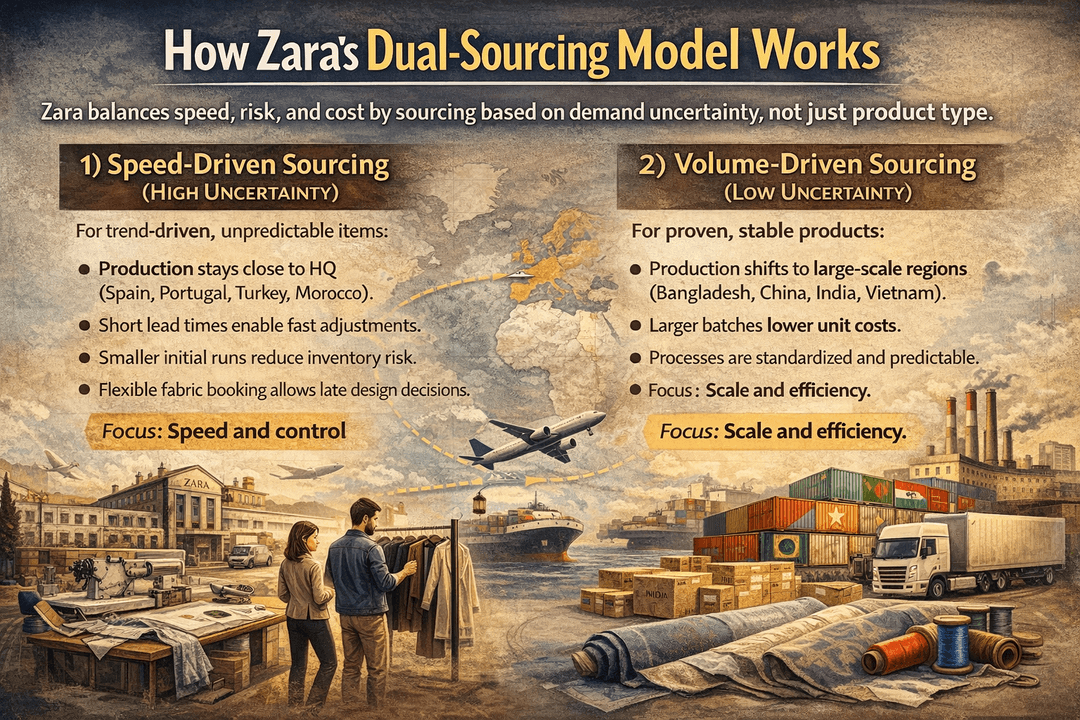
How Zara’s dual-sourcing model works
Zara’s supply chain is designed to balance speed risk and cost efficiency by separating production decisions based on demand uncertainty, not just product type.
At a high level, the model works like this:
Products are split by risk profile
- Unpredictable, trend-driven items are treated as high-risk.
- Stable, repeatable basics are treated as low-risk.
The sourcing strategy changes accordingly.
1) Speed-driven sourcing (high uncertainty)
For products where demand is hard to forecast — such as fashion-forward silhouettes or seasonal designs — Zara prioritizes control and responsiveness.
- Production is located close to headquarters (Spain, Portugal, Turkey, Morocco).
- Lead times are short, allowing rapid replenishment or pullback.
- Communication loops are tight, enabling late-stage design or quantity adjustments.
- Fabrics may be pre-booked or held in greige form to delay final decisions.
- Smaller initial production runs reduce markdown and inventory risk.
2) Volume-driven sourcing (low uncertainty)
Once a product’s demand is validated, Zara shifts focus to scale and unit economics.
- Production moves to high-capacity regions (Bangladesh, China, India, Vietnam).
- Factories are optimized for efficiency and consistency, not experimentation.
- Larger batch sizes lower per-unit cost.
- Production schedules are more rigid but predictable.
- Quality is standardized through repeatable processes.
3) Fluid transition between the two modes
What makes Zara’s model especially effective is its ability to move products between these sourcing modes.
- A design may start in a proximity cluster to test demand.
- Once demand stabilizes, production transitions to a volume cluster.
- This preserves speed early while capturing margin later.
- The result is faster reaction without long-term cost penalties.
Key takeaway for sourcing teams
- Zara does not source by geography first.
- Zara sources by risk, then uses geography to execute that decision.
- Understanding this logic matters more than knowing individual factory names.
Why Zara’s supplier network used to be a “black box”
Historically, mapping Zara’s supply chain was extremely difficult.
Supplier lists were private, subcontracting was opaque, and public disclosures offered little more than high-level summaries. Knowing a factory’s country did not tell you whether it actually produced for Inditex — or merely claimed to.
This opacity protected large brands but left smaller companies guessing.
What changed: trade data and mandated disclosures
Two shifts changed this landscape:
- Global trade data Bill of Lading (BOL) records now make it possible to identify high-frequency shippers into Inditex logistics hubs and detect supplier clusters.
- Regulatory disclosure Under post-2025 governance and sustainability rules, Inditex publishes detailed regional supplier counts and compliance coverage in its annual reports.
Individually, these data sources are incomplete. Combined, they reveal patterns that were invisible a decade ago.
How to use SourceReady to confirm a factory truly works with Zara
SourceReady structures trade data, certifications, capacity signals, and customer relationships across 1.2M+ verified suppliers in 100+ countries. Instead of ranking suppliers by paid exposure, it prioritizes relevance — helping you find factories that match your category, constraints, and risk profile.
Step-by-step guide
1. Search like you’re using ChatGPT
Start with natural language queries such as:
- “Factories that ship to Inditex / Zara”
- “Zara suppliers in Turkey for tailored womenswear”
- “Portugal cut-and-sew factories similar to Zara”
This helps you explore broadly before narrowing down.

2. Add filters based on your requirements
Refine your shortlist by applying constraints such as:
- Country / region (e.g., Turkey, Portugal, Morocco, Vietnam)
- Certifications (e.g., GRS, OEKO-TEX, BSCI/SMETA if relevant)
- Product category / construction type (knitwear, woven, outerwear, denim)
- MOQ range, lead time, or capabilities (if available)
3. Read supplier profiles like you’re doing due diligence
Don’t rely on a single signal. Review multiple sections together:
- Images & production highlights (do they match your product complexity?)
- Capabilities (materials, machinery, processes)
- Shipments (frequency, consistency, and whether the pattern makes sense)
- Customer / relationship signals (if shown)
A good supplier profile should “hang together” logically: product capability + shipment patterns + certifications should align.
4. Invite suppliers to quote (and test responsiveness)
Once you have a shortlist, invite suppliers to quote with a clear RFQ:
- tech pack / reference samples
- target fabric + trims
- expected order quantity + sizing
- timeline + compliance needs
Treat the first round as both pricing discovery and a supplier quality test (communication, speed, precision, willingness to clarify).
Here's the supplier that have worked with Zara! Read now!
The hidden risk: why copying Zara’s factories often fails
For SMBs, the biggest mistake is assuming: “If Zara uses this factory, it must be the best option for me.” In reality, Zara’s supplier ecosystem is optimized for Zara’s scale, speed, and negotiating power — not for smaller brands.
Here are the common failure modes:
1. Priority risk: you will never be the main customer
Even if a factory works with a top-tier client, your order will sit behind:
- replenishment requests
- urgent re-cuts
- bulk production windows
This can show up as “soft delays” — quotes that slip, schedules that move, production that gets pushed back.
2. MOQ and pricing structure don’t match SMB reality
Zara-level factories often run on:
- high minimums
- standardized fabric programs
- cost curves that only make sense at volume
You might get quoted, but the economics may be brutal at 300–1,000 units.
3. Product mismatch (capability ≠ your SKU reality)
A factory might be excellent at one thing (e.g., mass knit basics) but not suited for your:
- complex construction
- higher finishing standards
- smaller batch colorwork
- frequent development iterations
“Zara supplier” doesn’t automatically mean “fits your product.”
4. Subcontracting and traceability risk
High-capacity factories sometimes overflow work to partner units during peaks. If you’re small, you may be more exposed to:
- being routed to a secondary line
- inconsistent QC
- unclear traceability
The smarter approach
Instead of chasing the exact same factory, aim for Zara-adjacent suppliers:
- within the same cluster region
- similar category specialization
- capacity aligned with your order size
That’s how you get Zara-like reliability without Zara-like constraints.

Conclusion: transparency turns insight into leverage (Expanded)
For years, Zara’s supply chain looked impossible to replicate because it was opaque. The assumption was that speed and coordination at this level required massive capital, deep relationships, and insider access.
That assumption no longer holds.
Today, trade data, regulatory disclosures, and structured supplier information have lowered the barrier to understanding how leading brands actually operate. What used to be hidden behind NDAs is now visible in patterns — shipment frequency, regional concentration, production logic, and compliance focus.
The real advantage is no longer scale. It’s clarity.
Brands that understand why production sits in certain regions, how volume and speed are balanced, and when to prioritise flexibility over unit cost can design smarter supply chains — even at much smaller sizes.
You don’t need to copy Zara’s factories. You need to adopt Zara’s thinking:
- Separate speed from scale
- Match suppliers to product risk
- Build optionality into sourcing decisions
In a market where margins are tight and timelines are unforgiving, transparency isn’t just helpful — it’s what turns sourcing from guesswork into strategy.
FAQ
1. Does Zara own its factories?
Zara does not own most of its factories. Instead, its parent company Inditex works with a large network of independent suppliers and manufacturers that operate under strict compliance, quality, and capacity requirements.
2. Why does Zara produce so much clothing in Europe instead of Asia?
Zara produces a significant share of fashion-forward items in Europe to reduce lead times and react quickly to demand changes. Proximity allows faster replenishment, tighter quality control, and late-stage design adjustments.

Find the sourcing tools you need.
Explore how SourceReady helps you research products, discover suppliers, verify factory information, analyze trade data, and manage your sourcing workflow in one place
Explore Features
Graduating from USC with a background in business and marketing, Judy Chen has spent over a decade working in e-commerce, specializing in sourcing and supplier management. Her experience includes developing strategies to optimize supplier relationships and streamline procurement processes for growing businesses. As SourceReady’s blog writer, Judy leverages her deep understanding of sourcing challenges to create insightful content that helps readers navigate the complexities of global supply chains.


